
- 2 megawatts: Projected power consumption per server rack in next-generation AI accelerators
- Trillions by 2030: Anticipated annual data center spending due to AI growth
- 12.5 megawatts: Standardized infrastructure blocks in Vertiv’s modular solutions
Experts agree that the Vertiv-NVIDIA collaboration represents a critical advancement in AI infrastructure, enabling faster, more reliable deployment of AI factories through digital twin simulation and converged physical systems.
Vertiv and NVIDIA Forge Digital Blueprint for AI Factory Revolution
COLUMBUS, OH – March 16, 2026 – In a move set to redefine how the world builds the infrastructure for artificial intelligence, critical infrastructure leader Vertiv has announced a deep collaboration with NVIDIA. The partnership provides the essential physical backbone for NVIDIA's next-generation AI factory designs, aiming to accelerate deployment and dramatically reduce the risks associated with constructing these massive, power-hungry facilities.
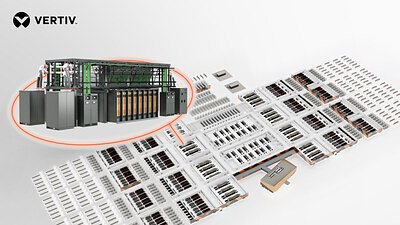
Vertiv is integrating its power and cooling systems into NVIDIA's ecosystem as simulation-ready digital models. This allows companies to design, test, and validate the entire physical plant of an AI factory within a virtual environment before a single piece of hardware is ordered or a slab of concrete is poured. The collaboration centers on the NVIDIA Vera Rubin DSX AI factory reference design and the NVIDIA Omniverse DSX Blueprint, a digital twin platform for data center design and simulation. Vertiv’s contribution, the Vertiv™ OneCore Rubin DSX, offers pre-validated, modular building blocks for the power and thermal management systems that are the lifeblood of any AI operation.
The New Frontier: Manufacturing Intelligence at Scale
The term "AI factory" is more than just a new buzzword for a data center; it represents a fundamental shift in computing. Unlike traditional data centers designed for a variety of workloads, AI factories are specialized facilities engineered for a single purpose: to manufacture intelligence at an unprecedented scale. This specialization brings immense challenges that legacy infrastructure was never designed to handle.
The core of the issue is density and power. Next-generation AI accelerators, such as those in NVIDIA's Rubin platform, are driving power consumption to extreme levels, with some projections showing individual server racks consuming up to 2 megawatts—an amount of power that could supply hundreds of homes. This immense power draw generates a corresponding amount of heat, necessitating complex hybrid cooling solutions that combine traditional air cooling with advanced direct-to-chip liquid cooling.
These technical hurdles arise amid intense market pressure. NVIDIA has signaled the arrival of an "agentic AI inflection point," where AI models will increasingly act as autonomous agents, driving exponential growth in compute demand. Industry forecasts now anticipate annual data center spending could reach into the trillions by 2030. For companies racing to build capacity and capture this market, the speed and cost of deployment are critical. A miscalculation in power distribution or a flaw in the cooling design can lead to catastrophic delays and budget overruns.
From Concrete to Code: Simulating First to Deploy Perfectly
The Vertiv-NVIDIA collaboration directly confronts these challenges by shifting the paradigm from "build and test" to "simulate and validate." By providing what it calls "DSX SimReady" digital assets for its physical infrastructure, Vertiv enables developers and engineers to model their entire AI factory within the NVIDIA Omniverse DSX Blueprint.
This digital twin approach allows for the virtual construction and operation of a facility. Engineers can simulate real-time thermal dynamics, test the resilience of the power grid connection under various loads, and optimize the layout for maximum efficiency and performance. This process of identifying and resolving potential failures in a digital environment, rather than during costly physical commissioning, is central to de-risking the enormous capital investments required for AI factories.
"As AI factories scale to unprecedented levels of power and density, enterprises require a converged approach to physical infrastructure that unifies power, cooling, and digital twin simulation to reduce deployment risk," said Vladimir Troy, vice president of AI Infrastructure at NVIDIA. "By integrating simulation-ready infrastructure models into the NVIDIA Vera Rubin DSX design, Vertiv is providing the repeatable building blocks and validated interfaces necessary to accelerate the path from design to operational readiness."
This method promises to significantly shorten the timeline from initial design to a fully operational AI factory. By working with pre-validated and pre-integrated digital components, the complex coordination between compute, power, cooling, and control systems is streamlined, helping customers achieve faster time-to-capacity with greater operational confidence.
A Converged Blueprint for Gigawatt-Scale AI
At the heart of Vertiv's strategy is a philosophy of "converged physical infrastructure." This approach moves away from treating power and cooling as a collection of separate products and instead integrates them into a cohesive, interdependent system optimized across the entire power train and thermal chain. This system-level design is intended to deliver not only deployment speed but also compounding gains in efficiency and reliability.
This philosophy is materialized in the Vertiv™ OneCore integrated modular solutions. The architecture is based on standardized, repeatable 12.5-megawatt infrastructure blocks. These deployment-ready modules can be configured and combined like building blocks to support a wide range of deployments, from smaller AI clusters to the gigawatt-scale AI factories envisioned for the near future. By establishing repeatable designs with validated interfaces, Vertiv aims to simplify scaling while ensuring consistency and high performance across massive installations.
"AI factories are forcing a fundamental change in how digital infrastructure is designed, validated, and deployed," noted Scott Armul, chief product and technology officer at Vertiv. "Vertiv's role is to help turn complex AI infrastructure from a collection of separate products into converged, simulation-ready physical systems. By combining our power and cooling portfolio with validated interfaces and digital models, we can help customers accelerate development, improve operational confidence, and unlock better output per watt."
The Unseen Engine of the AI Revolution
While the spotlight in the AI revolution often shines on the silicon chips and the software models, this collaboration underscores the critical, and often overlooked, role of physical infrastructure. The full potential of advanced AI platforms can only be unlocked if the underlying power and cooling systems can support them reliably and efficiently. The move towards co-designing the physical plant with the compute stack, as demonstrated by the NVIDIA ecosystem that also includes partners like Schneider Electric, Siemens, and Jacobs, marks a pivotal moment for the data center industry.
Vertiv's contribution of modular, simulation-ready physical systems provides a tangible pathway for companies to adopt this new, integrated design methodology. By providing a blueprint that spans power, cooling, controls, and lifecycle services, the partnership aims to create a new standard for AI infrastructure development. This work is expected to inform future converged infrastructure offerings not just for hyperscale giants, but for the entire spectrum of colocation, enterprise, and emerging AI deployment environments, ensuring the foundational elements are in place to support the next wave of technological advancement.
Topics & Related
AI & Machine Learning
Artificial Intelligence
Agentic AI
AI & Software Platforms
Related Company Pulse