
- 10.1 million metric tons (MMT) of whole soybeans and 18.6 MMT of soybean meal imported by Southeast Asia in the 2024/25 marketing year.
- ASEAN region could account for over 42% of global soybean meal imports by the 2032/33 marketing year.
- U.S. supplies approximately 90% of Indonesia's food-use soybean imports.
Experts agree that U.S. soy is strategically positioning itself as a reliable, sustainable, and high-quality protein source in Southeast Asia's competitive market, leveraging sustainability and long-term partnerships to counter South American competitors.
U.S. Soy Fortifies Position in Southeast Asia's Protein Race
BANGKOK, THAILAND – April 02, 2026 – In a calculated display of agricultural diplomacy and commercial strategy, leaders from the U.S. soybean industry converged on Bangkok in late March, aiming to solidify their foothold in Southeast Asia's booming and fiercely competitive protein market. Through two back-to-back summits, the U.S. Soybean Export Council (USSEC) telegraphed a clear message: in a world of volatile supply chains and shifting alliances, American soy offers a reliable, sustainable, and high-quality solution for a region with an insatiable appetite.
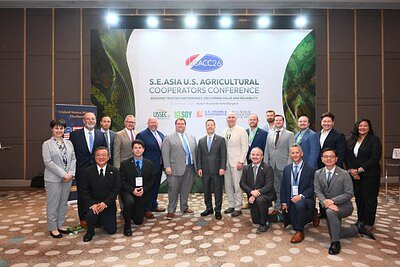
The S.E. Asia U.S. Agricultural Cooperators Conference and the Asia Soy Excellence & Food Summit brought together a diverse group of American farmers, exporters, and regional buyers. The events served as a crucial platform for reinforcing partnerships at a time when global agricultural trade is fraught with complexity, from geopolitical tensions to unpredictable climate patterns.
A Region Hungry for Protein
The strategic focus on Southeast Asia is no accident. The region has become a powerhouse of demand, driven by a confluence of powerful economic and demographic trends. In the 2024/25 marketing year alone, Southeast Asian nations imported a staggering 10.1 million metric tons (MMT) of whole soybeans and 18.6 MMT of soybean meal from all origins. These figures paint a picture of a region heavily reliant on imports to fuel its growth.
This demand is propelled by a burgeoning middle class with rising disposable incomes and a corresponding dietary shift towards higher protein consumption. As urbanization accelerates, the demand for poultry, pork, and seafood has surged, creating a massive downstream need for high-quality animal feed—a market where soybean meal is a critical ingredient. Projections from industry analysts suggest the ASEAN region could account for over 42% of global soybean meal imports by the 2032/33 marketing year, highlighting the immense long-term opportunity.
Leading this consumption wave are countries like the Philippines, which stands as the single largest global importer of U.S. soybean meal, and Vietnam, whose rapidly expanding livestock and aquaculture sectors have created powerful and consistent demand. Even in nations with strong culinary traditions around soy foods, like Indonesia's reliance on soybeans for tempeh and tofu, the U.S. has carved out a dominant position, supplying approximately 90% of the country's food-use soybean imports.
"Southeast Asia remains a key growth region for U.S. Soy," noted Carlos Salinas, USSEC's Executive Director for East Asia, during the Bangkok events. "As demand for protein continues to rise, there are clear opportunities to expand the use of U.S. soybean meal and soy food products across the region."
The 'Green Bean' as a Competitive Edge
In a market crowded with powerful competitors, the U.S. is increasingly leveraging sustainability as a key differentiator. Faced with buyers who are under growing pressure from consumers and regulators to demonstrate environmental responsibility, the American soy industry is positioning its product as the conscientious choice. Central to this strategy is the Sustainable U.S. Soy (SUSS) label, which verifies that the product was grown under a comprehensive system of sustainable practices and conservation regulations.
This 'green' branding is more than just marketing; it's a strategic response to evolving market expectations. Industry partners using the SUSS label on their products report stronger brand differentiation and enhanced consumer trust. The message from USSEC is that U.S. Soy offers a lower carbon footprint and verifiable sustainability credentials that competitors may struggle to match. This focus on traceability and verified sourcing is becoming a critical factor in purchasing decisions for major food and feed manufacturers across the region.
Navigating a Field of Giants
The Southeast Asian market is far from an easy win. The United States faces formidable competition, primarily from South American agricultural giants Brazil and Argentina. In 2022, Brazil held a 46% share of the whole soybean import market in ASEAN, running nearly neck-and-neck with the U.S. share of 44%.
In the even larger soybean meal market, the U.S. is a more distant third. In the 2022/2023 marketing year, Brazil and Argentina together supplied nearly 80% of ASEAN's soybean meal imports, with the U.S. providing just 13.5%. These South American producers often benefit from currency fluctuations and logistical advantages that allow them to offer highly competitive pricing.
However, this is where the U.S. strategy of emphasizing reliability and partnership comes into play. Argentina's market is frequently disrupted by domestic policy uncertainty and volatile export taxes, creating supply chain risks for buyers. By contrast, the U.S. industry, represented by multi-generational farm families and established export infrastructure, promotes its long-standing commitment to consistent quality and dependable supply. The recent conferences in Bangkok were designed to reinforce this very message through direct business-to-business meetings and expert-led discussions on navigating market uncertainty.
Trade Winds and Political Headwinds
The flow of soybeans into Southeast Asia is not governed by market forces alone. Geopolitical and trade policies cast a long shadow over the entire agricultural landscape. The ongoing trade friction between the United States and China continues to send ripples through global commodity markets, impacting pricing and trade flows for all of Asia.
Furthermore, the lack of a comprehensive trade agreement between the U.S. and the broader ASEAN bloc puts American exporters at a potential disadvantage compared to countries that are part of regional trade pacts. An agreement to eliminate tariffs could significantly boost the competitiveness of U.S. soy. In the absence of such a deal, the U.S. relies on building strong bilateral relationships and highlighting its non-price advantages.
The events in Bangkok underscored a strategy that seeks to transcend these challenges by embedding U.S. Soy into the very fabric of the region's food security framework. By focusing on collaboration, innovation, and shared goals around nutrition and sustainable production, the U.S. industry aims to become an indispensable partner. This approach recognizes that in today's complex global environment, long-term relationships and mutual trust are often the most valuable commodities of all.