
- $58 billion: The global sustainable fashion market is projected to grow to this value by 2033, up from nearly $10 billion in 2024.
- 23%: U.S. fiber hemp production grew by this percentage in 2024, reaching 60.4 million pounds, but much of it went unsold due to limited domestic manufacturing capacity.
- 2025: Vietnam surpassed China to become the largest exporter of textiles to the United States, solidifying its role as a textile powerhouse.
Experts would likely conclude that this partnership represents a strategic alignment of U.S. hemp production with Vietnam's growing sustainable textile manufacturing capabilities, creating a scalable, transparent supply chain that meets global demand for eco-friendly fashion while addressing domestic oversupply issues.
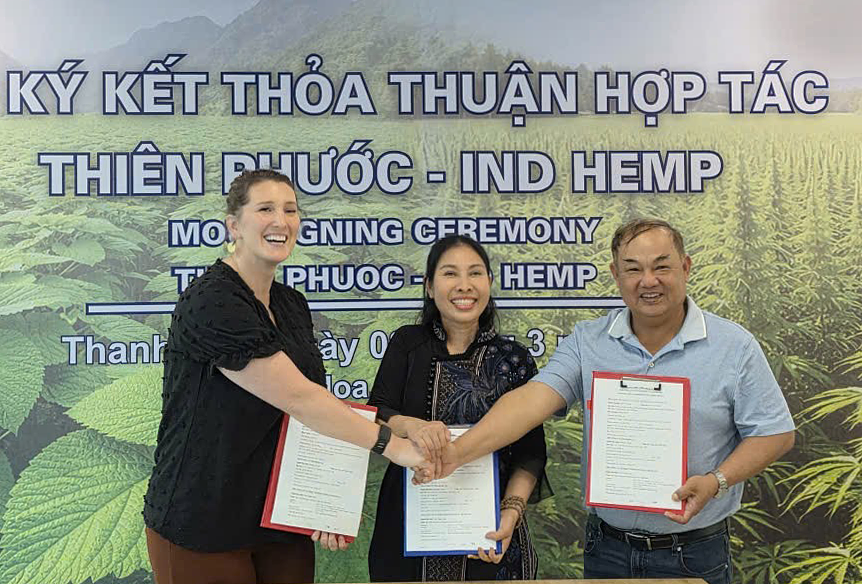
US Hemp Weaves New Path to Vietnam's Textile Powerhouse
FORT BENTON, MT – April 07, 2026 – A groundbreaking partnership is set to transform the global textile landscape, creating a new, sustainable highway for American-grown hemp straight to the heart of Vietnam's booming garment industry. Montana-based IND HEMP, U.S.-Vietnam trade specialist Summit International Trading, and Vietnamese textile producer Thien Phuoc Ramie Group have signed a Memorandum of Understanding (MOU) to build a scalable, transparent supply chain for hemp-based fabrics.
This strategic alliance bridges the agricultural heartland of the United States with one of the world's most formidable manufacturing hubs. The first fruits of this collaboration—yarns and fabrics made from Montana hemp processed in Vietnam—are being unveiled this week at the Functional Fabric Fair in Portland, Oregon, offering a tangible glimpse into the future of sustainable fashion.
A New Trans-Pacific Supply Chain
The collaboration is built on a clear division of expertise. IND HEMP, a leading American producer of industrial hemp, supplies decorticated fiber grown and processed on its home turf. Summit International Trading, with its deep experience in the U.S.-Vietnam trade corridor, manages the complex logistics of shipping the raw material across the Pacific and coordinating operations on the ground. Once in Vietnam, Thien Phuoc Ramie Group, already a powerhouse in natural fiber processing, takes over for the crucial steps of degumming, spinning, and weaving the hemp into finished textiles.
“Summit International has deep experience importing from and exporting to the U.S. from Vietnam and managing international textile supply chains,” said Morgan Tweet, CEO of IND HEMP, in a statement. “Ms Thuy of Thien Phuoc has built a strong natural fiber processing platform with ramie. Together, they have the capability to integrate hemp into an existing, working textile supply chain system.”
The viability of this ambitious project was proven late last year. In December 2025, the first containers of raw U.S. hemp fiber landed in Vietnam, a landmark event made possible by recent policy shifts in the Southeast Asian nation that now permit such imports. Previously, Vietnam’s access to hemp was largely limited to finished yarns and fabrics, primarily from China. This new arrangement allows for unprecedented vertical integration and traceability.
Thanh Hu of Summit International Trading expressed confidence in the partnership. “American farmers are known to produce the best crops at scale in the world, and from visiting the farms and facilities of IND HEMP in Montana last year, we are confident that we have the partner necessary to supply both quality and consistency as hemp fiber continues to grow in both use and demand in textiles in Vietnam,” Hu noted.
Vietnam: The Epicenter of Green Textile Manufacturing
The choice of Vietnam as the manufacturing hub is no coincidence. The nation has rapidly ascended to become a dominant force in the global textile market, surpassing China in 2025 to become the largest exporter of textiles to the United States. Its well-developed manufacturing base, strong trade relationships, and a growing government-backed commitment to sustainability make it an ideal partner.
Global pressures, particularly from key markets like the European Union, are accelerating Vietnam's green transition. The EU’s Carbon Border Adjustment Mechanism (CBAM), which began its reporting phase in October 2023, will impose carbon tariffs starting in 2026, creating a powerful financial incentive for Vietnamese manufacturers to reduce their carbon footprint. This regulatory push, combined with Vietnam's national goal of achieving net-zero emissions by 2050, has spurred investment in water-saving technologies, renewable energy, and eco-friendly materials.
This shift aligns perfectly with the demands of major global apparel brands. Companies like Levi Strauss & Co., VF Corp, Patagonia, and Lululemon, all of whom have significant supplier networks in Vietnam, are increasingly prioritizing supply chain transparency and sustainability. The ability to trace a garment back to a specific hemp field in Montana offers a level of assurance that is becoming a key differentiator in the market. The global sustainable fashion market, valued at nearly $10 billion in 2024, is projected to skyrocket to over $58 billion by 2033, and this partnership is perfectly positioned to capture a piece of that growth.
An Export Lifeline for American Hemp
While the deal opens new doors for Vietnam, it also provides a critical solution to a uniquely American problem: an oversupply of industrial hemp. Following its federal legalization, U.S. farmers and processors like IND HEMP scaled production rapidly. However, domestic manufacturing capacity for textiles and other industrial uses has not kept pace. U.S. Department of Agriculture data from 2024 shows that while fiber hemp production grew by 23% to 60.4 million pounds, the percentage of harvested fiber that went unsold also increased, signaling a market struggling to absorb its own output.
This partnership provides a vital export outlet, turning a domestic surplus into a global opportunity. It ensures that American farmers have a stable, growing market for their crops while allowing processors to operate at a scale that is efficient and profitable.
“While IND HEMP is committed to supporting domestic manufacturing with industrial hemp materials, the reality is that they have scaled production and processing faster and to greater scale than the U.S. domestic manufacturing market can consume,” the company explained. International trade provides growth for farmers and satisfies a global consumer demand for sustainable products.
This international push is part of a broader strategy for the Montana-based company, which has spent the last two years building trade relationships across North America, South America, Europe, and Asia. The effort has been supported by a network of public and private organizations, including the National Industrial Hemp Council of America (NIHC), the Montana Department of Agriculture, and the Western United States Agricultural Trade Association (WUSATA), all working to open global markets for American agricultural products. This collaborative model demonstrates a path forward for other emerging U.S. industries looking to compete on the world stage.