
- 95% of surveyed companies reaffirmed commitment to maintaining operations in China, with 0% reporting complete withdrawal.
- 75% of companies plan to reinvest profits in China in 2026, totaling an estimated US$13.79 billion over the next 3-5 years.
- Guangzhou remains the top investment destination, favored by 38% of respondents, followed by Shenzhen (29%), Shanghai (10%), and Beijing (5%).
Experts conclude that despite moderating profitability and geopolitical tensions, US and international firms view China as a strategic long-term market, prioritizing deepened investment and localization over short-term gains.
US Firms Deepen China Bet, Citing Long-Term Growth Over Current Headwinds
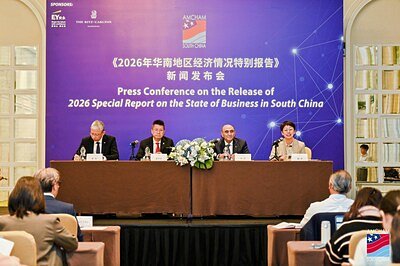
GUANGZHOU, China – March 10, 2026 – A major new report reveals that American and international companies are deepening their commitment to China, earmarking billions for reinvestment despite moderated profitability and the persistent shadow of geopolitical tensions. The 2026 Special Report on the State of Business in South China, released today by the American Chamber of Commerce in South China (AmCham South China), paints a picture of strategic resilience, with businesses prioritizing long-term market access over short-term headwinds.
For the ninth consecutive year, the southern metropolis of Guangzhou has been ranked as the top investment destination in China by the 426 companies surveyed. The findings suggest a strategic pivot by foreign firms, who appear to be digging in for the long haul, with 95% reaffirming their commitment to maintaining operations and not a single company reporting a complete withdrawal from the market.
This unwavering commitment comes even as financial performance has softened. While a strong majority of 82% of companies reported profitability in 2025, this figure represents a three-percentage-point drop from the previous year. Yet, this has not deterred future investment. A remarkable 75% of the companies studied plan to reinvest profits in China in 2026, with an estimated US$13.79 billion collectively earmarked for reinvestment over the next three to five years.
Guangzhou's Enduring Appeal in the Greater Bay Area
The report once again crowns Guangzhou as the most favored investment location, selected by 38% of respondents. Its neighbor, the tech powerhouse Shenzhen, saw its appeal grow significantly, jumping six percentage points to 29%, placing it firmly ahead of Shanghai (10%) and Beijing (5%).
Guangzhou’s consistent top ranking highlights its unique position as a stable and strategic hub within the dynamic Guangdong-Hong Kong-Macao Greater Bay Area. While official foreign direct investment (FDI) data often shows larger absolute capital inflows into financial centers like Shanghai, the AmCham survey reflects business sentiment regarding operational environment, growth potential, and government support. Guangzhou's appeal is rooted in its world-class logistics infrastructure, including one of the world's busiest ports and airports, and a diverse, robust industrial base that spans from traditional auto manufacturing to cutting-edge biomedicine and artificial intelligence.
The city's proactive policies aimed at attracting high-tech industries and streamlining administrative processes for foreign firms contribute to this positive perception. For companies already embedded in the region's complex supply chains, Guangzhou offers a compelling mix of manufacturing prowess, connectivity, and a vast domestic market at its doorstep.
The Paradox: Softer Profits, Stronger Commitment
A central paradox emerges from the report's data: why are companies doubling down on investment when profitability is moderating? The answer appears to lie in a strategic shift from viewing China as a low-cost export base to embracing it as a vast, indispensable domestic market. This “In China, for China” strategy prioritizes long-term market share over immediate returns.
Dr. Harley Seyedin, Chairman and President of AmCham South China, articulated this sentiment in the report. "Although profitability has moderated slightly in the near term, the broader data reflects remarkable strategic resilience," he stated. "Companies are deepening—not retreating from—their engagement in China, recognizing the scale of its market, the sophistication of its innovation ecosystem, and its long-term growth trajectory."
This reinvestment is increasingly directed toward localization. Rather than simply expanding factory floors, firms are pouring capital into local research and development, customizing products for Chinese consumers, and building more resilient, domestic-focused supply chains. This strategy not only makes them more competitive against local rivals but also helps insulate their operations from the volatility of international trade disputes.
Even among the 28% of companies that relocated some investment, the moves were minor, with 79% of that group shifting less than 30% of their capital outside China. The message is clear: companies are fine-tuning, not abandoning, their China operations.
"The message from American businesses is clear: they are committed to long-term participation in China's growth," Dr. Seyedin continued. "This sustained reinvestment reflects confidence in the market's resilience and its central role in global business operations."
Cautious Optimism on US-China Relations
Adding to the complex picture, business sentiment regarding the future of US-China relations has shown significant improvement. According to the report, 39% of companies now hold a positive outlook on the relationship, a substantial 14-percentage-point increase from 2024. This growing optimism suggests a belief that while tensions may not vanish, the resulting operational disruptions could become more manageable.
However, this optimism is tempered by on-the-ground realities. The report starkly notes that the adverse effects of both US and Chinese tariffs intensified markedly in 2025, affecting a record proportion of companies since tracking began in 2018, with American firms bearing the heaviest burden. This highlights a disconnect between hope for diplomatic stability and the persistent financial pain caused by trade policy.
This nuanced view from South China contrasts with more cautious tones from other business surveys. Recent reports from the European Chamber of Commerce and other regional AmChams have pointed to a more challenging business environment and a greater degree of reassessment among their members. This suggests that the deep integration and specific industrial ecosystem of South China may be fostering a unique level of resilience and commitment not seen uniformly across the country.
Ultimately, the AmCham South China report portrays a foreign business community that is pragmatic and deeply strategic. While navigating a landscape of softening profits and punishing tariffs, these companies are voting with their wallets, betting that a deeper, more localized presence in the world’s second-largest economy is a non-negotiable component of their global future.