
- Signal-to-Noise Ratio (SNR): Up to 68 dB, placing it in the high-performance category for audio sensors.
- Frequency Response: 5 Hz to 12 kHz, enabling detection of low-frequency vibrations for industrial applications.
- Market Adoption: UPM01 already shipping in high-volume production for smart glasses and TWS applications in 2025.
Experts view Upbeat Technology's new MEMS sensors as a significant advancement in audio sensing, particularly for noise reduction and industrial applications, with potential to set a new standard in the competitive MEMS market.
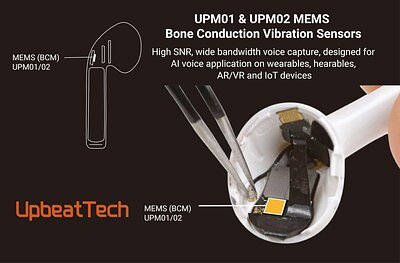
Upbeat Tech's New MEMS Sensors Promise to Silence the Noise
TAIPEI, Taiwan – December 19, 2025 – In a move poised to redefine the boundaries of audio sensing and artificial intelligence, Taipei-based Upbeat Technology has unveiled a new family of high-bandwidth MEMS sensors designed to give machines a new way to listen. The UPM01 and UPM02 sensors leverage vibration and bone-conduction technology to deliver what the company calls unprecedented voice clarity and intelligent sensing, targeting a world increasingly reliant on voice commands and autonomous systems.
The announcement enters a fiercely competitive MEMS (Micro-Electro-Mechanical Systems) market, where giants like Bosch Sensortec and STMicroelectronics have long held sway. Yet, Upbeat is carving out a distinct niche by directly tackling one of the most persistent challenges in voice technology: background noise. By capturing sound through the vibrations in a user's skull or the subtle tremors of a machine, these sensors promise to isolate signals with remarkable fidelity, a feat that traditional air-conduction microphones often struggle to achieve in bustling city streets, windy environments, or noisy industrial settings.
A Technological Leap in Listening
At the heart of Upbeat's announcement are the technical specifications of its new sensors. The UPM01 and UPM02 boast a wide, flat frequency response from 5 Hz to 12 kHz and a signal-to-noise ratio (SNR) of up to 68 dB. In the world of audio engineering, a higher SNR means a cleaner signal with less unwanted hiss or background interference. This 68 dB figure places Upbeat's technology squarely in the high-performance category, competitive with offerings from established players like TDK InvenSense, whose premium microphones range from 65 dB to 70 dBA SNR.
What sets the technology apart, however, is its dual-pronged approach. The UPM02 is engineered for bone conduction, making it ideal for AI wearables like True Wireless Stereo (TWS) earbuds and smart glasses. By detecting the vibrations of the user's voice as they travel through bone, it can effectively ignore ambient sounds, enabling crystal-clear phone calls or reliable voice commands for an AI assistant, even in a crowded cafe. The UPM01, meanwhile, can blend the user's voice with ambient sound when needed or function as a pure vibration sensor.
The low-frequency sensitivity, extending down to 5 Hz, is particularly significant for industrial applications. This capability allows the sensors to detect micro-vibrations associated with mechanical stress, imbalance, or wear and tear in machinery—signals that are often precursors to catastrophic failure. When paired with Upbeat's UP301 dual-core RISC-V AI microcontroller, the system can perform on-device analysis, transforming a simple sensor into an intelligent predictive maintenance tool.
"We are thrilled to integrate Upbeat Tech's UPM01 bone-conduction MEMS sensor into our devices," said SJ Liu, CEO at J5Create, in a statement highlighting early market adoption. "Its high sensitivity, superior SNR, and wide bandwidth enable crystal-clear audio capture even in the noisiest environments, delivering a noticeably better user experience."
Powering the Next Wave of Intelligent Devices
The potential applications for this technology extend far beyond clearer phone calls. Upbeat is positioning its sensor family as a foundational component for the next generation of autonomous systems and the burgeoning AIoT (Artificial Intelligence of Things) ecosystem. The company's strategy appears to be a direct response to a critical consumer demand: longer battery life.
This focus is validated by industry research. "Ultra-low power solutions solve for a key consumer demand for long-lasting battery life, which is the top metric buyers use to evaluate wearables," noted Daniel Holcolmb, Sr. Analyst at Parks Associates. He added that their research shows 78% of wearables users report wanting long battery life. "Solutions like Upbeat Technology's UPM01 and UPM02 highlight how vibration-based sensing can unlock new use cases in AI wearables, robotics, and drones, where conventional audio approaches often fall short."
For the rapidly growing 'low-altitude economy,' this translates into more reliable and safer drones. By mounting the UPM01 sensor on a drone's frame, operators can monitor propeller health and detect mechanical fatigue in real-time, enabling predictive maintenance that prevents costly failures and enhances operational safety. In humanoid robotics, these same sensors can provide a sense of touch or detect internal mechanical stress, contributing to more robust and aware autonomous platforms.
In the consumer space, the applications are equally innovative. The press release details a compact, magnetically attached recording card that can capture both sides of a phone conversation via vibration, paving the way for seamless transcription and translation services. For smart glasses and other open-ear audio devices, the technology allows for 'whisper-mode' input, where users can issue commands in a very low voice that would be lost on a traditional microphone but is perfectly captured through bone conduction.
Setting a New Standard in a Crowded Market
Upbeat Technology's UPM01 has already been shipping in high-volume production throughout 2025 for smart glasses and TWS applications, demonstrating proven, real-world performance ahead of this formal announcement. This existing market traction, combined with the J5Create partnership, suggests the company is moving aggressively to establish a foothold before competitors can pivot.
The company's strategic inclusion of both analog and digital interfaces in the sensors also points to a deep understanding of engineering needs, offering product designers maximum flexibility to integrate the technology into a wide range of system architectures. This versatility is key to penetrating diverse markets from consumer audio to mission-critical industrial systems.
Looking ahead, Upbeat plans to showcase live demonstrations of its new sensing platform at the upcoming CES 2026 conference in Las Vegas, a traditional launchpad for groundbreaking consumer technologies. The company also teased the forthcoming UPM05 ultrasonic MEMS sensor, with availability planned for the third quarter of 2026, signaling a continued expansion of its sensing portfolio. By combining ultra-low power consumption with high-fidelity performance, Upbeat Technology is not just launching a new product; it is making a compelling case for a new standard in how our devices perceive the world around them.