
- 50% enhancement in leg strength provided by the VIATRIX™ exoskeleton.
- 25 kilometers (15.5 miles) or 4-5 hours of continuous operation on a single charge.
- Operates in temperatures ranging from -20°C to 65°C (-4°F to 149°F).
Experts view the VIATRIX™ as a significant advancement in consumer exoskeletons, leveraging proven industrial technology to enhance outdoor mobility and accessibility.
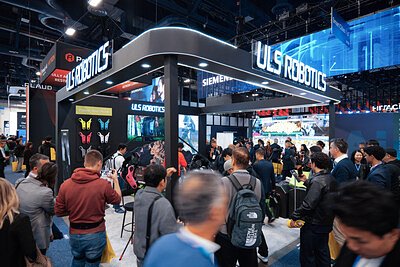
ULS Robotics' VIATRIX™ Brings Industrial Exoskeletons to Hiking Trails
LAS VEGAS, NV – January 08, 2026
The bustling halls of the Consumer Electronics Show (CES) have long been a stage for the future, but this year, a product typically confined to factory floors and disaster sites made a powerful stride into the consumer spotlight. ULS Robotics, a company known for its heavy-duty industrial exoskeletons, unveiled its first consumer-grade device, the VIATRIX™ powered exoskeleton. The debut was met with immediate industry acclaim, securing a prestigious CES 2026 Innovation Award in the highly competitive robotics category and signaling a pivotal shift for both the company and the future of personal mobility.
Designed for outdoor enthusiasts, the VIATRIX™—its name derived from the Latin for "traveler"—is not a medical device but a personal augmentation tool. It promises to be for hiking what the e-bike has become for cycling: a technology that enhances human capability, reduces fatigue, and broadens access to challenging activities. This launch marks the official entry of a seasoned industrial player into the burgeoning consumer market, a move built on years of validated, real-world technological expertise.
A Leap in Personal Augmentation
At the heart of VIATRIX™ are several key innovations that distinguish it from its industrial predecessors and current market competitors. The most significant is the proprietary Float360™ floating hip joint mechanism. This design allows for an unprecedented range of natural human motion, enabling users to perform deep squats or wide-legged stances without the rigid constraints often associated with robotic frames. This flexibility is crucial for navigating uneven terrain, climbing over obstacles, or simply moving with a natural, unencumbered gait.
Powering the device are self-developed, automotive-grade servo motors that deliver formidable yet stable assistance, providing what the company claims is a 50% enhancement in leg strength. This power is managed by an AI-driven adaptive learning system. Over time, the system analyzes an individual user's unique gait patterns to provide personalized, intelligent torque assistance that adjusts automatically to different road conditions, whether on a flat path, a steep incline, or a rocky trail.
Endurance for the long haul is provided by a large-capacity 99Wh battery, capable of supporting up to 25 kilometers (about 15.5 miles) or 4-5 hours of continuous operation on a single charge. Critically for adventurers, the device is built to withstand extreme environments, operating stably in temperatures ranging from a frigid -20°C to a sweltering 65°C (-4°F to 149°F). Despite its robust capabilities, the core unit weighs 2.9 kg (6.4 lbs) without the battery, designed to be powerful without being overly burdensome.
Forged in Industry, Refined for the Trail
The creation of VIATRIX™ is not an overnight success but the culmination of a long and proven history in a far more demanding sector. Founded in 2018, ULS Robotics has built its reputation as a leader in industrial-grade exoskeletons, with what it describes as 20 years of technological accumulation and seven years of intense industrial application validation.
"The launch of VIATRIX™ marks ULS Robotics' official entry into the consumer market as a leader in industrial-grade exoskeletons," said Xu Zhenhua, founder and CEO of ULS Robotics, in the company's official announcement. "We have transformed 20 years of technological accumulation and 7 years of industrial applications validation into a truly intelligent device designed for outdoor life."
The company's industrial portfolio is extensive, with five generations of products covering upper limbs, waist, lower limbs, and even full-body skeletons. These devices are deployed in over 30 industries—from automotive manufacturing and logistics to emergency rescue and construction—across 25 countries. This background provides ULS Robotics with a significant competitive advantage: a deep reservoir of data on durability, power management, and human-robot interaction under extreme stress. Their technology has been battle-tested in scenarios far harsher than a weekend hike, including providing logistics support at the Hangzhou 2023 Asian Games and even appearing in the sci-fi blockbuster "The Wandering Earth II."
The "E-Bike for Hiking" Enters a Growing Market
ULS Robotics is entering a consumer exoskeleton market that is, by all accounts, just beginning to heat up. The concept of an "e-bike for hiking" is gaining traction, with several innovative companies vying to define this new category of personal technology. The global exoskeleton market, currently dominated by medical and industrial uses, is projected to grow from around $550 million in 2024 to over $3.4 billion by 2035, with the consumer segment expected to drive a significant portion of that expansion.
The VIATRIX™ joins a field of ambitious competitors also showcased at CES 2026, including the Dnsys X1 and Z1 hip and knee exoskeletons, the Hypershell Pro X, and the anticipated MO/GO from Google X spin-off Skip. These devices share a common goal: to make outdoor activities more accessible and enjoyable by reducing physical strain and boosting endurance. They target a broad demographic, from seasoned athletes looking to push their limits to aging populations wanting to maintain an active lifestyle, and casual hikers who simply want to go farther with less fatigue.
Winning the CES Innovation Award provides VIATRIX™ with crucial validation in this crowded and noisy environment. The robotics category at CES 2026 saw a 32% increase in submissions, with VIATRIX™ standing out to a panel of expert judges for its engineering and design. This recognition helps cut through the hype, lending credibility to its technological claims and positioning it as a serious contender right out of the gate. While pricing for VIATRIX™ has not yet been announced, it is positioned as a premium option. For context, competitors like Skip's MO/GO are expected to retail for around $4,500, suggesting this technology will initially be an investment for serious enthusiasts.
Redefining the Limits of Adventure
The arrival of sophisticated consumer exoskeletons like VIATRIX™ raises fascinating questions about the future of recreation and human potential. For many, this technology could be liberating. An avid hiker recovering from a knee injury might regain the confidence to tackle a beloved mountain trail. An older individual could join their grandchildren on strenuous treks that would otherwise be impossible. A long-distance runner could add miles to their training regimen with reduced joint impact.
The promise is one of inclusion, enabling more people to experience the physical and mental benefits of the great outdoors. By intelligently augmenting a user's own strength, these devices don't replace human effort but rather supplement it, reducing the energy cost of movement and staving off the fatigue that often cuts adventures short. The result is not just the ability to go farther or faster, but to remain fresher and more engaged with the surrounding environment. What once seemed like science fiction is now on display in Las Vegas, a tangible product ready to transform how we explore our world.