
- 104,000 participants: The study analyzed data from 104,000 young people aged 14–35 over a decade.
- 77% sensitivity rate: ECG screening demonstrated a high sensitivity rate of 77% in identifying hidden heart conditions.
- 12 deaths per week: An estimated 12 sudden cardiac deaths occur weekly among young people in the UK.
Experts conclude that the study provides compelling evidence supporting the effectiveness of ECG screening in identifying and preventing life-threatening cardiac conditions in young people, challenging current UK policy reservations.
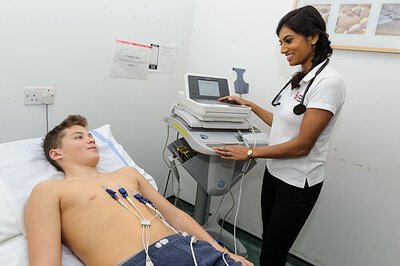
UK's Youth Cardiac Screening Policy Challenged by Landmark Study
LONDON, UK – February 24, 2026 – A groundbreaking study, the largest of its kind, has provided powerful evidence that simple heart checks can save young lives, directly challenging the United Kingdom's current stance on cardiac screening and intensifying calls for a national prevention strategy. The research, analyzing over 100,000 young people, reveals that electrocardiogram (ECG) screening is highly effective at identifying hidden, life-threatening heart conditions, a finding that campaigners hope will force a policy overhaul to prevent the estimated 12 sudden cardiac deaths that occur in young people every week across the UK.
Published in the prestigious Journal of the American College of Cardiology, the decade-long study funded by the charity Cardiac Risk in the Young (CRY) offers a stark counter-narrative to the UK National Screening Committee's (UK NSC) long-held reservations. While the committee has historically cited concerns over test accuracy and potential harm from false positives, this new paper demonstrates a high sensitivity rate of 77% and a low false-positive rate of just 2.1%.
The Overwhelming Evidence for Screening
The comprehensive research, conducted by a team at City St George's, University of London, tracked 104,000 individuals aged 14 to 35 between 2008 and 2018. It confirmed previous findings that one in every 300 young people screened harbors a potentially fatal cardiac condition. Crucially, the study showed that these diagnoses are not merely academic; more than 40% of those identified with serious issues went on to receive significant, life-saving interventions. These treatments included implantable defibrillators (ICDs), pacemakers, corrective cardiac ablation surgery, and, in two cases, heart transplantation.
"This study shows that cardiac screening can save lives," said lead researcher Professor Michael Papadakis, Professor of Cardiology at City St George's. "Across a decade of screening in a general population of 14–35-year-olds we identified hundreds of young people with dangerous heart conditions who were able to receive treatment before tragedy struck."
One of the study's most significant revelations is that athletic activity is not the primary determinant of risk. While screening has often focused on elite athletes, this research found no significant difference in cardiac risk between athletes and non-athletes. With just 9% of the study participants identifying as competitive athletes, the findings underscore that young sudden cardiac death is a threat to the entire youth population, raising profound questions about policies that limit screening to sporting elites.
A Case for Repeated Testing
The report also pioneers a crucial new argument: a single screening is not always enough. A systematic follow-up revealed that 0.08% of individuals who initially received a normal ECG result were later diagnosed with a condition associated with young sudden cardiac death. Tragically, 0.03%—or one in every 3,333 people tested—suffered a sudden cardiac arrest or death an average of four years after their 'all-clear' test. This suggests that some conditions are acquired or develop later in life, reinforcing the need for a system of repeat screening.
"This research has clearly demonstrated it is no longer a question of IF screening saves lives, but now about how many lives screening saves and how to prevent more tragedies," stated Dr. Steven Cox, CEO of Cardiac Risk in the Young. "We now have the evidence to support our proposition that screening in young people, in the general population, needs to be repeated."
This call for repeated testing is not without precedent. In Italy, a mandatory pre-participation screening program for all young competitive athletes, which includes annual ECGs, was introduced in 1982. The policy has been credited with a remarkable 89% reduction in the incidence of sudden cardiac death among its athletic population. Advocates argue this demonstrates that a robust, national screening strategy is not only effective but achievable.
The UK's Policy Under Scrutiny
Despite the mounting evidence, the UK NSC currently does not recommend a national screening program for cardiac conditions in young people. Its official position, last reviewed in 2019, points to uncertainty about test accuracy in the general population, a lack of research on overall effectiveness, and the potential for harm from false positives, which could lead to unnecessary anxiety and medical procedures. The committee has also noted the absence of an agreed-upon treatment pathway for asymptomatic individuals identified through screening.
This new study directly addresses many of those concerns by providing robust, large-scale data from a general population cohort. The findings arrive at a critical moment, as the UK NSC is set to re-examine the evidence and open a public consultation on the issue in the spring of 2026. Campaigners and bereaved families, who have long funded CRY's screening program through charitable donations, are hopeful this paper will provide the definitive evidence needed to shift government policy.
The Future is AI-Powered
Addressing the logistical and economic challenges of a national program, CRY is looking to the future. The charity announced its 2030 strategic vision will include the launch of an AI Cardiac Screening and Research Project. Experts believe artificial intelligence and machine learning hold the key to making widespread screening more accurate, scalable, and cost-effective.
AI algorithms are already proving capable of analyzing ECG data with a level of detail that surpasses human perception, identifying subtle patterns that may predict future cardiac events even when an ECG appears normal to a cardiologist. This technology could dramatically enhance the power of screening while lowering the associated costs of interpretation.
Professor Papadakis highlighted this potential, adding, "Importantly we will investigate the impact of Artificial Intelligence (AI) on detecting ECG features suggestive of disease that the naked eye cannot see. AI has the potential to considerably enhance the power and accuracy of ECG as a screening tool."
For three decades, CRY has been at the forefront of this battle, driven by the families left behind. Professor Sanjay Sharma, CRY's Consultant Cardiologist, reflected on the journey. "When we began this journey, few believed it would be possible to prevent sudden deaths in young people but today, the importance of our research is clear, and it points to a future in which many more young lives will be saved," he stated. "And, it should never be forgotten that this seminal piece of work...is only possible due to the exceptional and tireless fundraising efforts of bereaved families across the UK who somehow manage to see beyond their own grief to do all they can to prevent other families from going through a similar, devastating experience."