
- $474.1 million: Total loan volume closed by Truss Financial in 2025
- 9% to 15%: Projected growth of Non-QM lending as a share of total mortgage originations by end of 2026
- 569 loans: Number of Non-QM loans processed by Truss Financial in 2025
Experts view the rise of Non-QM lending as a necessary evolution in the mortgage market, driven by demand from non-traditional borrowers and supported by rigorous underwriting standards that ensure creditworthiness.
Truss Financial's Rise Signals Major Shift in US Mortgage Market
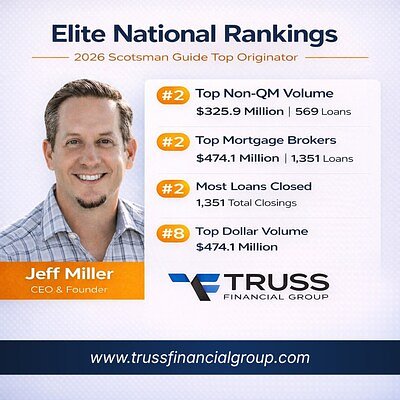
LADERA RANCH, CA – April 13, 2026 – In a clear signal of a fundamental shift occurring within the American mortgage landscape, Truss Financial Group CEO Jeff Miller has secured top national honors in the prestigious 2026 Scotsman Guide rankings. Based on independently audited 2025 production data, Miller achieved the #2 position nationwide for Top Non-QM Volume, #2 for Most Loans Closed, and #2 among all Top Mortgage Brokers. While a significant achievement for the Ladera Ranch-based firm, these rankings illuminate a far broader story: the rapid ascent of non-qualified mortgages (Non-QM) as an essential financial tool for a growing segment of the U.S. economy.
Miller’s performance, which included closing an impressive 1,351 loans for a total of $474.1 million, was particularly dominant in the alternative lending space. The firm processed 569 Non-QM loans alone, amounting to $325.9 million in volume. This places Truss Financial at the forefront of a movement catering to borrowers—such as self-employed professionals, real estate investors, and gig economy workers—whose financial profiles don't fit the rigid box of traditional lending criteria.
The New Mainstream: Non-QM Lending's Explosive Growth
For years, the mortgage industry has been dominated by 'qualified mortgages' that adhere to strict government-backed standards, often relying heavily on W-2 income and a low debt-to-income ratio. However, the American workforce has evolved. The rise of entrepreneurship, freelance work, and diverse investment strategies has created a substantial population of creditworthy borrowers who are systematically excluded by these conventional models.
This is the gap that the Non-QM market is filling, and its growth is accelerating. Industry analysts project that Non-QM lending, which accounted for over 9% of total mortgage lock volume by the end of 2025, could represent over 15% of all mortgage originations by the end of this year. This surge is fueled by clear demand. As traditional banks tighten their lending standards in response to economic volatility, Non-QM lenders are stepping in to provide vital capital.
These are not the high-risk, undocumented loans of the pre-2008 era. Today's Non-QM products are sophisticated instruments designed to rigorously assess a borrower's ability to repay using alternative methods. Popular products include bank statement loans, which analyze cash flow over 12 or 24 months for self-employed individuals, and Debt Service Coverage Ratio (DSCR) loans, which qualify real estate investors based on a property's rental income rather than their personal finances.
A Blueprint for Dominance in a Specialized Market
The success of Truss Financial Group demonstrates a potent strategy of deep specialization and operational excellence. By intentionally moving away from the highly commoditized world of conventional agency lending, the firm has established itself as an expert in navigating complex financial profiles. Its product suite is a testament to this focus, offering solutions like asset depletion programs for retirees, no-appraisal Home Equity Lines of Credit (HELOCs), and Profit & Loss statement loans for business owners.
"Securing top placements in the Scotsman Guide supports our mission," said Jeff Miller, CEO and Founder of Truss Financial Group. "Complex income needs flexible underwriting, and we focus on efficient capital and reliable options for entrepreneurs & investors."
Miller’s #2 national ranking in Non-QM volume, second only to Mark Cohen of Cohen Financial Group, underscores the firm's scale in this competitive niche. Likewise, his #2 position for Most Loans Closed, behind only Garo Banosian of Guaranteed Rate, reflects a high level of trust and efficiency that resonates with a broad base of borrowers who require more than a one-size-fits-all approach. This performance validates the firm’s model, proving that a dedicated focus on an underserved market can lead to industry-leading results.
Serving the Needs of the Modern Borrower
The necessity for alternative lending is rooted in the real-world challenges faced by millions of Americans. A successful small business owner, for example, may utilize legitimate tax deductions to reinvest in their company, lowering their taxable income on paper. While a smart business practice, this often leads to an automatic denial from a traditional mortgage lender. A bank statement loan from a lender like Truss Financial bypasses this issue by examining the actual cash flow through their business and personal accounts, providing a more accurate picture of their financial health.
Similarly, a real estate investor looking to expand their portfolio may be hampered by conventional loan limits on the number of properties they can finance or by debt-to-income calculations that don't accurately reflect their investment strategy. A DSCR loan resolves this by underwriting the loan based on the investment's own merit—its ability to generate enough rental income to cover the mortgage payment and other expenses. This unlocks growth opportunities that would otherwise be inaccessible.
By providing these and other flexible solutions, Non-QM lenders are not just closing loans; they are enabling entrepreneurship, facilitating wealth creation through real estate, and empowering a vital and growing segment of the economy to achieve its financial goals.
Navigating a Maturing and Regulated Landscape
As the Non-QM market expands, it is also maturing under a robust regulatory framework. Following the financial crisis, the Consumer Financial Protection Bureau (CFPB) established the Ability-to-Repay/Qualified Mortgage (ATR/QM) rule, which mandates that lenders make a good-faith determination that a borrower can repay their loan. While Non-QM loans fall outside the 'qualified' safe harbor, they are still fully subject to the ATR rule.
Recent regulatory updates have further shaped the market, moving away from a rigid 43% debt-to-income cap for QM loans to a more flexible price-based threshold. This change acknowledges that DTI is not the only indicator of creditworthiness and has helped level the playing field for private lenders. The introduction of a 'Seasoned QM' category, which grants loans QM status after 36 months of timely payments, further signals a move toward recognizing real-world performance.
Industry experts anticipate this trend of disciplined growth will continue, with an increased focus on enhanced documentation standards, credit quality, and compliance. Technology is playing a crucial role, with digital audit trails and AI-powered verification tools becoming standard for ensuring both regulatory adherence and sound underwriting. This evolution marks the Non-QM sector's transition from a niche alternative to a stable, sophisticated, and indispensable component of the broader U.S. mortgage ecosystem.