
- $15M raised: TruDoc secures $15 million in Pre-Series B funding to expand virtual hospitals across the GCC.
- $500M market: UAE's telehealth market projected to surpass $500 million by 2025.
- Largest at-home critical care: TruDoc claims to operate the GCC's largest at-home critical care program.
Experts agree that TruDoc's model represents a strategic shift toward patient-centric, home-based healthcare, aligning with regional digital transformation goals and promising better outcomes through continuous, integrated care.
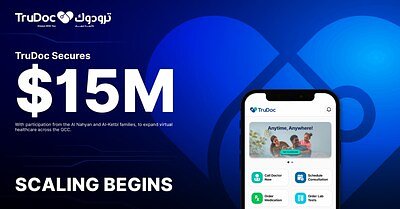
TruDoc Raises $15M to Expand Virtual Hospitals Across the GCC
DUBAI, UAE – March 05, 2026 – TruDoc Healthcare, a virtual-first healthcare platform, has secured $15 million in a Pre-Series B funding round poised to accelerate a fundamental shift in how medical care is delivered across the Gulf Cooperation Council (GCC). The investment saw significant participation from the esteemed Al Nahyan and Al-Ketbi families, alongside continued backing from existing investor Pulsar Capital, which acquired a majority stake in the company in 2023.
The capital injection is earmarked to expand what TruDoc describes as the region's largest at-home critical care program, solidifying a healthcare model that moves beyond the physical confines of clinics and hospitals. This move reflects a growing investor and governmental consensus that the future of healthcare is continuous, connected, and centered around the patient's home.
Reimagining Healthcare Beyond Hospital Walls
For decades, the healthcare paradigm has been built around large, centralized facilities. Patients traveled to hospitals for episodic care, and systems were optimized for treating acute illness rather than managing long-term health. TruDoc, with its latest funding, is aggressively challenging this legacy structure.
"For centuries, healthcare has been organised around buildings—patients moving toward facilities, systems optimised for episodic care," said Vish Narain, Executive Chairman at TruDoc and Managing Partner at Pulsar Capital. "That architecture no longer reflects how people live, age, or manage chronic disease. What TruDoc is building is healthcare as infrastructure: continuous, accountable, and designed to operate beyond four walls, at population scale."
This vision manifests in a 'full-stack' platform that integrates multiple layers of care. It begins with virtual-first primary consultations and extends to longitudinal management for chronic diseases, at-home pharmacy delivery, and mobile diagnostics. The cornerstone of this model is the 'hospital-at-home' program, which provides 24/7 telemonitoring and in-person support for high-acuity patients who would traditionally require hospitalization. Research has shown that such models can lead to better patient outcomes, including shorter recovery times and lower mortality rates, by providing intensive care in a more comfortable and less disruptive environment.
By creating a single, integrated 'Care Operating System,' the company aims to dismantle the fragmented nature of traditional healthcare, providing one accountable partner for patients, insurers, and employers. This approach promises faster medical interventions, better patient adherence to treatment plans, and a significant reduction in costly, and often preventable, hospital admissions.
"The question is no longer whether high-quality care can be delivered outside hospitals—it's how fast healthcare systems can adapt to that reality," stated Asad Khan, CEO at TruDoc. "TruDoc has shown that hospital-grade, high-acuity care can be delivered safely and effectively in homes, at scale."
Strategic Capital and a Regional Vote of Confidence
The participation of the Al Nahyan and Al-Ketbi families is more than a financial endorsement; it is a strong signal of alignment with the national strategic visions of the UAE and neighboring Saudi Arabia. Both nations are aggressively pursuing digital transformation in healthcare as part of broader economic diversification plans, aiming to build sustainable, efficient, and world-class health systems.
The telehealth market in the UAE alone is projected to surpass $500 million by 2025, with Saudi Arabia's market following a similar trajectory. This rapid growth is fueled by government initiatives like the UAE's 'Innovation Strategy' and Saudi Arabia's 'Digital Health Strategy,' which actively promote the adoption of virtual care solutions.
Dr. Ahmed Mansour, CEO of the Private Department of H.E. Sheikh Mohamed Bin Khaled Al Nahyan, highlighted this strategic alignment. "Healthcare systems everywhere are being asked to do more—serve more people, manage more chronic disease, and deliver better outcomes—without endlessly expanding physical infrastructure," he said. "TruDoc represents a fundamentally different approach: one that scales access and efficiency while maintaining clinical integrity. This model is well aligned with the UAE's long-term priorities."
This local investment underscores a trend of regional capital fueling homegrown technological innovation. Instead of importing models from abroad, GCC investors are empowering local companies to build solutions tailored to the region's unique demographic and healthcare challenges, establishing the Gulf as a potential global leader in digital health infrastructure.
The Competitive Edge in a Patient-Centric Future
While the telehealth market is becoming more crowded, TruDoc aims to differentiate itself through the depth and integration of its services. Its claim to operate the GCC's 'largest at-home critical care deployment' is a key part of this strategy, moving beyond simple video consultations into complex case management. This is evidenced by its implementation of the hospital-at-home model in Saudi Arabia in collaboration with Johns Hopkins Aramco Healthcare.
Further strengthening its clinical capabilities, TruDoc recently acquired Wellthy Therapeutics, a leading virtual chronic disease management company. This move bolsters its ability to support a significant patient population—those with chronic conditions like diabetes and hypertension who account for a large portion of healthcare costs. By providing continuous monitoring and proactive interventions, the platform helps these patients manage their health more effectively from home.
The ultimate goal is to create a proactive, predictive, and personalized healthcare experience. The company plans to use the new funding for product innovation, including a 'Super Health App' that could leverage AI and facial-scan technology to monitor vital signs. For patients, this translates into a future where healthcare is not a destination but a constant, accessible companion, improving quality of life and providing peace of mind for individuals and their families across the region.