
- 96 years: The Natural Resources Transfer Agreements (NRTA) have been in place since 1930, forming the legal basis for provincial control over resources on Treaty lands.
- Trillions of dollars: The wealth generated from resource extraction under the NRTA, while First Nations have been excluded from economic benefits.
- 1927 rejection: Treaty leaders explicitly rejected the NRTA proposal three years before its enactment, highlighting a historical lack of consent.
Experts in Indigenous rights and constitutional law would likely conclude that the NRTA's implementation without Treaty Nations' consent constitutes a violation of Crown-Treaty relationships and that its repeal is necessary to rectify historical injustices and ensure economic stability in the Prairies.
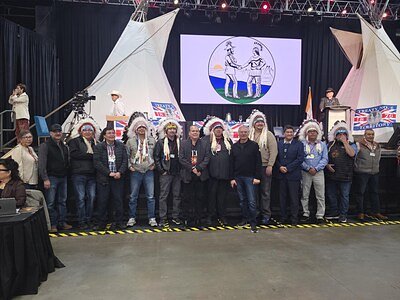
Treaty Chiefs Demand Repeal of 96-Year-Old Resource Pacts
MASKEKOSIHK, TREATY NO. 6 TERRITORY, AB – April 02, 2026 – In a powerful and unified display of sovereignty, Treaty Chiefs from across the Canadian Prairies have issued a formal demand for the complete repudiation of a nearly century-old constitutional agreement, warning of significant economic instability if federal and provincial governments fail to act. Gathered at the Enoch Cree Nation in Treaty No. 6 territory, the leaders called for immediate nation-to-nation talks to address the 1930 Natural Resources Transfer Agreements (NRTA), which they argue illegally stripped First Nations of their jurisdiction over lands and resources.
The assembly, titled "Unfinished Business – A National Assembly of Treaty Chiefs on the Constitutional Future of the NRTA," brought together leaders, Elders, and youth to challenge the legal foundations of resource extraction in Alberta, Saskatchewan, and Manitoba. Hosted by Kehewin Cree Nation, the event concluded with a clear ultimatum: the era of provinces unilaterally controlling and profiting from resources on Treaty lands must end.
A Legacy of Broken Promises
At the heart of the dispute are the Natural Resources Transfer Agreements of 1930. These agreements, entrenched in Canada's constitution, transferred federal control over Crown lands and resources to the provincial governments of Alberta, Saskatchewan, and Manitoba. This move was intended to put the Prairie provinces on equal footing with Canada's original provinces. However, historical records show this transfer was executed without the consent of, or consultation with, the Treaty Nations who had signed foundational agreements with the Crown.
First Nations leaders point out that their ancestors never surrendered their rights to the resources beneath the soil or the wealth generated from their territories in the Numbered Treaties. In fact, Treaty leaders explicitly rejected the NRTA proposal in 1927, three years before it was enacted. Despite this, the federal government proceeded, a move that leaders today describe as a profound violation of the Crown-Treaty relationship.
"We demand justice and an end to decades of arbitrary actions by the three Prairie provinces and Canada under the Natural Resources Transfer Agreements," stated Chief Vernon Watchmaker of Kehewin Cree Nation. "The NRTA is a violation of our Treaties, dishonours the Crown–Treaty relationship, and must be declared null and void."
For 96 years, the NRTA has been the legal basis for provincial governments to manage and collect royalties from oil, gas, potash, forestry, and agriculture, generating trillions of dollars in wealth. For First Nations, it has meant the erosion of Treaty rights to hunt, fish, and trap, significant environmental degradation of their lands, and exclusion from the economic benefits derived from their own territories.
Economic Uncertainty and Investor Warnings
The Chiefs' unified stance is not merely a call to rectify historical injustices; it is a direct warning to the modern economic engines of the Prairies. Leaders are putting governments, industry, and global investors on notice that the status quo is no longer tenable and creates a climate of profound uncertainty.
"Treaty leaders are fully aware of Canada's and Alberta's actions toward domestic nation-building," said Chief Joel Mykat of Ermineskin Cree Nation. "We assert that the outstanding issues surrounding the NRTA, and the continued denial of Treaty jurisdiction, create instability and hinder economic progress. Chiefs are putting industry and investors on notice: this issue will not go away and must be addressed."
This declaration comes as the global investment community places increasing emphasis on Environmental, Social, and Governance (ESG) criteria, including the United Nations Declaration on the Rights of Indigenous Peoples (UNDRIP). UNDRIP, which is now part of Canadian federal law, emphasizes the principle of Free, Prior, and Informed Consent (FPIC) for any development affecting Indigenous lands and resources. Legal experts suggest that continued reliance on the NRTA without addressing Treaty rights could expose projects to significant legal challenges, delays, and reputational damage, making the region less attractive for capital investment.
Chief Allan Adam of the Athabasca Chipewyan First Nation, whose territory lies in the heart of Alberta's oil sands, delivered a stark message about the future of development. "No nation-building projects are possible without full Treaty recognition and a clear action plan on the NRTA. Canada and the provinces know this. If they are serious about Canada's economic future, they must come to the table and work with us on restitution and a Treaty-based path forward."
A New Path Forward: Sovereignty and Shared Prosperity
Beyond demanding the repeal of the NRTA, the Treaty Chiefs are proposing a new model for resource governance based on a true nation-to-nation relationship. They are calling for federal and provincial ministers to meet with them before the upcoming First Ministers' Meeting this summer to begin formal discussions. Central to these talks is the demand for a new framework that includes direct revenue sharing and gives Tribal leaders a seat at the table as full and equal participants in all decisions regarding resource development.
"For more than a century, Treaty lands have powered Canada and the provinces through resources such as oil, gas, wheat, lumber, and critical minerals," added Grand Chief Joey Pete. "Today, we are telling the world that any future resource development must include action on the NRTA. We demand it now, and we stand in solidarity."
This vision aligns with principles laid out in the 1996 Royal Commission on Aboriginal Peoples, which called for the recognition of an Indigenous order of government and shared jurisdiction over resources. Models for such arrangements already exist in various forms across Canada, from co-management boards for parks and wildlife to equity partnerships where First Nations become part-owners in major infrastructure projects. The Chiefs' demands seek to make this the standard, not the exception.
Grand Chief Trevor Mercredi of Treaty 8 First Nations (Alberta) emphasized that the core issue is one of inherent authority. "The Governments of Alberta, Saskatchewan, and Manitoba continue to act in blatant disregard of the legal and inherent authority of Treaty Nations over our lands," he stated. "These actions undermine the very foundations of Canada. Treaty jurisdiction and sovereignty are not negotiable, and threats to the rights and futures of First Nations will not be tolerated."
With this united front, the leaders have signaled a new chapter in their long fight for recognition and justice. They expect to reconvene within the next month to finalize a comprehensive action plan, indicating their resolve to escalate pressure until their call for a new, equitable relationship is met.