
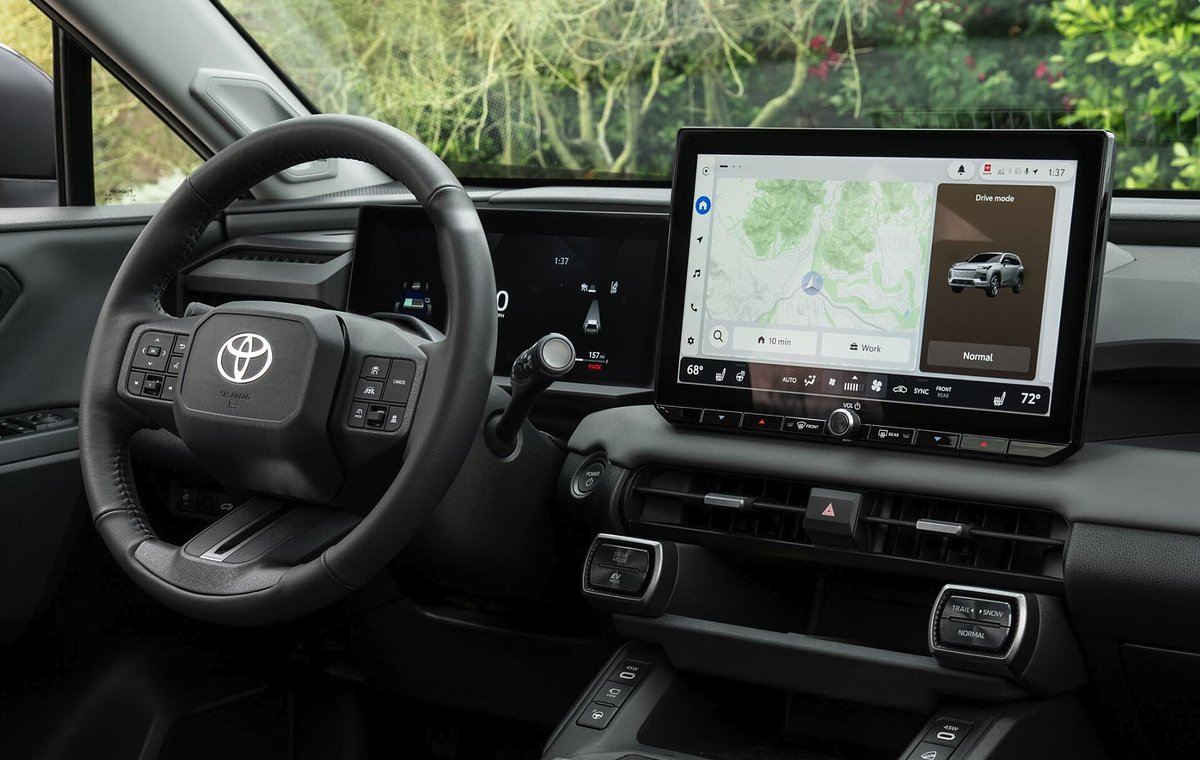
- 2026 RAV4: The new Toyota Audio Multimedia system will debut in the all-new 2026 RAV4, America's best-selling compact SUV.
- Arene OS: Toyota's proprietary 'Arene' vehicle operating system enables in-house software development and over-the-air updates.
- Mapbox Partnership: The collaboration leverages Mapbox's advanced mapping APIs and SDKs for a customizable, future-proof navigation experience.
Experts view Toyota's partnership with Mapbox and the development of the Arene OS as a strategic move to gain control over in-car software, ensuring a cohesive brand experience and the ability to rapidly deploy innovations without relying on third-party tech giants.
Toyota's Digital Overhaul: Mapbox Powers Next-Gen RAV4 Navigation
SAN FRANCISCO, CA – January 05, 2026
Toyota is set to redefine the driver's relationship with their dashboard, announcing a deepened partnership with location platform Mapbox to build its next-generation navigation system. The new Toyota Audio Multimedia system will make its debut in the all-new 2026 RAV4, America's best-selling compact SUV, before a global rollout to future models. The collaboration marks a significant strategic pivot for the automotive giant, signaling a decisive move to bring critical software development in-house and compete in the rapidly evolving world of the software-defined vehicle (SDV).
While a new navigation system may seem like a standard model-year update, this initiative is far more foundational. It represents the first customer-facing deployment of Toyota's ambitious 'Arene' vehicle operating system, transforming its cars from static hardware into upgradable, dynamic digital platforms. By leveraging Mapbox's flexible development tools, Toyota is taking direct control over the in-car user experience, an arena where automakers are increasingly battling for brand differentiation and customer loyalty.
Toyota Takes the Wheel on In-Car Software
For years, automakers have wrestled with the challenge of creating in-car technology that can rival the fluid, intuitive experience of a smartphone. Many have relied on third-party suppliers or, more recently, adopted comprehensive operating systems like Google's Android Automotive. Toyota, however, is charting a different course. The decision to develop its navigation application in-house using its proprietary Arene software platform is a declaration of digital independence.
Arene, developed by Toyota's mobility technology subsidiary Woven by Toyota, is a comprehensive vehicle operating system designed to decouple software from the underlying hardware. This allows for faster development cycles, modular feature deployment, and the ability to update vehicles long after they leave the factory floor. By building on this platform, Toyota is not just creating a map; it is architecting a future-proof ecosystem. The partnership with Mapbox is critical to this strategy, providing the advanced mapping APIs and SDKs that Toyota's engineers need to build a bespoke experience.
"When we set out to design our next-generation navigation experience, we needed a partner who could work with us on our vision to deliver ever-better in-cabin experiences for our customers," said Brian Inouye, Chief Engineer at Toyota Motor North America R&D. "With Mapbox, we are excited for drivers to experience a new level of utility, performance, and detail within the 2026 Toyota RAV4."
This move mirrors a broader industry trend where a vehicle's value is increasingly defined by its software capabilities. By owning the software stack, Toyota can ensure a cohesive brand experience, control valuable vehicle data, and rapidly deploy innovations without being beholden to the development timelines of external tech giants.
A Revolution in the Digital Cockpit
The most immediate impact for drivers will be a navigation experience that is both visually stunning and highly functional. The new system leverages Mapbox's advanced rendering technologies to display maps with dynamic lighting, rich textures, and 3D building data, creating a more detailed and immersive world. Using Mapbox Studio, a powerful design tool, Toyota's design teams can create customized map styles that seamlessly match the unique aesthetic of each vehicle's digital cockpit.
The centerpiece of this new user experience is a first for Toyota's lineup: full-screen maps in the Digital Meter. This feature places dynamic, turn-by-turn directions directly in the driver's line of sight, just behind the steering wheel, minimizing distraction and enhancing navigational clarity. It's a direct answer to one of the primary advantages of smartphone-based navigation and a significant leap forward from traditional infotainment displays.
This focus on a high-performance, visually rich interface is a clear attempt to solve the historical pain points of built-in navigation systems, which have often been criticized as clunky, slow, and having outdated maps compared to their smartphone counterparts. The result is an intuitive, built-in experience designed to make navigation easier and more delightful.
"We're thrilled to work hand-in-hand with Toyota and its partners to bring its next-generation navigation vision to life," said Peter Sirota, CEO of Mapbox. "Together, we're setting a new standard, using our cloud-first location platform to create a driving experience that's more responsive, customizable, and future-ready."
Navigating a Competitive Landscape
Toyota's strategy places it in a fascinating position within the competitive automotive landscape. While rivals like General Motors, Ford, and Volvo are increasingly embracing Google's Android Automotive OS with Google Automotive Services (GAS)—integrating Google Maps and Google Assistant directly into the car—Toyota is choosing a more proprietary path. This approach allows the company to avoid ceding control of the user interface and valuable data to a third party.
This is not to say Toyota is alone. Other automakers, like BMW, have also pursued a hybrid strategy, using elements of Android Automotive's open-source base but building their own services on top, often in partnership with specialists like Mapbox. This allows them to maintain brand identity and control over the digital experience. By selecting Mapbox, a platform known for its developer-first flexibility, Toyota gains a powerful toolkit without handing over the keys to its entire digital kingdom.
The race is on to define the car of the future, and the central battleground is the software that runs it. Toyota's investment in Arene and its strategic partnership with Mapbox is its definitive play in this high-stakes game, betting that a custom-built, seamlessly integrated experience will ultimately win over consumers.
Beyond the Dealership: The Power of Over-the-Air Updates
Perhaps the most transformative aspect of this new architecture is its native support for over-the-air (OTA) updates. Because the system is built with Mapbox SDKs designed for continuous deployment, Toyota can deliver innovations, bug fixes, and feature enhancements directly to vehicles wirelessly. This fundamentally changes the car ownership model.
Instead of a vehicle's technology becoming progressively obsolete, it can now evolve and improve over time. An update could enhance map details, improve routing algorithms, or introduce entirely new functionalities without a single trip to the dealership. This capability is crucial for maintaining vehicle relevance and customer satisfaction over a longer lifespan, potentially boosting long-term loyalty and resale value.
As the industry shifts towards a future where a significant portion of a vehicle's value is tied to its software, the ability to keep that software current is paramount. For the owner of a 2026 RAV4, this means the navigation system they use in 2028 could be significantly more advanced than the one they had on day one. This move firmly positions Toyota alongside EV pioneers like Tesla and other modern automakers who treat the car as an evolving connected device, ensuring its vehicles remain at the cutting edge of technology for years to come.