
- 3-year pilot program: Testing water-based transit across Toronto's Inner Harbour, starting June 2026.
- 12-person capacity: Water taxis will accommodate bicycles, with fares expected to be around $13 one-way.
- Population growth: Waterfront resident population projected to rise from 76,000 to 119,000 by 2051.
Experts view the water shuttle pilot as a promising but modest first step toward integrating water-based transit into Toronto's mobility network, with cautious optimism about its long-term viability as a congestion solution.
Toronto Launches Water Shuttle Pilot to Connect Growing Waterfront
TORONTO, ON – April 07, 2026 – Toronto is set to embrace its waterfront in a new way with the launch of the East-West Water Shuttle Pilot, a three-year initiative designed to test the viability of water-based transit across the city's Inner Harbour. Waterfront Toronto, in partnership with the City of Toronto and the Toronto Port Authority, announced today that veteran operator York Bay Marine Services has been selected to run the seasonal service, scheduled to begin in June 2026.
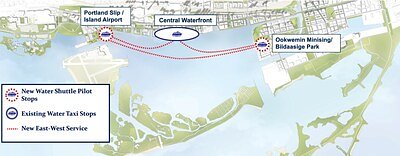
The pilot program aims to create new connections between the city's rapidly developing eastern and western waterfronts. The shuttle will operate between three key stops: a new dock at Ookwemin Minising in the Port Lands, providing access to the new Biidaasige Park; the existing slip at the foot of Yonge Street; and a new stop at Portland Slip, connecting the western waterfront and Billy Bishop Toronto City Airport. This initiative represents a tangible step toward realizing a long-held vision of a more integrated and accessible harbour, similar to those in other major global cities.
"Toronto's waterfront is growing fast, and we need new ways to help people move across it," said Mayor Olivia Chow. "This water shuttle pilot is about building a more connected city, linking communities from the Port Lands to the western waterfront and making it easier for people to get where they need to go. We are investing in practical, innovative solutions that expand transit options, reduce congestion, and open up our harbour for everyone to enjoy."
A New Wave of Connectivity
Operating from June through September for its initial three-year term, the shuttle service will be managed by York Bay Marine Services (YBM), a company with over two decades of experience in Toronto Harbour. YBM currently manages several key waterfront facilities, including the Toronto Island Marina and the Island Yacht Club, bringing a wealth of operational knowledge to the project. The pilot will utilize standard 12-person water taxis, with the capacity to accommodate bicycles, to gauge public interest and operational demands.
The project is a direct outcome of the 2020 Marine Use Strategy, a long-term roadmap focused on creating "more connections to more destinations." This strategy envisions a harbour that balances diverse uses while making it easier for residents and visitors to access the water.
"Rooted in our Marine Use Strategy's vision... the East-West Water Shuttle Pilot is an exciting step toward realizing the full potential of Toronto's harbour," stated George Zegarac, President and CEO, Waterfront Toronto. He added that the pilot will help officials "better understand how water-based transit can serve Toronto's growing waterfront for generations to come."
The project also features an inclusive model, allowing other water taxi operators to use the new docking infrastructure at Ookwemin Minising and Portland Slip. This approach could allow for a natural scaling of service if demand exceeds the initial capacity, fostering a more dynamic and responsive waterfront transit ecosystem.
Testing the Waters for a Future Network
While the pilot itself is a modest first step, it is rooted in ambitious long-term planning. The service emerged as a key recommendation from the 2026 Sea Bus Feasibility Study, which analyzed the potential for a full-scale, fixed-route marine transit network. The study highlighted the dramatic growth projected for the waterfront, with the resident population along the five-kilometre stretch from Ontario Place to the Port Lands expected to grow from 76,000 to over 119,000 by 2051. Annual visitor trips are projected to nearly double to 115 million in the same period.
The study concluded that while a large-scale, commercially self-sustaining seabus network is not yet feasible—largely because major residential and commercial developments are still under construction—it could potentially break even by 2035. The current pilot is therefore a crucial data-gathering exercise. It will provide real-world insights into ridership patterns, operational hurdles, and the public's appetite for water travel, information that will be vital for planning a more robust system.
However, some experts advise cautious optimism. While the scenic route offers a unique experience, its immediate impact on the city's broader congestion issues may be limited. Steven Farber, director of the University of Toronto Mobility Network, has suggested that a seabus system might currently be more of a "nice to have" recreational and tourism-focused service rather than a primary tool for congestion relief, given the initial ridership projections.
The Economics of Water Transit
The pilot is being launched with a lean financial model. While the City of Toronto is contributing $100,000, likely for initial infrastructure support, officials have indicated that the ongoing operation will not require a direct public subsidy. Fares, which will be announced in the coming months, are expected to be comparable to the roughly $13 one-way fee charged by existing water taxis serving the Toronto Islands. For the service to evolve into a true public transit option, future integration with the Presto fare system is seen by many as a critical next step.
The potential economic ripple effects are a key driver for the project's partners. Improved accessibility is expected to provide a significant boost to waterfront businesses and attractions. The Waterfront Business Improvement Association (BIA) has expressed excitement, noting that a reliable water link will increase both tourism and local visits to the area.
"The Toronto Port Authority is a strong advocate for transportation on the water, and we're proud to partner on this exciting pilot," said RJ Steenstra, President and CEO, Toronto Port Authority. He pointed to the success of water transit in cities like Vancouver, Sydney, and London as a model for enhancing multi-modal access and addressing congestion. Bill Duron, Chair of York Bay Marine Services, echoed this sentiment, stating his company's confidence that "people's use of this new downtown transportation network" will complement land-based alternatives as the waterfront community grows.
Charting a Course with Global Cities
Toronto's foray into water transit places it alongside numerous other international cities that have successfully leveraged their waterways. From Istanbul's bustling Bosphorus ferries to Brisbane's fully integrated CityCat service, the global lesson is clear: success hinges on seamless integration with the broader public transportation network. For a water shuttle to become more than a novelty, users must be able to easily transfer to and from buses, streetcars, and subways.
This pilot is not happening in a vacuum. It is designed to complement the largest transit investment in the area's history: the $3-billion Waterfront East LRT. This light rail line will eventually connect Union Station to the Port Lands, unlocking new neighbourhoods and serving a projected 150,000 people. The water shuttle pilot can be seen as an early, flexible layer of connectivity that can operate while this more permanent infrastructure is built. It offers an immediate solution to bridge gaps in the waterfront's east-west connections, providing a scenic and practical alternative to navigating construction and traffic on land. As the waterfront continues its transformation, this small fleet of boats may prove to be the first wave of a new era in Toronto's urban mobility.