
- 2029: Target year for mass production of Holographic Windshield Displays (HWD).
- 10,000 nits: Superior brightness of the HWD technology, ensuring clarity in direct sunlight.
- 92% transparency: The HWD maintains high visibility while displaying information.
Experts view the QuadAlliance's collaboration as a strategic and technically sound approach to accelerate the industrialization of holographic windshield displays, potentially revolutionizing in-car driver interfaces by 2029.
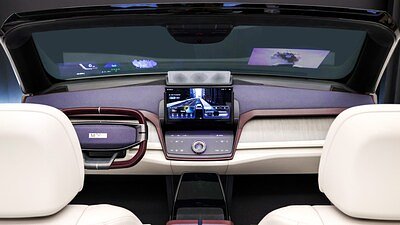
Titans of Tech Forge Alliance for Holographic Car Windshields
JENA, Germany – February 03, 2026 – The science fiction of a fully interactive, holographic car windshield is moving a significant step closer to reality. Four industrial powerhouses—ZEISS, tesa, Saint-Gobain Sekurit, and Hyundai Mobis—have announced the formation of a 'QuadAlliance,' a strategic partnership aimed at accelerating the mass production of Holographic Windshield Displays (HWD).
This collaboration creates an end-to-end supply chain designed to streamline the complex process of turning a standard vehicle windshield into a dynamic, transparent smart screen. By pooling their expertise in optics, materials science, automotive glazing, and system integration, the alliance intends to have this next-generation technology ready for mass production by 2029, potentially transforming the driver's relationship with their vehicle and the road.
Beyond the Dashboard: A New Vision for Driving
Current in-car display technology, from small head-up displays (HUDs) to more advanced augmented reality (AR-HUD) systems, has sought to place critical information in the driver's line of sight. However, these systems are often limited by a small projection area, packaging constraints within the dashboard, and image quality that can suffer in bright daylight. The QuadAlliance's HWD technology aims to leapfrog these limitations entirely.
Instead of projecting onto a small section, the technology embeds a Holographic Optical Element (HOE) within the windshield's laminated glass, effectively turning a vast portion of the glass into a high-resolution display. This promises an ultra-large, full-color interface that can show navigation, vehicle status, and infotainment content without requiring the driver to look away from the road. The alliance claims the technology delivers superior brightness of over 10,000 nits, ensuring clarity even in direct sunlight, with a transparency of over 92% so that the driver's view remains unobstructed.
Furthermore, the system architecture offers unparalleled design freedom for automakers. The projection unit (PGU) is remarkably compact—less than 1.5 liters in volume—and can be placed flexibly within the vehicle's interior, a significant advantage over the bulky hardware required for many current AR-HUDs. This allows for cleaner, less cluttered cockpit designs and easier adaptation to various vehicle models, including those with steeply raked or curved windshields. With support for 4K resolution and beyond, the system is designed to be future-proof, evolving alongside projection technology.
A Blueprint for High-Tech Industrialization
Bringing a technology as complex as HWD from the laboratory to the highway is a monumental task fraught with technical, manufacturing, and logistical challenges. The formation of the QuadAlliance is a strategic move to de-risk this process by creating a cohesive, ready-to-deploy supply chain for automotive original equipment manufacturers (OEMs).
Each partner brings a critical and distinct piece of the puzzle:
- ZEISS: The German optics and photonics leader provides the foundational intellectual property. With decades of experience in holography, ZEISS is responsible for the optical design and the creation of the master hologram, the intricate template from which all subsequent holographic films are derived.
- tesa: A global leader in adhesive solutions and functional films, tesa's role is to solve the challenge of scale. It will use its expertise in precision roll-to-roll manufacturing to reliably and cost-effectively replicate the master hologram onto vast quantities of automotive-grade film.
- Saint-Gobain Sekurit: As a world leader in automotive glazing, this partner tackles the crucial integration step. Its expertise is essential for seamlessly laminating the delicate holographic film inside the layers of a windshield, ensuring it meets stringent global standards for safety, durability, and optical clarity.
- Hyundai Mobis: The system integrator of the group, Hyundai Mobis develops the Projection Generating Unit (PGU) and the Human-Machine Interface (HMI). It ensures the projected images are bright and clear and that the entire system works intuitively within the vehicle's electronic architecture.
This collaborative model represents a new blueprint for bringing deeply technical innovations to the automotive market, where reliability, scale, and cost are paramount.
The Race to Redefine the Cockpit
While the QuadAlliance presents a powerful front, it does not operate in a vacuum. The race to own the next-generation automotive cockpit is fierce. Established Tier 1 suppliers like Continental and Bosch are already supplying sophisticated AR-HUDs to major OEMs. Meanwhile, specialized deep-tech companies like Switzerland's WayRay are also focused exclusively on holographic AR displays, having already attracted investment from automakers.
The alliance's 2029 target for mass production is ambitious but reflects the long development cycles in the automotive industry. Success will depend on overcoming several significant hurdles. The first is cost. HWD technology is expected to debut as a premium feature in luxury vehicles, potentially adding thousands of dollars to a car's sticker price. Proving its value proposition over increasingly capable, lower-cost AR-HUDs will be critical for widespread adoption.
Secondly, regulatory compliance is non-negotiable. Windshields are a critical safety component, and any technology integrated within them must pass a battery of global tests, including those governed by standards like UNECE R43 and FMVSS 205, which dictate optical clarity, distortion, and impact resistance. The inclusion of Saint-Gobain Sekurit is a clear strategic move to address this challenge head-on.
In the press announcement, Dr. Roman Kleindienst, Head of ZEISS Microoptics, framed the development in historical terms. "Over the past decade, we have achieved a 'Gutenberg Moment' for HOE mastering and replication process, making holography ready for mass-market applications," he stated. "Now, by driving the formation of a holographic ecosystem through the QuadAlliance, we aim to cultivate the best technology and supply chain synergy to streamline HWD industrialization."
The alliance has stated that its partnership is not intended to be exclusive, acknowledging that OEMs value flexibility in their supply chains. However, by presenting a unified, pre-vetted solution from four industry leaders, the QuadAlliance is placing a powerful bet that its integrated approach offers the fastest and most reliable path for automakers to bring the future of in-car displays to their customers.