
- Patient Age: 8-month-old infant weighing 5.5 kg
- Survival Rate: India's top centers report one-year survival rates of over 90% for liver transplants
- Cost: Liver transplant in India costs ₹15 to ₹35 lakhs
Experts highlight this successful transplant as a testament to advanced pediatric surgical capabilities in India, emphasizing the critical role of living donors in overcoming organ scarcity and achieving world-class outcomes even in highly complex cases.
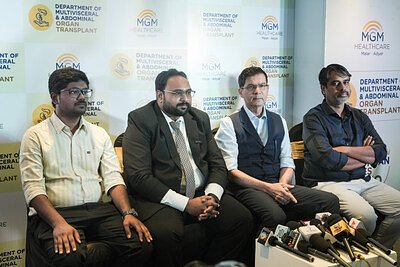
Tiny Patient, Giant Leap: Inside an 8-Month-Old's Liver Transplant
CHENNAI, India – March 02, 2026 – In a remarkable display of surgical skill and parental love, a team of doctors at MGM Healthcare Malar, Adyar, has successfully performed a life-saving liver transplant on an 8-month-old infant weighing a mere 5.5 kilograms. The child, who was battling a severe congenital liver condition, received a portion of a new liver from his own father, who served as a living donor in the high-stakes procedure.
The infant was diagnosed with Extrahepatic Biliary Atresia (EHBA), a rare disease of the liver and bile ducts that occurs in infants. His condition had become critical, leading to a cascade of severe complications including chronic liver disease, fluid accumulation in the abdomen (ascites), recurrent infections, severe jaundice, and a failure to gain weight. For the medical team, it was a race against time.
The Medical Challenge
Performing a liver transplant on any infant is a formidable task, but the patient's young age and low body weight presented an extreme level of complexity. Transplant surgeons face immense technical difficulties in such cases, where delicate blood vessels can be as small as one or two millimeters in diameter, demanding microscopic precision to ensure blood flow to the new organ. Furthermore, an infant's immature immune system requires a carefully calibrated approach to post-operative care to prevent both organ rejection and life-threatening infections.
Typically, medical teams might wait for a child to gain more weight before attempting such a major surgery. However, the infant's rapidly deteriorating health made immediate intervention a necessity.
"Performing a liver transplant on such a young and underweight child is extremely challenging," said Dr. Anil Vaidya, MD, Chair and Director of the Institute of Multi-Visceral and Abdominal Organ Transplant at MGM Healthcare Malar, Adyar. "Typically, we wait for the child to gain weight, but given the severity of his condition, immediate action was necessary. Thanks to the dedication and coordination of our multidisciplinary team, the surgery was successful, and the child is now recovering well."
A Father's Gift and a Team's Precision
The decision to proceed was made possible by the infant's father, who stepped forward to donate a portion of his own liver. Living donor liver transplantation (LDLT) is a critical solution in pediatric care, especially in a country like India where the scarcity of deceased donor organs for children is a major hurdle. This selfless act provided a perfectly matched graft, bypassing the long and uncertain wait for a deceased donor organ.
The intricate procedure was the culmination of meticulous planning by a large, multidisciplinary team. The surgical effort was led by Dr. Vaidya, a globally recognized multi-organ transplant surgeon with over three decades of experience, including pioneering work in the UK and the United States. His team included transplant specialists Dr. Senthil Muthuraman and Dr. Venkatesh BS. They were supported by a dedicated anaesthesiology team led by Dr. Dinesh Babu and Dr. Saravanan, and a robust pediatrics and neonatology unit including Dr. Arun Kumar and Dr. NKV Vigneshwar, alongside medical gastroenterology specialist Dr. Kavitha Sampathkumar. This collaborative approach ensured every phase of the operation, from donation to transplantation and post-operative care, was seamlessly managed.
"We are immensely proud to have achieved this rare and complex milestone," stated Mr. Venugopal Bhat, COO & Vice President – Group Strategic Initiatives at MGM Healthcare Malar, Adyar. "This successful surgery reflects the seamless coordination of our multidisciplinary teams and demonstrates that critical pediatric liver conditions can be managed effectively with expert care and timely intervention."
A Milestone in India's Transplant Journey
This successful transplant is more than a single medical victory; it is a significant marker of India's advancing capabilities in the highly specialized field of pediatric organ transplantation. India has emerged as a regional hub for liver transplants, with top centers reporting one-year survival rates of over 90%, comparable to the best international standards. This achievement at the Chennai hospital reinforces that position, proving that world-class outcomes are possible even in the most challenging pediatric cases.
However, the success story also casts a light on the broader challenges within the country's organ transplant landscape. India's deceased organ donation rate remains critically low, at approximately 0.52 per million population, creating a vast gap between the number of patients in need and the availability of organs. This shortage is particularly acute for pediatric patients who require size-specific organs.
In this context, the expertise in living donor transplantation demonstrated in this case is not just an alternative, but a vital lifeline. It showcases how specialized centers are innovating to save lives despite systemic challenges, pushing the frontiers of what is medically possible.
The Path to Recovery and a New Beginning
For the infant and his family, the successful surgery marks the beginning of a new, albeit challenging, chapter. The road to recovery from a liver transplant is a long one, requiring lifelong management. The child will need to take immunosuppressive medications for the rest of his life to prevent his body from rejecting the new liver. This requires a delicate balance, as the medication also makes him more vulnerable to infections, demanding constant vigilance from his family and medical team.
Beyond the medical complexities lies the significant financial and emotional burden on families. A liver transplant in India can cost upwards of ₹15 to ₹35 lakhs, an amount beyond the reach of most citizens. While government schemes like Ayushman Bharat and support from non-profit organizations offer a safety net for some, many families resort to crowdfunding and personal loans to cover the immense costs of surgery and long-term care.
As the infant continues his recovery under the close observation of the multidisciplinary ICU teams at MGM Healthcare Malar, his steady improvement offers a powerful symbol of hope. His journey represents the convergence of a father's love, the pinnacle of medical expertise, and the resilience of the human spirit against overwhelming odds, granting a new lease on life to one of the hospital's smallest and most vulnerable patients.