
- $4,437: Average additional home value gain in winning cities post-Super Bowl (Zillow analysis).
- 65%: Percentage of time winning cities' housing markets outperformed the U.S. average.
- $25,262: Tampa's post-championship home value surge above the national average (2021).
Experts agree that while a Super Bowl win may correlate with short-term home value increases, economic fundamentals—not sports victories—drive long-term real estate trends.
The Super Bowl Home Value Bump: A Winning Myth?
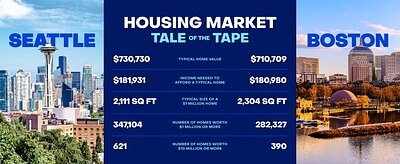
SEATTLE, WA – February 03, 2026 – As football fans in Boston and Seattle brace for this weekend's championship clash, the traditional spoils of victory—a parade, bragging rights, and a gleaming trophy—are top of mind. However, a new analysis from real estate giant Zillow suggests another potential prize for the winning city: a boost in home values.
The intriguing report finds that in 13 of the past 20 years, the metro area that won professional football's biggest game saw its home values grow faster than the U.S. average in the year that followed. The study claims the typical home in a championship market gained, on average, an additional $4,437 in value compared to the national benchmark. But while the correlation is fascinating, experts caution homeowners against banking on a championship to boost their equity.
The Championship Correlation
According to Zillow's data, some cities have seen significant post-championship gains. After its team's victory in February 2021, the Tampa metro area experienced a remarkable surge, with home values rising $25,262 more than the national average over the next year. Similarly, Denver's 2016 title was followed by a housing market that outpaced the country by $21,459, while Boston's 2017 win preceded an additional $15,565 in growth for local homeowners.
Over the two-decade span analyzed, the winning city's housing market has beaten the U.S. average 65% of the time. However, even the company behind the analysis urges caution. The press release includes a crucial dose of reality from its own expert.
"While this is a fun trend, it's highly unlikely that a championship football team is the driving force causing home values to grow," said Zillow Senior Economist Kara Ng in the release. "A win on the field brings bragging rights, but unfortunately won't boost your Zestimate."
This sentiment is widely shared among independent economists, who argue that such correlations, while statistically interesting, often mask the true, more complex forces shaping regional real estate markets.
Correlation Is Not Causation
A closer look at the cities that saw the biggest post-championship bumps reveals that their housing markets were often already primed for growth due to strong economic fundamentals. The trophy, it seems, was more of a cherry on top of a robust economic sundae.
Consider Denver in 2016. In the year following the win, the Denver Housing Market Area was already experiencing powerful economic momentum. From 2015 to 2016, the region added over 42,000 nonfarm payroll jobs, a growth rate of 3.1%. Major infrastructure projects, like the expansion of the FasTracks light rail system, were fueling a construction boom. This combination of job growth and investment created a tight housing market where demand was already outstripping supply, pushing prices upward regardless of what happened on the football field.
Likewise, Boston's outperformance after its 2017 victory occurred against a backdrop of rapid population and economic expansion that had been building for years. While the rate of home value increase had begun to decelerate slightly from its peak in 2016, the city's powerful economic engine, which added over 32,000 jobs in 2017, was the true driver of its high-flying real estate market.
When the Trophy Fails to Lift the Market
Perhaps more telling are the instances where a championship win was followed by underperformance in the housing market. These cases starkly illustrate how major macroeconomic forces can easily overwhelm any potential 'championship effect.'
The most dramatic example is New York after its 2008 championship. In the year that followed, the typical home value in the metro area fell by a staggering $15,741 more than the national average. Of course, 2008 was not just any year; it was the epicenter of the Global Financial Crisis, triggered by a nationwide housing bubble collapse. With the nation's financial system in turmoil and the housing market in freefall, a sports victory was powerless to reverse the powerful economic tide.
More recently, Los Angeles saw its home values grow, but by $8,763 less than the national average in the year following its 2022 championship. This underperformance wasn't due to a lack of civic pride but rather a direct consequence of soaring mortgage interest rates. As rates climbed from around 3% to nearly 7% in 2022, housing affordability plummeted. This financial pressure effectively slammed the brakes on the market, cooling demand and slowing price appreciation despite the city's newly acquired football crown.
The Real Economics of Civic Pride
No one denies the 'feel-good factor' that a championship brings. The surge of civic pride, unity, and positive sentiment is a real and valuable social benefit. This boost in morale is often cited by team owners and city officials as a key justification for public investment in teams and stadiums. However, translating that pride into measurable, widespread economic gain is another matter entirely.
Independent economic studies have consistently found that sports teams and mega-events have a limited or negligible direct impact on local economies, including home values. While a new stadium might spur localized development and increase property values in its immediate vicinity, these benefits are often not distributed evenly and can be offset by the high cost of public subsidies. The consensus among many urban planners and economists is that while sports foster community involvement, foundational factors like job growth, income levels, housing supply, and interest rates remain the primary determinants of a region's real estate health.
Ultimately, the Zillow analysis serves as a clever piece of data-driven storytelling—a marketing play that strategically uses a fun, timely correlation to capture public attention. By packaging its data in a narrative that connects with a massive audience of sports fans, the company reinforces its brand as a data authority and generates media buzz, all while wisely including its own disclaimer. It’s a playbook that scores points for engagement, even if the core premise doesn't hold up to economic scrutiny. For homeowners in Boston and Seattle, enjoying the game may be the best bet; their home's long-term value will depend on economic fundamentals, not the final score.