
- 80% market share: Linkerbot dominates the global high-DOF dexterous robotic hand market.
- 4,000 units/month: The company's production capacity for dexterous hands.
- $1,000 price point: The O6 model costs roughly one-tenth of competitors' comparable products.
Experts would likely conclude that Linkerbot's engineering breakthroughs and vertically integrated manufacturing have revolutionized the dexterous robotics market, making advanced automation accessible and scalable for industries worldwide.
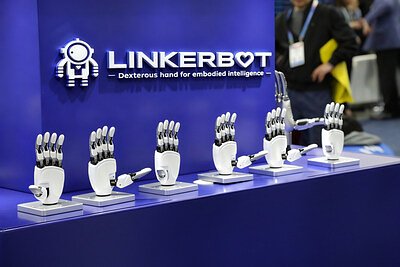
The Silent Grip: How Linkerbot Seized the Dexterous Robot Market
LAS VEGAS, NV – January 08, 2026 – The floors of CES 2026 are alive with the whir of servos and the spectacle of humanoid robots taking tentative steps into the future. But away from the crowds mesmerized by walking gaits, a far more immediate and impactful revolution in robotics is being solidified. Linkerbot, a company focused on what has long been one of robotics' grand challenges—dexterous manipulation—is not just demonstrating a future concept; it's showcasing a present-day market dominance that has quietly reshaped an entire industry sector.
With the unveiling of its complete Linker Hand product line and the astonishing "Linker Craftsman" self-manufacturing workstation, the company has laid bare a strategy that has allowed it to capture a staggering 80% of the global high-degree-of-freedom (DOF) dexterous robotic hand market. This isn't about chasing hype; it's about delivering tangible, high-value automation at an unprecedented scale and cost.
An Unseen Revolution in Production
While competitors struggle with bespoke, high-cost models and lengthy production timelines, Linkerbot has achieved what was once considered impossible in this niche: mass production. The company is now the only one in the world capable of producing high-DOF dexterous hands at a rate of thousands of units per month, with reports indicating a capacity to ship over 4,000 units in a single month. This industrial prowess has enabled the company to ship its 10,000th dexterous hand, with ambitious goals to deliver between 50,000 and 100,000 units in the coming year.
This scale is achieved through a vertically integrated manufacturing process across four proprietary factories. By controlling every step, from the in-house development of micro-reducers to final assembly, Linkerbot maintains assembly tolerances at the micrometer level. The result is a 95% improvement in consistency and a radical compression of delivery cycles. Customers who once waited over three months for a competitor's product can now receive a Linkerbot hand in just two weeks—a six-fold acceleration that is upending supply chain expectations.
This operational efficiency directly challenges the established robotics landscape, where advanced components are often synonymous with long waits and exorbitant prices. By solving the production problem first, Linkerbot has positioned itself not just as a technology leader, but as a reliable industrial partner.
Engineering the Impossible: Power, Precision, and Price
The foundation of Linkerbot's market control is a series of engineering breakthroughs that defy previous industry trade-offs between performance, weight, and cost. The star of its CES exhibit is the Linker Hand O6, a marvel of power density. Weighing a mere 370 grams—about the same as a can of soup—the hand can securely grip and lift a 50-kilogram payload. This power-to-weight ratio, equivalent to an egg lifting a full-grown adult, is more than double the industry standard.
This feat is made possible by a unique combination of PEEK, a high-performance engineering polymer, and proprietary, house-made micro-reducers. The innovation doesn't just make the hand strong; it makes it affordable. The O6 model is priced at under $1,000, a figure that is roughly one-tenth the cost of comparable products from competitors like the UK-based Shadow Robot Company. This aggressive pricing strategy is democratizing access to advanced robotic manipulation, putting it within reach of small and medium-sized enterprises, university labs, and startups for the first time.
Linkerbot’s portfolio demonstrates remarkable versatility, extending from the lightweight O6 to the industrial-grade L20. The L20 features a proprietary "Super Electric Cylinder" that achieves 90% drive efficiency and a screw-end thrust of 200N, tested for a lifespan exceeding one million cycles. This ensures that the company’s offerings can handle everything from threading a needle with sub-millimeter precision to hoisting heavy industrial components, all within a single, scalable product ecosystem.
From Self-Replication to Self-Evolution
Perhaps the most forward-looking demonstration at Linkerbot's booth is the "Linker Craftsman" workstation. Here, two robotic arms, each equipped with dexterous L20 hands, autonomously perform the entire assembly process for new robotic arm modules. In a stunning display of automation's ultimate promise, Linkerbot's robots are building more robots.
The company is quick to point out that this is not a contrived demo but "production reality." This capability represents a monumental shift from self-replication to what the company calls "self-evolution." The machines are not just copying themselves; they are part of an integrated system that can learn, adapt, and improve the very means of its own production. It's a closed-loop manufacturing ecosystem that promises to accelerate innovation and drive down costs even further, creating a virtuous cycle of automated production.
This concept moves robotics beyond a tool for executing human-programmed tasks and toward a future of truly autonomous, flexible factories capable of reconfiguring and improving themselves without direct human intervention.
Learning from the Real World
Underpinning Linkerbot's hardware is a sophisticated and pragmatic approach to artificial intelligence. Instead of relying solely on digital simulations for robot training, the company has invested heavily in building LinkerSkillNet, the world's largest human skill library built entirely from real-world physical data. The company's philosophy is clear and direct.
"Simulators can't replicate subtle friction variations or reproduce the human finesse of handling fragile objects without breaking or dropping them," Linkerbot stated in its announcement. "Our robotic hands are trained in the real world."
This strategy allows the robots to master complex, delicate tasks that have long been challenging for automation. The system has already mastered over 500 distinct skills, from intricate assembly to gentle material handling. This real-world capability has attracted a roster of blue-chip clients, including Samsung, Siemens, and Foxconn, who are deploying the technology to solve urgent industrial challenges. Furthermore, the technology is being used in top research institutions like MIT, Stanford, and Cambridge, fueling the next wave of discovery in embodied AI. By creating a system that learns from physical interaction, Linkerbot is ensuring its robots are not just intelligent in theory, but effective in practice.