
- Military-affiliated households have 3x more retirement savings than civilians
- 28% of active-duty families report low or very low food security
- Military spouses face 4x higher unemployment rates than civilians
Experts agree that while military families enjoy structural financial benefits, systemic challenges like frequent relocations, spouse unemployment, and high living costs near bases create significant financial strain that requires targeted policy and support interventions.
The Paradox of Service: Military Finances Face Pressure and Prosperity
SAN ANTONIO, TX – May 11, 2026 – A landmark report released today paints a complex and often contradictory picture of the financial health of America’s military community. While service members and their families often boast higher median incomes and more substantial retirement savings than their civilian counterparts, they simultaneously grapple with unique and relentless financial pressures that erode their economic stability. The inaugural ‘State of Personal Finance in the Military Community Report’ by The USAA Educational Foundation reveals a tale of two realities, where the structural benefits of military life are consistently challenged by the high costs of service.
Frequent relocations, staggering rates of spouse unemployment, and inflated living costs near military installations create what the report calls predictable “pinch points” that strain household budgets. These challenges can transform financial advantages into a daily struggle, particularly for younger enlisted families and those transitioning out of the service.
“This report reflects the financial realities of military life as our service members live it, where we can see financial strain among many families and the positive impacts that financial readiness can have,” said David Evetts, President of the USAA Educational Foundation. He highlighted the dual nature of the findings, noting that while data shows the “positive economic impacts of military service,” there is a pressing need to address persistent issues to maximize well-being. “Together, we can turn these insights into action that helps military families build lasting financial security.”
A Two-Sided Financial Coin
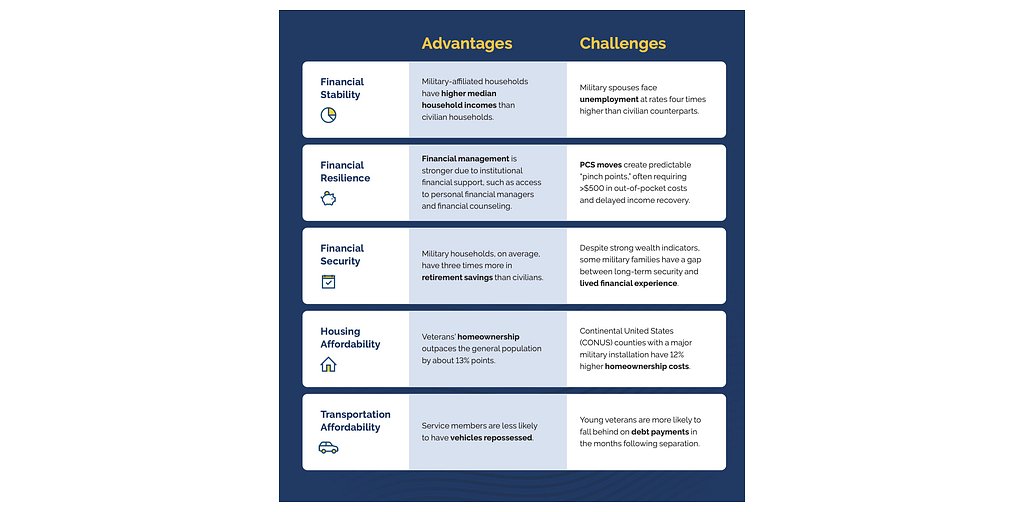
The report underscores a fundamental paradox: on paper, military families appear financially secure, yet their lived experience often tells a different story. The data shows military-affiliated households have, on average, three times more in retirement savings than civilians, and their median household incomes are higher. Furthermore, veterans outpace the general population in homeownership by approximately 13 percentage points.
However, these positive indicators are offset by significant, service-related financial burdens. The same report notes that counties in the continental U.S. with a major military installation have homeownership costs that are 12% higher, immediately eating into the financial gains of service members stationed there. This gap between long-term security and day-to-day financial reality is a central theme, confirmed by research from multiple military support organizations.
Data from Blue Star Families’ 2025 Military Family Lifestyle Survey corroborates these findings, reporting that financial strain remains a top concern impacting morale and retention. Their research found that a staggering 28% of active-duty family respondents experienced low or very low food security. Similarly, the Military Family Advisory Network (MFAN) found that over 80% of military family respondents reported their finances caused them stress, with nearly 80% paying more than they could afford for housing in 2023.
The Predictable Pinch Points: Moves and Unemployment
Two of the most significant drivers of financial instability are unique to the military lifestyle: Permanent Change of Station (PCS) moves and the resulting impact on spousal employment. While a PCS is a standard part of a military career, its financial consequences are anything but routine.
The USAA Foundation report highlights that PCS moves often require more than $500 in out-of-pocket costs, a figure other studies suggest is a conservative estimate. A 2020 MFAN survey found families lose an average of $5,000 per move in unreimbursed expenses and property damage, with many needing over a year to recover financially. These costs include everything from restocking pantries and paying new utility deposits to replacing items that don't fit a new home or climate.
Compounding this disruption is the crisis of military spouse unemployment. The report states that military spouses face unemployment rates four times higher than their civilian counterparts. Other analyses from the Department of Labor place the rate at around 22%, nearly five times the national average. Beyond unemployment, underemployment is rampant, with highly educated and experienced spouses often forced into lower-wage jobs that don't match their qualifications simply for the sake of having an income. Research from Syracuse University’s Institute for Veterans and Military Families (IVMF) shows that active-duty military spouses earn a median income 42% lower than their civilian peers. This chronic loss of a second income creates significant long-term financial instability and is a major factor in a service member's decision to leave the military.
A Widening Gap for Younger and Transitioning Troops
While financial challenges affect the entire force, the strain is felt most acutely by younger enlisted personnel and those navigating the precarious transition back to civilian life. According to Blue Star Families, over 20% of service members in the E1-E5 pay grades report finding it difficult to get by financially. This vulnerability is further evidenced by a recent Wounded Warrior Project survey, which found that nearly half of its respondents were living paycheck-to-paycheck, with little confidence they could cover a $1,000 emergency expense.
For those leaving the service, the challenges can intensify. The USAA Foundation report notes that young veterans are more likely to fall behind on debt payments in the months following separation. The transition period is fraught with financial uncertainty as veterans seek new employment, navigate the VA benefits system, and establish a new life without the built-in support structure of the military.
A Coalition for Change: Mobilizing Support and Solutions
In response to this complex financial landscape, a broad coalition of government bodies, non-profit organizations, and legislative advocates is mobilizing to create systemic change. The Department of Defense offers financial readiness programs, and proposed legislation like the RESOURCES Act aims to improve financial training and retirement planning options for service members.
Non-profit organizations are at the forefront of providing direct support. Groups like Hiring Our Heroes and the Military Spouse Corporate Career Network (MSCCN) offer career coaching, resume assistance, and job placement services tailored to the unique challenges spouses face. Blue Star Families’ “Spouseforce” program provides training for portable, in-demand careers in the tech sector, while The Paradigm Switch helps spouses upskill for remote digital work.
On Capitol Hill, bipartisan efforts are underway to address these issues through policy. The proposed Military Spouse Small Business Recognition Act aims to remove barriers for spouse entrepreneurs, while other legislation seeks to enhance benefits for surviving spouses and ensure troops are paid during government shutdowns. These initiatives recognize that the financial health of military families is not just a personal issue but a matter of national security, directly impacting force readiness and retention. The collective goal is to rebalance the scales, ensuring the benefits of service are not overshadowed by its hidden costs.