
- 20+ systems integrated into AeroVironment’s AV_Halo platform, spanning battle management, AI-driven intelligence, and virtual training.
- $500M projected market size for tethered drones by 2033.
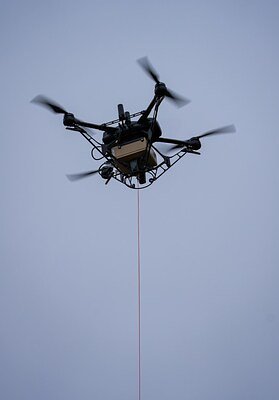
- 200-foot persistent aerial surveillance capability of Hoverfly Spectre drones, enabling uninterrupted ISR for days or weeks.
Experts agree that the integration of Hoverfly’s tethered drones into AeroVironment’s AV_Halo platform exemplifies the strategic shift toward open-architecture systems in defense, enhancing interoperability and operational efficiency on the modern battlefield.
The New Digital Battlefield: How Open Platforms Are Forging Dominance
SANFORD, FL – December 03, 2025 – In the world of defense technology, true innovation is often found not in a single piece of hardware, but in the digital sinew that connects them. The recent announcement that Hoverfly Technologies’ tethered drones have been “whitelisted” on AeroVironment’s AV_Halo command and control (C2) software ecosystem is a prime example. While on the surface a technical integration, this move signifies a much deeper market shift—one where open architecture and interoperability are becoming the most valuable assets in a nation’s arsenal. This partnership moves beyond a simple collaboration; it provides a blueprint for how the defense industry is racing to build the unified, software-defined battlefield of the future.
The Strategic Imperative for Interoperability
For years, the defense sector has been hampered by proprietary, siloed systems. Different drones, vehicles, and sensors often required their own unique control stations, creating a fragmented and complex operational picture for commanders. This inefficiency is a critical vulnerability in an era of rapidly evolving threats. In response, the U.S. Department of War has championed a strategic mandate for a Modular Open Systems Approach (MOSA). This isn't just a preference; it's a legal requirement aimed at dismantling vendor lock-in, accelerating technology adoption, and ensuring that systems from different manufacturers can communicate and operate seamlessly.
AeroVironment’s AV_Halo platform is a direct product of this strategic vision. Launched earlier this year, it's designed as a hardware-agnostic, AI-powered software core for multi-domain operations. By building on open standards, AeroVironment is positioning AV_Halo not as just another product, but as the central nervous system for a vast array of unmanned assets. The platform already integrates over 20 systems, offering capabilities that span from battle management (AV_Halo COMMAND) and AI-driven intelligence fusion (AV_Halo CORTEX) to immersive virtual training (AV_Halo MENTOR).
The whitelisting of Hoverfly is the first major public validation of this open-architecture promise with a third-party drone specialist. As AeroVironment's Chief Technology Officer, Scott Bowman, noted, "AV_Halo was developed as an open architecture software core and built for industry integration, connecting best-in-class capabilities." This move demonstrates that the platform can indeed absorb and unify premier technologies, creating a whole that is far greater than the sum of its parts. It signals to the market that the future of defense contracting lies not in building closed-off ecosystems, but in contributing best-in-class components to a larger, interconnected network.
A Partnership Reshaping Market Dynamics
This integration is a powerfully symbiotic move that reshapes the competitive landscape for both companies. For Hoverfly, a recognized leader in the tethered unmanned aerial systems (TeUAS) market, this is a significant strategic victory. Being natively supported within the AV_Halo ecosystem provides immediate, streamlined access to a broad and growing user base within the U.S. military and allied forces. Warfighters already trained on AV_Halo’s common interface can now deploy a Hoverfly Spectre drone without needing a separate controller or extensive new training. This dramatically lowers the barrier to adoption and solidifies Hoverfly's position against competitors in a tethered drone market projected to reach nearly half a billion dollars by 2033.
For AeroVironment, a defense giant with a vast portfolio of autonomous systems, the partnership is equally critical. It validates their open-architecture strategy in a tangible way, proving that AV_Halo is more than just a framework for their own products. By successfully integrating a leading third-party system, AeroVironment makes its platform exponentially more attractive to military customers who want a single, unified C2 solution without being tied to a single hardware provider. It transforms AV_Halo from a product suite into a true ecosystem, encouraging other specialized technology providers to seek integration and further enriching its capabilities. This positions AeroVironment as a central hub in the evolving defense-tech network, a highly valuable and defensible market position.
"This whitelisting represents more than software compatibility—it's the realization of true cross-domain command and control," stated Bruce Tuftie, Hoverfly's Chief Strategy Officer. His comment underscores the strategic depth of the collaboration. It's about combining Hoverfly’s unique capability—a persistent, 200-foot “eye-in-the-sky”—with a platform that can immediately translate that aerial intelligence into coordinated action across the entire battlespace.
From Persistent Stare to Decisive Action
Beyond the strategic and market implications, the true value of this integration is measured in its operational impact on the warfighter. A tethered drone like the Hoverfly Spectre offers a capability that battery-powered drones cannot: persistence. By drawing power through its tether, it can remain airborne for days or even weeks, providing an uninterrupted stream of high-fidelity intelligence, surveillance, and reconnaissance (ISR) data. This is crucial for tasks like base security, convoy overwatch, and maintaining communications in contested areas.
Previously, the data from such a sensor might have been fed to a separate screen, requiring an operator to manually relay information to those controlling other assets. The AV_Halo integration dissolves that barrier. Now, the feed from the Hoverfly drone appears within the same common operating picture that displays friendly and enemy forces, other unmanned systems, and tactical data. An operator can use the same interface to control the Hoverfly’s camera and then, in the next instant, task a loitering munition or another asset to respond to a threat identified by the drone.
This seamless "sensor-to-shooter" link drastically shortens the decision cycle—the critical time between detecting a threat and neutralizing it. Furthermore, Hoverfly's systems are designed for resilience, capable of operating in GPS-denied environments and without emitting a detectable RF signature, making them invaluable assets on a modern, electronically contested battlefield. By coupling this persistent, resilient sensor with a unified command network, the partnership gives tactical units an unprecedented level of situational awareness and responsiveness, directly enhancing mission effectiveness and improving personnel safety.
This integration transforms the tethered drone from a passive surveillance tool into an active, networked node in a dynamic C2 system, enabling warfighters to "make faster, smarter decisions across the entire battlespace," as Tuftie aptly put it. The future battlefield will be won by those who can process information and act on it the fastest, and this partnership is a significant step in that direction. The roadmap for AV_Halo, with its planned inclusion of more autonomous agents, enhanced simulation environments, and advanced airspace deconfliction tools, suggests this is only the beginning. As software ecosystems like AV_Halo continue to expand and integrate more "best-in-class" technologies, the distinction between hardware providers and software integrators will blur. The new measure of dominance will be the ability to create a cohesive, intelligent network that empowers the human-machine team to out-think and out-pace any adversary.