
- 200 lux: The perovskite solar module in the V150 Plus can begin charging in light levels as low as 200 lux, equivalent to a dimly lit room.
- 4,000 lux: On a typical overcast day or on a covered porch (around 4,000 lux), the lock generates enough energy for a full day's operation.
- 40% efficiency: Recent lab tests show perovskite solar cells achieving over 40% efficiency under low-level LED lighting, outperforming silicon panels.
Experts view the V150 Plus as a significant milestone in commercializing perovskite solar technology, with the potential to revolutionize the smart home industry by eliminating battery dependency and setting a new standard for maintenance-free devices.
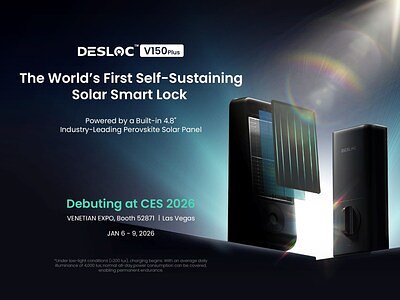
The Lock That Never Sleeps: Perovskite Solar Aims to End Battery Anxiety
SAN FRANCISCO, CA – November 26, 2025 – In the relentless march of smart home technology, one mundane but critical problem has persisted: the battery. Now, a bold claim from smart lock specialist DESLOC promises to relegate that frustration to the past. The company has unveiled its V150 Plus, a smart lock it bills as the world's first to be powered by an integrated perovskite solar system, designed to be truly self-sustaining even in low-light conditions. The announcement, strategically timed ahead of the Consumer Electronics Show (CES) in January, isn't just about a new gadget; it’s a calculated bet on a next-generation energy technology that could fundamentally alter the economics and user experience of the entire smart device ecosystem.
For years, the smart lock market has been a story of trade-offs. Consumers gain keyless convenience and remote access but inherit the nagging duty of battery management. Ignore the low-power warnings, and you risk being locked out, fumbling for a backup key or a portable charger. Existing “solar” solutions have offered little more than a life-extender, using conventional silicon panels that require direct sunlight—a rarity on the covered porches and shaded entryways typical of American homes. DESLOC's V150 Plus claims to solve this problem at its core, promising perpetual power without ever needing a battery change. This isn't an incremental improvement; it's a potential paradigm shift.
The Perovskite Power Play
The technological heart of the V150 Plus is not just solar, but a specific, advanced form of it. Perovskite solar cells (PSCs) have long been the holy grail of materials science research, promising higher efficiencies and lower production costs than their silicon counterparts. Their most compelling feature for consumer electronics, however, is an exceptional ability to generate power from low and ambient light.
While traditional silicon panels are largely inert on a cloudy day or in deep shade, the perovskite module integrated into the V150 Plus can begin charging in light levels as low as 200 lux, equivalent to a dimly lit room. On a typical overcast day or on a covered porch, which might receive around 4,000 lux, DESLOC claims the lock generates more than enough energy for a full day's operation. This is made possible by the unique crystalline structure of perovskite materials, which are far more efficient at converting the spectrum of light found indoors and in shaded areas into electricity. Recent lab tests have shown PSCs achieving over 40% efficiency under low-level LED lighting, performance that silicon can't begin to match.
This move by DESLOC represents a significant milestone in the commercialization of perovskite technology. While companies like Oxford PV have begun deploying perovskite-on-silicon tandem cells for utility-scale projects, and niche products like solar-powered beach umbrellas have emerged, the V150 Plus marks one of the first high-volume consumer applications where the technology's unique low-light advantage is the central value proposition. The company has coupled the panel with a proprietary energy management algorithm, creating a system that intelligently allocates power based on ambient light and battery status. This isn't just bolting a solar panel onto a lock; it's an integrated power system designed for a lifetime of maintenance-free operation.
Of course, perovskite technology is not without its historical challenges. Early-generation cells suffered from degradation when exposed to moisture and heat, raising questions about long-term durability. However, recent advancements in material encapsulation and more stable chemical formulations are rapidly closing this gap, with some projections now showing operational lifespans exceeding 10 years, making them viable for long-term consumer goods. DESLOC's confidence in offering a 'set-and-forget' device suggests they have either solved or effectively mitigated these stability concerns for a smart lock's use case.
A Strategic Bid to Conquer the U.S. Market
The V150 Plus is more than a technological showcase; it's a sharp-edged strategic tool. DESLOC is the North American-facing brand of DESMAN, a dominant player in Asia's high-end smart lock market with 16 years of experience and over 400 patents. This launch is a meticulously planned entry into the competitive U.S. market, targeting a clearly defined and widespread consumer pain point.
According to the National Association of Home Builders, more than two-thirds of new single-family homes in the U.S. are built with porches, creating the exact low-light environments where previous solar smart locks have failed. By delivering a product that works reliably in these conditions, DESLOC is directly addressing a massive, underserved segment. The company is betting that the promise of eliminating 'battery anxiety' will be a powerful enough lure to pull customers away from established brands like Schlage, August, and eufy.
The timing of the announcement is also no accident. By revealing the V150 Plus weeks before it debuts at CES 2026, DESLOC is building a narrative and capturing media attention ahead of the industry's biggest trade show. The event is expected to be dominated by themes of sustainability and ambient computing, where technology seamlessly integrates into the background of our lives. A perpetually powered smart lock that you never have to think about fits perfectly into this vision.
This move puts immense pressure on competitors. While rivals have focused on adding features like biometric scanners or Matter integration, DESLOC has zeroed in on the fundamental power problem. If the V150 Plus delivers on its promise, it could render a significant portion of the current market's offerings obsolete in the eyes of consumers who value convenience and reliability above all else. Competitors will be forced to either accelerate their own research into ambient energy harvesting or risk being left behind, potentially creating a new arms race centered not on features, but on a truly maintenance-free experience.
The industry will be watching the Venetian Expo floor closely this January. The V150 Plus is a test case for both a new technology and a market-entry strategy. Its success or failure will not only determine DESLOC's foothold in North America but could also signal a new era for smart home devices, one where the power cord and the replacement battery are finally, truly, a thing of the past.