
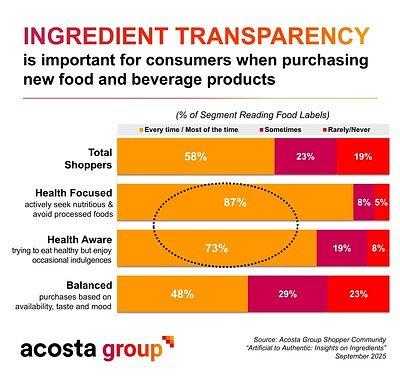
- 58% of all shoppers read labels “all or most of the time” before buying a new product
- 71% of shoppers support U.S. efforts to adopt Europe’s stricter standards on artificial ingredients
- 42% of shoppers opt for natural, “clean beauty” products when price is not a factor
Experts agree that the demand for ingredient transparency is reshaping consumer behavior and forcing brands to prioritize clean label formulations and regulatory alignment with stricter safety standards.
The Label Revolution: Shoppers Demand Ingredient Transparency
JACKSONVILLE, FL – February 24, 2026 – A seismic shift is underway in America’s shopping aisles. Consumers are no longer just looking at prices; they are meticulously scanning ingredient lists, and they are worried about what they see. A new study from Acosta Group reveals that half of all U.S. shoppers are concerned about the health risks of artificial ingredients, chemicals, and preservatives in their food. This growing anxiety is fueling a powerful movement towards transparency and fundamentally altering the relationship between brands and consumers.
The research underscores a dramatic change in consumer behavior: label reading is now a routine part of the shopping experience. According to the report, a remarkable 58% of all shoppers read labels “all or most of the time” before buying a new product. This figure skyrockets to 87% among a growing segment of “health-focused” consumers who actively seek out nutritious, unprocessed foods.
“Label reading is becoming a routine part of shopper decision-making,” said Mark Rahiya, Group President of Omnichannel Sales and Services at Acosta Group. “Consumers are actively seeking ingredients that support specific health goals. That creates an opportunity for natural and organic brands to connect through transparency and clearly communicated benefits.”
This trend is accelerating, particularly among younger demographics. The study found that 39% of Gen Z and 40% of health-focused shoppers are reading labels more often than they were just six months ago. The message to brands is unambiguous.
“That’s a clear message to brand owners, confirming that ingredient transparency is key to purchasing decisions,” noted Kathy Risch, SVP of Thought Leadership and Shopper Insights at Acosta Group.
The 'Clean Label' Mandate
This consumer-led demand for transparency is creating a new “clean label” imperative that is rippling across the food and beverage industry. While the study notes that two-thirds of shoppers still take a flexible approach, balancing healthy choices with occasional indulgences, the influence of the health-conscious consumer is undeniable. These shoppers are driving market trends and forcing legacy brands to adapt or risk being left behind.
In response, many established CPG giants are undertaking significant product reformulations, stripping out artificial colors, flavors, and preservatives in favor of simpler, more recognizable ingredients. This shift is not merely cosmetic; it reflects a strategic pivot to recapture consumer trust. The economic stakes are high, as the natural and organic market segment continues to outpace the growth of conventional products. This has fueled a wave of investment and acquisition, with large corporations often purchasing smaller, agile natural brands to quickly gain a foothold in this lucrative space.
However, this transition is fraught with challenges. Consumers are increasingly savvy and wary of “greenwashing”—vague or misleading claims of being “natural” without substantive proof. True transparency, from ethical sourcing to clear on-pack information, is becoming the new standard for building brand loyalty.
A Push for Stricter Rules: The U.S. Looks to Europe
Consumer concern is not just influencing corporate behavior; it's also fueling a significant demand for regulatory action. The Acosta Group study found that nearly 62% of all shoppers believe more food product safety regulation is required. Even more tellingly, 71% support U.S. efforts to adopt Europe’s stricter standards on artificial ingredients.
This sentiment reflects a long-standing divergence in regulatory philosophy. The European Union largely operates on a “precautionary principle,” where substances must be proven safe before use. Conversely, the U.S. has often relied on a system where ingredients can be deemed “Generally Recognized As Safe” (GRAS) by manufacturers without direct FDA pre-market approval. This has allowed additives that are banned or restricted in Europe—such as certain synthetic food dyes like Red 40 and preservatives like BHT—to remain common in American products.
Now, momentum for change is building from the ground up. In a landmark move, California passed the Food Safety Act in late 2023, which will ban four additives, including Red Dye 3 and brominated vegetable oil (BVO), starting in 2027. Similar legislation is being considered in other states, putting pressure on federal regulators and national brands to standardize safety rules. The FDA itself has recently proposed a federal ban on BVO, signaling a potential alignment with stricter international standards and acknowledging the mounting scientific evidence and public pressure.
Beauty's Balancing Act: Clean Ingredients vs. Proven Results
While the demand for transparency is universal, its application in the beauty and personal care aisles is more nuanced. Here, consumers are engaged in a delicate balancing act, weighing the desire for “clean,” natural ingredients against the demand for clinically proven efficacy.
The Acosta Group research shows an almost even split in preference: when price is not a factor, 42% of shoppers opt for natural, “clean beauty” products, while 39% choose results-focused products that contain FDA-approved synthetic ingredients with clinically proven effectiveness. This divide is generational, with a majority of Gen Z shoppers (51%) strongly preferring the clean beauty category.
This presents a complex challenge for brands, which must cater to two distinct consumer mindsets. The result has been a surge in innovation. On one hand, the clean beauty market is booming, with brands emphasizing plant-based, non-toxic formulations and transparent ingredient lists. On the other hand, “clinical” brands are highlighting scientific research and potent, lab-developed ingredients. Some companies are attempting to bridge the gap, developing product lines that feature high-performance, naturally derived ingredients to offer the best of both worlds.
Even in this complex category, transparency remains a powerful differentiator. Nearly 60% of shoppers seeking natural beauty items are diligently reading labels, indicating that even when efficacy is a priority, the demand to know what is inside the bottle remains a critical component of the purchasing decision.