
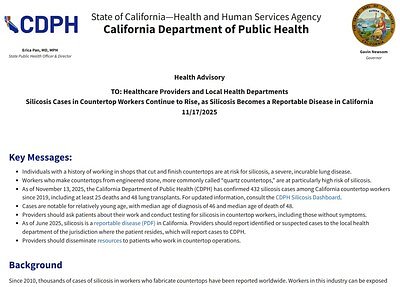
- 447 cases of silicosis in California workers by 2025, up from just 13 in 2019
- 25 deaths and 49 lung transplants linked to engineered stone exposure in California
- Engineered stone contains over 90% crystalline silica, far higher than natural granite (<45%) or marble (almost none)
Experts argue that engineered stone poses an unacceptable risk to workers, with some advocating for a ban due to the inability to safely fabricate it even with strict controls.
The Killer in the Kitchen: Engineered Stone's Hidden Health Crisis
BOSTON, MA – December 15, 2025 – A safety alert from the Massachusetts Department of Public Health (DPH) has cast a harsh light on the hidden human cost of a modern design staple: the artificial stone countertop. The confirmation of the state's first case of silicosis in a countertop fabrication worker marks a grim milestone, signaling that a public health crisis, which has ravaged states like California, is now an undeniable national epidemic. The victim, a Hispanic man in his 40s, developed the incurable lung disease after 14 years of cutting and grinding the popular material often marketed as "quartz" or "engineered stone."
This single case in Massachusetts is a somber echo of a catastrophic outbreak on the West Coast. In California, the number of workers diagnosed with silicosis from artificial stone fabrication has skyrocketed from just 13 in 2019 to a staggering 447 by the end of 2025. The toll is devastating: 25 of those workers have died, and 49 have required lung transplants to survive. The trend reveals a dark paradox at the intersection of design and industry: a product celebrated for its beauty and durability is leaving a trail of death and disease among the workers who craft it.
From Dream Kitchens to Deadly Dust
The appeal of engineered stone is undeniable. It offers a vast palette of colors and patterns, consistent durability, and lower maintenance than many natural stones, making it a go-to choice for homeowners, designers, and builders. But its primary selling point—its composition—is also its greatest danger. These slabs are typically composed of over 90% crystalline silica, a mineral crushed and bound together with resins. For comparison, natural granite contains less than 45% silica, and marble contains almost none.
When these high-silica slabs are cut, ground, or polished, they release vast quantities of microscopic silica dust. Inhaling these fine particles causes silicosis, a progressive and irreversible disease where lung tissue becomes scarred, restricting the ability to breathe. Early symptoms like a persistent cough and shortness of breath can escalate to severe respiratory distress, fatigue, and an increased risk of lung cancer and other autoimmune diseases. As the Massachusetts worker reported, he was often provided with only a thin surgical mask—woefully inadequate protection against the clouds of toxic dust generated in his workplace.
A Mounting Human Toll and Regulatory Gaps
The crisis disproportionately affects immigrant communities, particularly Hispanic and Latino men, who form the backbone of the stone fabrication workforce. The Massachusetts case is emblematic of a nationwide pattern of exposure, where workers in small, often poorly regulated shops face the highest risks. Despite the existence of federal safety standards, the reality on the ground is often dangerously different.
The U.S. Occupational Safety and Health Administration (OSHA) updated its silica standard in 2016 (29 CFR 1926.1153), mandating dust control measures like wet-cutting methods, proper ventilation, and the use of appropriate respirators. However, compliance and enforcement remain critical weak points. The Massachusetts DPH alert explicitly called for employers to implement these known safety protocols, a clear indication that they are not being universally applied. Some public health experts and medical researchers now argue that given the nano-sized particles and extremely high silica concentration in engineered stone, there may be no way to fabricate it safely, even with the most stringent controls.
The medical community is now on high alert. Healthcare providers are being urged to screen any patients with respiratory symptoms for occupational exposure to silica. But with a long latency period between exposure and diagnosis, many more cases are likely hidden, waiting to emerge years from now. For those diagnosed, the prognosis is bleak. With no cure, treatment focuses on managing symptoms, and for the most severe cases, the only option is a lung transplant—a drastic measure that highlights the complete failure of prevention.
A Global Reckoning: Accountability and the Call for a Ban
As the crisis escalates in the United States, the global community is taking decisive action. In a landmark move, Australia implemented a nationwide ban on the use, supply, and manufacture of all engineered stone in 2024, citing the unacceptable risk to workers. This precedent has intensified calls for similar action in the U.S., shifting the conversation from mere mitigation to outright prohibition.
The legal landscape is also transforming. Law firms like Brayton Purcell LLP, which highlighted the Massachusetts alert, are securing massive verdicts and settlements for victims and their families—over $78 million to date. This legal pressure is a direct challenge to the accountability of manufacturers who place these high-silica products into the stream of commerce, as well as the employers who fail to protect their workforce. The rising tide of litigation signals a significant financial risk for an industry that has, until now, largely avoided the consequences of its product's lifecycle.
The Search for Safer Surfaces: Innovation Driven by Crisis
The silicosis epidemic is becoming a powerful market disruptor, forcing a critical re-evaluation of materials throughout the design and construction industries. This public health crisis is now driving innovation, creating a demand for safer, more responsible alternatives. Consumers, designers, and contractors, now more aware of the risks, are beginning to seek out materials that do not carry a hidden human cost.
Viable, silica-free alternatives are readily available. Porcelain slabs, made from clay and fired at high temperatures, offer extreme durability and a wide range of aesthetics without the risk. Solid surface materials, recycled glass countertops, soapstone, and classic marble are all stylish and functional choices that contain little to no crystalline silica. Even granite, with its much lower silica content, presents a significantly reduced hazard when fabricated with proper controls.
Perhaps the most direct innovation is emerging from within the engineered stone industry itself. In response to mounting pressure, some manufacturers are now developing and marketing "low-silica" or "silica-free" versions of their quartz products. This shift represents a crucial pivot—a design-led solution to a problem created by design. For the industry to have a sustainable and ethical future, it must move away from the high-silica formulas that have proven so dangerous. The future market will likely belong to those who embrace this change, whether through adopting entirely new materials or by leading the charge in reformulating their products for safety.