
- 10-month diplomatic push: President Milei's efforts to realign Latin American foreign policy toward Israel.
- El Al's new route: Direct flights between Tel Aviv and Buenos Aires launching in November 2026, subsidized by the Israeli government.
- $1 million grant: Funds from the Genesis Prize used to seed the American Friends of the Isaac Accords (AFOIA).
Experts would likely conclude that the Isaac Accords represent a significant geopolitical shift, strengthening Israel's alliances in Latin America while deepening regional divisions over its stance on Israel.
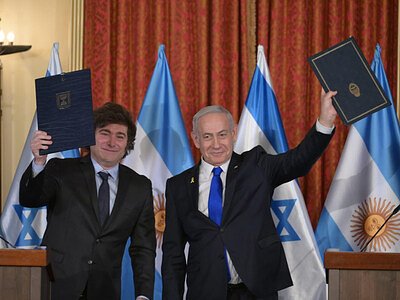
The Isaac Accords: Milei Forges New Israel-Latin America Axis
JERUSALEM – April 20, 2026 – In a ceremony laden with geopolitical significance, Israeli Prime Minister Benjamin Netanyahu and Argentinian President Javier Milei signed the historic Isaac Accords yesterday, launching an ambitious initiative to realign Latin American foreign policy and forge a new bloc of strategic cooperation with Israel.
The agreement, signed in Jerusalem, establishes a framework for expanded partnership based on what the leaders described as shared democratic values and mutual interests in security, economic growth, and technological innovation. The signing marks the culmination of a dramatic ten-month diplomatic push by President Milei, whose fervent pro-Israel stance is rapidly reshaping alliances across the Western Hemisphere.
The 'Milei Effect': A Diplomatic Revolution
President Milei's leadership represents a radical departure from Argentina's historically neutral, and at times critical, position toward Israel. Since taking office, the libertarian economist has embarked on an unapologetically pro-Israel foreign policy driven by a blend of ideological conviction, geopolitical strategy, and economic pragmatism. He views Israel as a key bastion of Western values in a global fight against socialism and extremism.
This diplomatic pivot was first signaled ten months ago when Milei became the first head of state to receive the Genesis Prize, often dubbed the "Jewish Nobel." During the Jerusalem ceremony, where the Isaac Accords initiative was first announced, Milei was lauded for his unwavering support. He has since translated words into action, initiating the process of moving Argentina's embassy to Jerusalem, a move that breaks with decades of international consensus.
His government has also reversed years of anti-Israel voting patterns at the United Nations and taken decisive steps to counter Iranian influence in the region. This includes designating Iran's Islamic Revolutionary Guard Corps (IRGC) as a terrorist organization and renewing efforts to bring justice for the 1990s bombings of the Israeli Embassy and AMIA Jewish community center in Buenos Aires. In a symbolic gesture, a major thoroughfare in Buenos Aires, formerly "Palestine Street," was recently renamed "Bibas Family Street" in honor of an Argentinian-Israeli family taken hostage by Hamas.
Beyond Handshakes: The Accords in Action
The Isaac Accords are designed to be more than a symbolic declaration. The initiative, inspired by the 2020 Abraham Accords, aims to foster tangible cooperation in critical sectors. A primary focus is on security, with member nations pledging to coordinate efforts against terrorism, antisemitism, and drug trafficking, specifically targeting Iran's expanding operational presence in Latin America.
Economically, the pact seeks to unlock new opportunities for trade and investment. Underscoring this commitment, Israel's national airline, El Al, announced it will launch direct flights between Tel Aviv and Buenos Aires in November 2026. The route, one of El Al's longest, is being supported by a substantial Israeli government subsidy, signaling its political importance outweighs purely commercial considerations. Further bilateral agreements in artificial intelligence and security were also signed alongside the main accord.
The engine behind the initiative's implementation is the American Friends of the Isaac Accords (AFOIA), a non-profit established by The Genesis Prize Foundation. When President Milei received the Genesis Prize, he declined the $1 million award, requesting the funds be used to seed AFOIA. The foundation has since used this to provide grants to organizations working to connect Israeli technology with Latin American markets, expand medical cooperation, and mobilize legislative support for Israel across the region.
A Region Divided: The Latin American Response
The press release from The Genesis Prize Foundation celebrates a "contagious" courage, and indeed, several Latin American nations have followed Argentina's lead. Ecuador, Costa Rica, and Paraguay have all designated Hamas, Hezbollah, and the IRGC as terrorist organizations. Ecuador has already opened an Office of Innovation in Jerusalem, and Costa Rica has announced plans to do the same, in addition to signing a free trade agreement with Israel.
However, the pro-Israel shift is far from universal, and Milei's policy is creating new fault lines in regional diplomacy. While Argentina strengthens its ties, other major Latin American players have moved in the opposite direction. Bolivia and Chile have both reportedly downgraded diplomatic relations with Israel in response to its military operations in Gaza. Colombia has also been a vocal critic.
Brazil, the region's largest economy, presents a mixed picture. While the government's relationship with Israel has cooled, the powerful Brazil-Israel Parliamentary Caucus recently became the first legislative body in Latin America to sign the Declaration of Shared Principles, a document developed by AFOIA to guide cooperation. This divergence highlights a growing split within Latin America, with nations now aligning along a new diplomatic axis defined by their stance on Israel.
The Architects of the Alliance
This diplomatic breakthrough was championed by a small group of influential figures. Stan Polovets, chairman and co-founder of The Genesis Prize Foundation, has been the public face of the initiative. "President Milei has shown the world that aligning with Israel is not only morally right, but is essential to advancing stability, innovation, and prosperity," Polovets stated. "His courage has been contagious, and I am confident that this initiative will inspire leaders across Latin America to follow suit."
Working tirelessly behind the scenes was Argentina's Ambassador to Israel, Axel Wahnish, who served as President Milei's personal rabbi and spiritual advisor prior to his appointment. Polovets credited Wahnish as the indispensable force behind the Accords. "This initiative would not have happened without the wise counsel and guidance of Ambassador Wahnish," he noted. "His role, while discreet and out of public view, should not be overlooked and will continue to be critical for the success of this groundbreaking initiative."
The strong backing of the United States was also evident at the signing ceremony, which was attended by prominent American figures. The Isaac Accords are not merely a bilateral or regional affair; they represent a significant move on the global chessboard, aiming to build a reliable pro-Israel coalition at a time when its support in other parts of the world, particularly Europe, has become increasingly uncertain. The agreement signals a new era of strategic partnership, one that promises profound economic and security dividends for its members while simultaneously deepening geopolitical divisions across the hemisphere.