
- $2 million annual savings for a financial services firm by automating cleaning schedules based on actual space usage.
- $50,000 monthly savings for a global consulting firm by eliminating ghosted meetings and unlocking hidden capacity.
- 200 million square feet of real-world office usage data used to train VergeSense's Large Spatial Model (LSM).
Experts would likely conclude that the VergeSense-Logitech partnership represents a significant advancement in workplace intelligence, enabling data-driven decision-making for hybrid office environments while prioritizing privacy and leveraging existing infrastructure.
The Invisible Hand: How AI and Smart Sensors Are Redefining the Office
SAN FRANCISCO, CA – June 10, 2026
The modern office is a paradox. For many global enterprises, it remains their most significant operational expense after payroll, yet its true value and utility have never been more uncertain. In the era of hybrid work, cavernous floors once buzzing with activity now face unpredictable tides of occupancy, leaving workplace leaders to navigate billion-dollar real estate decisions with little more than anecdotal evidence and outdated assumptions. A new partnership between occupancy intelligence leader VergeSense and hardware giant Logitech aims to replace that guesswork with a powerful, data-driven nervous system for the built environment.
VergeSense has officially joined the Logitech Collaboration Program, a move that integrates data from Logitech's ubiquitous conference room technology directly into VergeSense's sophisticated artificial intelligence platform. This collaboration is more than a simple tech integration; it represents a critical step in building the intelligent infrastructure necessary to make hybrid work not just viable, but efficient and optimized. By weaving together hardware-level data collection with predictive analytics, the partnership promises to give enterprises the tools to finally understand, adapt, and shape their physical workplaces with confidence.
The New Currency: Granular Occupancy Data
For years, facility managers have struggled with a fundamental lack of visibility. The problem of "ghosted meetings"—rooms that are booked but remain empty—creates artificial scarcity and frustration, while entire floors may sit underutilized, burning through cash in rent, utilities, and services. The challenge has only been magnified by flexible work schedules that render manual headcount surveys obsolete the moment they are completed.
This is the problem the VergeSense-Logitech integration is designed to solve. It leverages the advanced sensing capabilities already built into Logitech's widely deployed workplace hardware. Devices like the Logitech Rally Bar, a staple in many conference rooms, contain a dedicated AI Viewfinder that can perform accurate, real-time people counting during video calls and even when the room is idle. This is paired with data from devices like the Logitech Spot, a discreet sensor that uses millimeter-wave radar to detect human presence. Critically, these technologies are designed with privacy as a foundational principle. The radar technology in the Spot detects presence through heat and movement alone, making it physically incapable of capturing personally identifiable information. This privacy-first approach is essential for bypassing the lengthy legal and security hurdles that often stall the deployment of other monitoring technologies.
By tapping into hardware that many companies already own and trust, the partnership dramatically lowers the barrier to entry for gathering this crucial occupancy data. It creates a seamless data pipeline from the physical space to the analytical engine, capturing the true pulse of the office without requiring a complex and costly rip-and-replace of existing infrastructure.
From Raw Data to Predictive Intelligence
Simply counting people is only the first step. The true value lies in transforming that raw data into actionable, forward-looking insights. This is where VergeSense's Workplace AI Platform and its core engine, the Large Spatial Model (LSM), come into play. Trained on an enormous dataset covering over 200 million square feet of real-world office usage, the LSM is a foundational AI model built specifically to understand the complex relationship between people and physical space.
"Logitech is already a trusted part of the modern workplace technology stack, capturing one of the most valuable signals enterprises have about how their offices are actually used," said Dan Ryan, CEO & Co-founder at VergeSense. "By bringing that data directly into VergeSense, we're helping joint customers move faster from data to decision, with sharper planning forecasts and a more complete picture of how their spaces support their people."
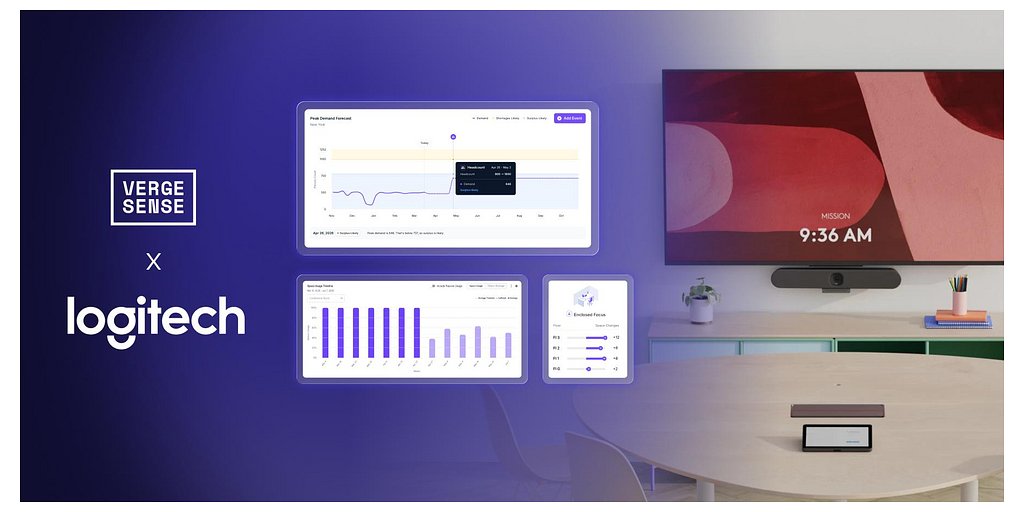
Instead of just providing a historical report of which rooms were used, the platform creates a unique "Usage Fingerprint" for each office. It learns the rhythms of an organization—which types of spaces are preferred for collaborative work, how meeting room usage changes as overall occupancy rises, and where bottlenecks occur. This allows the platform to move beyond reporting into the realm of predictive planning. Workplace leaders can now run "what-if" scenarios, modeling the impact of a new departmental seating arrangement or a change in hybrid work policy before committing a single dollar to reconfiguring a space.
“Our customers are looking for deeper insights on the workplace environment, occupancy, and space utilization,” added Sudeep Trivedi, Head of Strategy & Alliances at Logitech. “Through the integration with VergeSense, we are able to extend the insights from the Logitech devices into a unified solution and enable workplace leaders to make faster, more confident decisions.”
Forging an Intelligent Office Ecosystem
This collaboration is indicative of a larger, more significant trend in property technology (PropTech): the shift from standalone products to integrated ecosystems. The Logitech Collaboration Program itself is a strategic effort to build a network of partners that enhance the value of its core hardware, creating a comprehensive solution that is greater than the sum of its parts. By joining this program, VergeSense isn't just gaining a data source; it's embedding its intelligence into a foundational layer of the modern office technology stack.
This ecosystem approach offers a powerful counterpoint to competitors in the workplace analytics market, some of whom require proprietary sensors and offer siloed dashboards. The VergeSense-Logitech model allows enterprises to leverage existing investments and unify disparate data streams—from Logitech's people counts to WiFi data, badge swipes, and room booking systems—into a single, coherent view of their real estate portfolio. This holistic intelligence network is what enables the platform to deliver on its promise of predictive power, setting it apart from competitors that may only offer retrospective analytics.
The Tangible Impact on Real Estate and Experience
The implications for enterprise real estate are profound. With the ability to accurately forecast space needs, companies can make smarter leasing decisions, potentially avoiding massive capital expenditures. Case studies from VergeSense customers illustrate the scale of the opportunity: one financial services firm saved $2 million annually by automating cleaning schedules based on actual space usage rather than fixed timetables. Another global consulting firm avoided $50,000 per month in new leasing costs simply by identifying and eliminating ghosted meetings to unlock hidden capacity in their existing office.
Beyond the bottom line, this intelligence network is a powerful tool for enhancing the employee experience. When workplace teams understand which spaces are most in-demand and why, they can invest in creating more of what works and less of what doesn't. Data can reveal a need for more small huddle rooms, quiet zones for focused work, or large collaborative project spaces. By aligning the physical environment with the actual behaviors and needs of the workforce, companies can create an office that is not just a place to work, but a strategic tool for fostering innovation, collaboration, and employee satisfaction. This data-driven approach allows organizations to right-size their real estate footprint without sacrificing culture or productivity, ensuring the office remains a valuable asset in the future of work.