
- 40% increase in compute capability per square millimeter
- 45% jump in logic and DSP density
- 64 Gsps direct RF sampling rate
Experts would likely conclude that Altera’s Agilex 9 Direct RF-Series SoC FPGA sets a new benchmark in high-performance RF systems, offering unparalleled integration and efficiency for aerospace, defense, and advanced communications applications.
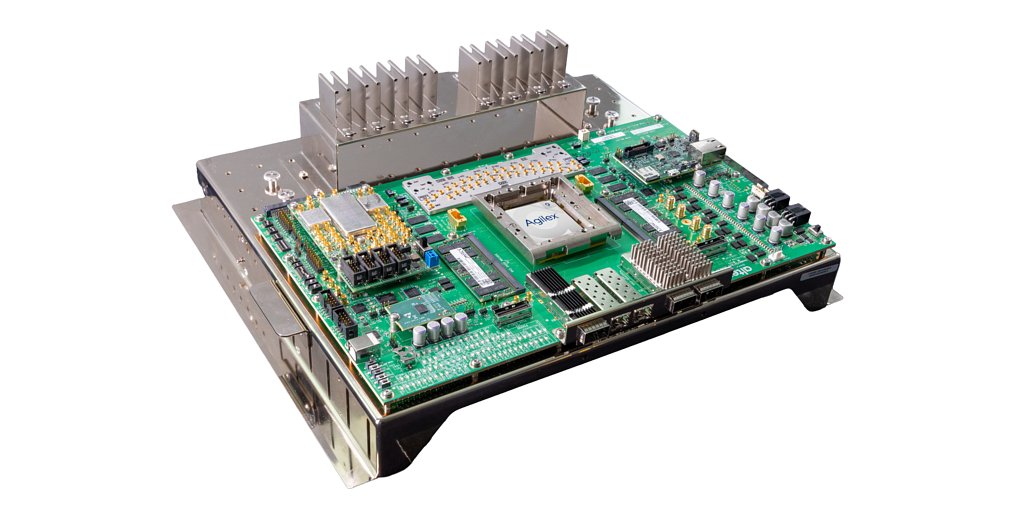
The Integration Game: Altera’s New Chip Redefines High-Performance RF Systems
BOSTON, MA – June 08, 2026 – In a move that signals a significant shift in the design of high-stakes electronics, Altera Corporation today unveiled its next-generation Agilex 9 Direct RF-Series SoC FPGA. Announced at the International Microwave Symposium, the new silicon isn't just an incremental update; it's a powerful statement on the future of system design, where the complex functions of radio frequency, computation, and memory are collapsing into a single, highly integrated platform. For the aerospace, defense, and advanced communications sectors, where performance and efficiency are paramount, this level of integration promises to accelerate innovation and redefine what’s possible at the intelligent edge.
Altera, newly independent after its spin-off from Intel and reasserting its identity as the industry's largest pure-play FPGA provider, is betting that this consolidation is the key to unlocking the next wave of technological advancement. The new device boasts a 40% increase in compute capability per square millimeter and a 45% jump in logic and DSP density, metrics that translate directly into more powerful and compact systems.
The Integration Imperative
For decades, engineers designing complex radio frequency (RF) systems have juggled a complex array of discrete components. Separate chips for analog-to-digital conversion, signal processing, and system logic were the norm, leading to larger circuit boards, higher power consumption, and significant design complexity. Altera’s Agilex 9 Direct RF-Series aims to dismantle that paradigm by merging these disparate functions into a monolithic System-on-Chip (SoC) FPGA.
This integration is more than a matter of convenience; it directly addresses the persistent challenge of Size, Weight, Power, and Cost (SWaP-C) that constrains developers in aerospace and defense. By eliminating the need for multi-chip designs, the new platform allows for smaller, lighter, and more power-efficient systems—critical for applications on satellites, aircraft, or man-portable communication gear. The tight coupling of RF-to-digital processing on a single piece of silicon also drastically reduces latency, a non-negotiable requirement for real-time applications.
The benefits are already being recognized by Altera’s partners. Ian Dunn, CTO at board partner Spectrum Control, affirmed the strategic advantage of this approach. “As RF systems become more complex and bandwidth demands continue to grow, integration and performance at the system level are critical,” he stated. “Altera’s newest Agilex 9 Direct RF-Series SoC FPGA enables us to simplify system architectures while delivering the high-performance signal processing our customers require. The combination of integrated RF, compute, and memory helps us accelerate development and bring more capable solutions to market faster.” This feedback underscores how such technological leaps improve the lives and workflows of the engineers building our future, allowing them to focus on system-level innovation rather than component-level integration challenges.
Powering the Real-Time Edge
The true impact of the Agilex 9 lies in its ability to process vast amounts of data where it is captured: at the edge. The device features integrated 64 Gsps (gigasamples per second) wideband RF data converters, allowing it to directly sample a huge swath of the radio spectrum without the need for traditional analog down-conversion stages. This capability is transformative for applications that require immediate situational awareness and response.
In advanced radar systems, for example, the chip’s increased compute and memory resources—bolstered by support for next-generation DDR5 and LPDDR5—enable more sophisticated beamforming algorithms and real-time processing of complex data cubes. This translates to higher-resolution imaging and faster, more accurate tracking of multiple targets. In the realm of electronic warfare, the ability to analyze the entire spectrum in real time and react with microsecond-level latency provides a decisive advantage in detecting and countering threats.
This push to the edge is also shaping the future of communications. As the world moves towards 6G, the demand for wider bandwidths and lower latency will only intensify. The Agilex 9's architecture is well-suited to handle the complex signal processing required for these next-generation networks. Furthermore, the platform’s configurable DSP blocks can be leveraged for both traditional signal processing and AI inference, opening the door for intelligent, adaptive RF systems that can learn and respond to their environment autonomously.
A New Benchmark in a Competitive Field
Altera's announcement does not happen in a vacuum. The high-performance RF SoC market is a fiercely contested space, with Altera’s primary rival, AMD (formerly Xilinx), having established a strong position with its Zynq UltraScale+ RFSoC and Versal ACAP product lines. These platforms also champion the cause of integration, offering a compelling blend of RF, processing, and programmable logic.
However, Altera is drawing a clear line in the sand with the Agilex 9's specifications. The 64 Gsps direct RF sampling rate is a standout feature, pushing the boundaries of what can be directly digitized and processed. While AMD's platforms are formidable and hold a significant market presence, industry observers note that Altera's Direct RF offerings often target the highest echelons of performance, particularly for demanding military and defense applications where cost is secondary to capability.
The 40% increase in compute per square millimeter and 45% greater logic density are not just marketing figures; they represent a tangible increase in the horsepower available to system designers, potentially setting a new benchmark for what can be achieved on a single chip. This competitive pressure is a healthy dynamic for the industry, driving innovation and providing engineers with more powerful tools.
“Across aerospace, defense, and advanced communications, our customers are being asked to handle more data and operate within tighter constraints,” said John Sotir, General Manager of Altera’s Aerospace, Defense and Government business unit. “With our latest Agilex 9 Direct RF device, we’re helping them meet those challenges by bringing together high-performance compute, memory, and RF capabilities into a single, highly integrated platform.” His statement articulates a clear strategy: to win by providing the most capable, integrated solution for the world's most demanding applications. With engineering samples now available and production silicon slated for the third quarter of 2026, the industry will be watching closely to see how designers leverage this newfound power.