
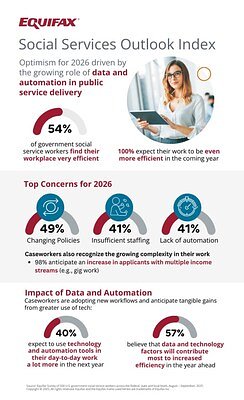
- 100% of government social service workers expect their work to become more efficient in the coming year, with 57% attributing this to advancements in data and technology.
- 98% of caseworkers anticipate an increase in applicants with non-traditional income streams from the gig economy.
- 40% of workers expect a significant increase in daily automation use within the next year.
Experts agree that technology, particularly automation and data tools, holds significant promise for improving efficiency in strained social service systems, but warn that successful implementation requires addressing systemic challenges like staffing shortages, policy complexity, and ethical concerns around AI.
The Digital Caseworker: Tech's Promise for Strained Social Services
ATLANTA, GA – December 04, 2025 – In the strained corridors of America's social service agencies, a powerful sense of optimism is emerging from an unexpected source: technology. A new survey reveals that the very frontline workers grappling with immense caseloads and systemic pressures are looking to data and automation as a critical lifeline. According to the inaugural Social Services Outlook Index from data analytics firm Equifax, a staggering 100% of government social service workers expect their work to become more efficient in the coming year, with a majority (57%) pointing directly to advancements in data and technology as the primary driver.
This wave of techno-optimism comes at a pivotal moment. For years, these agencies have been caught in a perfect storm of rising public demand, shrinking budgets, and chronic staffing shortages. The survey, which polled 500 workers supporting programs like Medicaid, SNAP, and TANF, paints a picture of a workforce ready for change, hoping technology can finally help them do more than just tread water.
A System Under Pressure
The enthusiasm for digital tools is not born from a love of technology for its own sake, but from the harsh realities of the job. For decades, caseworkers have been tasked with navigating a labyrinth of complex policies while managing ever-growing caseloads. The Equifax survey highlights that the top concerns hampering progress are not a resistance to change, but systemic failures: changing policies (49%), insufficient staffing (41%), and a lack of existing automation (41%).
Broader industry data paints an even starker picture. Social work consistently ranks in the bottom quartile for career happiness, with particularly low satisfaction in salary and resources. Many permanent staff report feeling perpetually required "to do more with less," leading to high rates of stress and burnout that threaten the stability of the entire system.
This pressure is being compounded by the evolving nature of the American workforce. Nearly all caseworkers surveyed (98%) anticipate an increase in applicants with multiple, non-traditional income streams from the gig economy. This adds new layers of complexity to eligibility verification, a task that has traditionally been a manual, paper-intensive process. The hope is that technology can cut through this complexity.
"Public service demands are growing, and many government caseworkers are grappling with heavy caseloads, adapting to new policies, and finding ways to do more with limited resources," said David Turner, Senior Vice President at Equifax Government Solutions, in the press release. He notes that automation can help by "freeing up time for caseworkers to focus on what matters most – delivering meaningful support to the people and communities they serve."
The Promise of Automation
Frontline workers envision a future where technology acts as a powerful administrative assistant, not a replacement. According to the survey, 40% of social service workers expect their daily use of automation to increase "significantly" in the next year. They see this shift having a direct, positive impact on their core mission, with over a quarter (27%) believing technology's greatest benefit will be an improved ability to determine appropriately sized benefits for eligible applicants.
This aligns with broader trends in government technology, where AI and automation are being positioned to handle routine administrative work. Generative AI tools are already being piloted in some sectors to summarize case notes, draft reports, and handle routine correspondence, potentially saving hours of administrative time per day. The goal is to transform the role of the caseworker from a processor of paperwork to a true advocate and problem-solver for clients.
Workers are also advocating for technology to enable deeper, systemic reforms. An overwhelming 98% of respondents agreed that a universal intake process—a single application form shared across multiple aid programs—would increase efficiency. Similarly, 99% believe having a single caseworker support a beneficiary across multiple programs is helpful. Interestingly, support for these modernizing reforms is strongest among the most experienced employees; 54% of those with over 10 years on the job say a universal form would make their role much more efficient, suggesting that those who know the system's flaws best are the most eager for a digital overhaul.
Hurdles on the Road to Modernization
Despite the widespread optimism, the path to a fully digitized, efficient social service system is fraught with challenges. The very issues that make technology so appealing—staff shortages and policy complexity—are also significant barriers to its successful implementation. Implementing new enterprise software or AI systems requires significant investment, training, and institutional capacity, resources that are already scarce.
Furthermore, the adoption of AI and automated decision-making in high-stakes government services raises profound ethical questions. Advocacy groups and public administration experts warn that AI systems trained on historical data could inadvertently perpetuate and even amplify existing societal biases, potentially leading to discriminatory outcomes in benefit determination. Ensuring fairness, transparency, and accountability in these algorithmic systems is a paramount challenge.
There is also the risk of eroding the essential "human touch" that defines social work. While automation can handle data verification, it cannot replicate the empathy, critical thinking, and nuanced judgment required to handle complex human situations. Stakeholders across the board stress that technology must be a tool to augment human workers, not supplant them.
The Business of Digital Government
This push for modernization has created a significant and growing market for technology vendors. Equifax, with its vast repositories of employment and income data, is strategically positioned to capitalize on this trend. Its flagship service, The Work Number®, is already used by a majority of state social service agencies to provide automated income and employment verification, a critical function for determining eligibility for billions of dollars in public benefits.
By providing near real-time data, such services promise to solve the verification challenge posed by the gig economy and reduce the administrative burden on caseworkers. The survey itself serves as a key piece of market validation, demonstrating a clear demand from frontline workers for the exact solutions the company provides. However, the role of large data brokers in government services is not without scrutiny. The sector demands an exceptionally high level of trust, data security, and transparency, and any vendor operating in this space must navigate a complex landscape of public oversight and privacy concerns.
The journey toward a technologically empowered social service sector is just beginning. While the optimism of caseworkers is a powerful catalyst for change, successful transformation will require more than just new software. It will demand a holistic approach that addresses the underlying issues of staffing and policy, while thoughtfully navigating the ethical minefield of automation to build a system that is not only more efficient, but also more equitable and human-centered.