
- Neurological Conflict: The anterior cingulate cortex (ACC) activates when observing benevolent leadership, creating internal tension in observers.
- Feedback Refinement: Dr. Adams-Miller's framework suggests 30-40% of workplace criticism may stem from observers' internal conflict rather than leader actions.
- Stability Impact: Consistent values-based leadership enhances neurological stability, reducing cognitive dissonance across organizations.
Experts agree that workplace criticism of benevolent leaders often reflects observers' internal neurological conflict rather than leadership flaws, requiring a nuanced approach to feedback interpretation.
The Brain Behind the Backlash: Why Good Leaders Face Criticism
FINDLAY, OH – December 09, 2025 – It is one of the most confounding paradoxes in modern leadership: executives who champion integrity, act with kindness, and foster transparency often find themselves facing a surprising degree of criticism and resistance. While conventional wisdom might point to missteps in strategy or communication, a new neuroscience-based framework suggests the answer may lie deeper—not in the leader’s actions, but in the brain of the observer.
Dr. Andrea Adams-Miller, an executive consultant and Master Neuroscientist, has released a framework detailed in her article, The Cost of Integrity in Leadership, that dissects this phenomenon. It posits that benevolent leadership can trigger an internal, neurological conflict in onlookers, which then manifests as external critique. This shifts the conversation from blaming the leader to understanding the complex human responses that shape organizational dynamics.
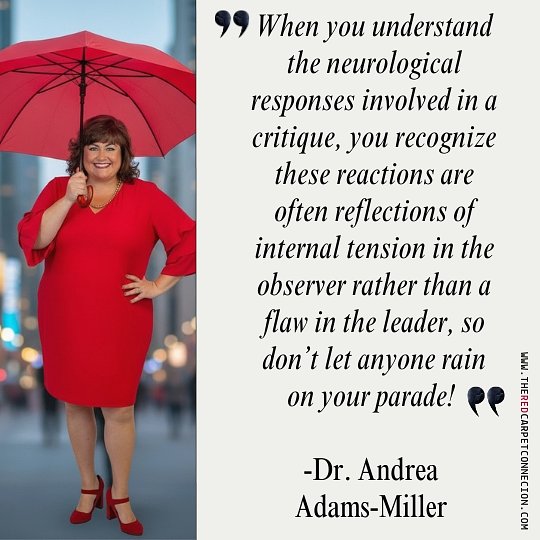
"Leaders often ask why benevolent actions are met with critique," stated Dr. Adams-Miller in her announcement. "When you understand the neurological responses involved, you recognize these reactions are often reflections of internal tension in the observer rather than a flaw in the leader."
The Neuroscience of Conflict
The central pillar of Dr. Adams-Miller’s framework is the anterior cingulate cortex (ACC), a brain region neuroscientists identify as a key hub for conflict monitoring. Citing foundational research published in Trends in Cognitive Sciences, her model explains that the ACC activates when it detects a discrepancy between competing informational inputs—in essence, when a person experiences cognitive dissonance.
According to the framework, when a leader demonstrates a high level of integrity, generosity, or ethical consistency, it can create a conflict for an employee or colleague whose own experiences, beliefs, or behaviors do not align. This mismatch between the observed ideal and the observer's internal state triggers the ACC, generating a feeling of psychological discomfort. Unable to resolve this internal tension easily, the brain may seek an external outlet. The simplest path is often to project that discomfort outward by finding fault with the source of the conflict: the leader.
This neuroscientific lens reframes workplace criticism not merely as feedback on performance, but as a complex signal that may reveal more about the giver’s internal state than the receiver’s actions. It provides a scientific underpinning for why doing the right thing can feel so difficult and why even the most well-intentioned changes are met with pushback. Research in the journal Frontiers in Psychology corroborates this, showing that resistance to change is heavily influenced by perceptions of fairness and leader-member relationships, suggesting that even ethical leaders will encounter pushback rooted in internal uncertainty.
Redefining Feedback in High-Integrity Cultures
Understanding the neurological roots of criticism opens a new pathway for managing it. Rather than becoming defensive, leaders can adopt a more strategic approach to feedback. Dr. Adams-Miller’s model provides several actionable recommendations for navigating this complex terrain and fostering healthier organizational communication.
The first step is to carefully evaluate the nature of the feedback. Leaders are encouraged to learn to distinguish between substantive, insightful critique that can drive improvement and criticism that is likely an emotional projection stemming from an observer's internal conflict. This requires a high degree of emotional intelligence and self-regulation.
To aid in this process, the framework advises using a council of trusted advisors to vet criticism. These individuals can provide an objective perspective, helping a leader determine whether a piece of feedback reflects a genuine issue or a recurring pattern of projection from specific individuals. This prevents the leader from overcorrecting based on neurologically driven noise rather than actionable data.
Perhaps most powerfully, the model calls for proactively teaching teams how to deliver structured, non-threatening feedback. Dr. Adams-Miller advocates for a three-part model: begin by stating the positive impact of an action, introduce a point for refinement or a different perspective, and conclude with an affirmation of the person or their overall effort. This approach is designed to minimize the threat response in the receiver and reduce the likelihood that feedback is delivered as a pure, unfiltered expression of discomfort.
The Strategic Value of Stability
This framework arrives at a time when the market demands both ethical leadership and unwavering performance. In high-pressure industries like healthcare, technology, and finance, executives face immense scrutiny. The 'cost of integrity,' as the framework's name suggests, is the emotional and professional toll of navigating resistance that arises not from failure, but from a commitment to values. By understanding the science behind this resistance, leaders can build greater cognitive resilience.
"Values-based leadership enhances neurological stability over time," Dr. Adams-Miller noted. "When leaders stay aligned, they become regulating signals for the entire organization."
This concept is a cornerstone of her recommendations. By maintaining behavioral consistency, leaders do more than build trust; they create a predictable, stable environment that reduces cognitive dissonance across the organization. This consistency strengthens the prefrontal regulatory systems in the leader’s own brain, bolstering their capacity for resilient leadership in the face of inevitable criticism. This stability becomes a strategic asset, fostering the psychological safety required for innovation, collaboration, and readiness for change.
While Dr. Adams-Miller's work enters a competitive leadership development market increasingly populated with 'neuro-leadership' programs, her specific focus on the criticism paradox offers a unique and valuable perspective. Her article and associated framework are being disseminated directly through professional networks and organizational briefings rather than traditional academic journals, a strategy that prioritizes direct application in the corporate world. For organizations willing to look beyond surface-level behaviors, this neuroscience-informed approach provides a sophisticated toolkit for building a culture where integrity can thrive not just as a principle, but as a source of enduring strength.