
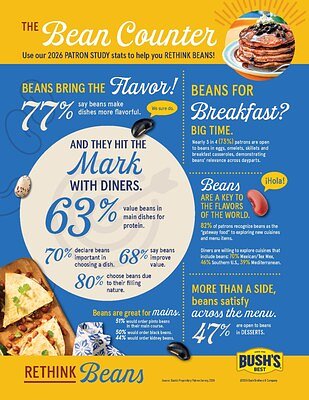
- 82% of diners view beans as a 'gateway food' for exploring new global cuisines
- 73% of patrons are open to beans in breakfast dishes
- 80% of diners report that dishes with beans are more filling and satisfying
Experts agree that beans are emerging as a strategic ingredient for restaurants, offering solutions for menu innovation, value perception, and profitability in a challenging economic climate.
The Bean Revolution: Reshaping Restaurant Menus and Margins
KNOXVILLE, Tenn. – May 12, 2026 – As the foodservice industry converges on Chicago for the National Restaurant Association Show, a new report suggests one of the most potent tools for future growth might be hiding in plain sight. Bush's Best, a 115-year-old company built on the humble bean, is set to unveil compelling new consumer data that positions the legume not as a mere side dish, but as a powerful driver of menu innovation, customer satisfaction, and operator profitability.
In a challenging economic climate marked by inflation and shifting consumer habits, the findings from a survey of 1,000 frequent diners offer a clear directive to chefs and restaurant owners: it's time to rethink beans. The data indicates that this versatile pantry staple can address many of the industry's most pressing challenges, from the demand for global flavors and plant-based options to the urgent need to deliver value without sacrificing quality.
Beyond the Side Dish: A New Consumer Palate
The most striking revelation from the new research is the modern diner's expanding culinary curiosity and their willingness to embrace beans in unexpected formats. The data shows that for a staggering 82% of patrons, beans act as a "gateway food," providing a familiar and comforting entry point for exploring new global cuisines and unfamiliar menu items. This positions beans as a low-risk vehicle for culinary innovation, allowing chefs to introduce international flavors with a higher chance of customer acceptance.
This adventurous spirit extends across all dayparts. The traditional notion of beans being confined to lunch and dinner is being decisively challenged. Nearly three in four patrons (73%) reported being open to incorporating beans into breakfast dishes like omelets, skillets, and breakfast casseroles. This finding unlocks a significant opportunity for operators to enhance morning menus with protein-packed, satisfying options that cater to health-conscious consumers.
Perhaps even more surprising is the ingredient's potential to break into the dessert category. The survey found that nearly half of all diners (47%) are open to the idea of beans in sweet applications, a concept that has long been a staple in many Asian cuisines but remains nascent in the United States. This signals a readiness for more sophisticated, texture-driven desserts and opens a new frontier for pastry chefs looking to innovate beyond traditional flour and sugar.
An Antidote to 'Shrinkflation' and Value Demands
As restaurants grapple with rising ingredient and labor costs, many have been forced to make difficult choices, leading to the phenomenon of "shrinkflation"—reducing portion sizes while holding prices steady. This practice, however, has not gone unnoticed by consumers, who are more sensitive to value than ever. Bush's research suggests beans offer a powerful solution to this dilemma.
An overwhelming majority of diners (80%) report that dishes containing beans are more filling and satisfying. Furthermore, 68% of patrons state that the inclusion of beans makes a main dish feel like a better value for the money. In an era where perceived value is paramount, adding beans can increase a dish's heft and satiety, justifying menu prices and leaving customers feeling satisfied rather than short-changed. This allows operators to manage food costs effectively while simultaneously boosting the customer's perception of value.
This value proposition is critical, as independent industry analysis confirms that consumer definitions of value have grown more complex. While price remains a factor, diners increasingly weigh it against food quality, portion size, and overall satisfaction. Ingredients that deliver on satiety and nutrition, like beans, are therefore becoming indispensable strategic assets in menu engineering.
The Rise of the Premium Legume
Concurrent with the demand for value is a clear willingness to see beans as more than a simple commodity. The survey dismantles the outdated perception of beans as a cheap filler, revealing that 71% of patrons agree they can be an elevated, premium ingredient. Even more telling, 77% believe beans can be part of an indulgent meal, on par with more traditionally luxurious components.
This shift is fueled by several converging trends. The continued momentum of plant-based eating is a major factor, with 60% of patrons agreeing that beans can replace meat, fish, or poultry in a dish without reducing their satisfaction. Diners are increasingly choosing beans for their nutritional benefits, citing protein (63%), flavor (62%), and fiber (53%) as top reasons for ordering them in a main dish.
"Our research confirms that beans win on both taste and health, while tapping into today's biggest consumer trends, from protein and fibermaxxing to globally inspired flavors," said Marco Alvarado, Foodservice Operations Lead at Bush Brothers & Co. "What sets Bush's Best apart for operators is a versatile portfolio that elevates flavor while making it easy to build innovative, on-trend menu items without adding complexity to the back-of-the-house."
Innovation on Display at the NRAS
At the upcoming National Restaurant Association Show in Chicago, Bush's Best plans to translate this data into action. The company's booth (#11302) will serve as an immersive experience designed to inspire foodservice operators to "RETHINK BEANS." A rotating menu of culinary creations, including concepts like a Chili Magic Bar and a Hot Honey Bean Pimento Toast, will showcase the ingredient's versatility across different cuisines, dayparts, and applications.
This move is a strategic play in a highly competitive foodservice ingredient market. Suppliers are no longer just selling products; they are selling solutions. By arming operators with robust consumer data and tangible, creative menu ideas, the company is positioning itself as a strategic partner in navigating the future of dining.
As thousands of industry professionals walk the floor at McCormick Place, the conversation will undoubtedly turn to efficiency, innovation, and value. The evidence suggests that for operators looking for an ingredient that satisfies consumer cravings for health, flavor, and global adventure—while also bolstering their bottom line—the answer may be simpler, and more powerful, than they ever imagined.