
- 75% faster inspections: AI-driven inspections can be up to 75% faster than manual methods.
- 30% more defects detected: The system can identify 30% more defects compared to traditional methods.
- $100,000 per hour: Unplanned downtime for critical assets can cost over $100,000 per hour.
Experts agree that Raytron's AI-powered infrared monitoring system represents a significant advancement in predictive maintenance, offering faster, more accurate defect detection and substantial cost savings by preventing unplanned downtime.
The AI Eye: Raytron's Infrared Tech Sees Future Industrial Failures
YANTAI, China – February 11, 2026 – In the high-stakes world of industrial manufacturing, the difference between a normal operating day and a multi-million-dollar disaster can be a few degrees. For decades, plant managers have relied on periodic inspections or waited for alarms to sound, a reactive approach that often comes too late. Now, a new wave of technology is enabling industries to see the future, and it looks like a heat map.
Raytron Technology Co., Ltd. has unveiled an intelligent infrared monitoring system that combines high-resolution thermal imaging with advanced artificial intelligence, aiming to shift industrial maintenance from a reactive, post-failure model to a predictive, preventative one. The system is designed to continuously monitor high-temperature equipment, detecting the subtle thermal anomalies that signal an impending breakdown, potentially saving industries from costly downtime and catastrophic safety events.
The Predictive Power of Seeing Heat
Every object warmer than absolute zero emits infrared radiation, an invisible light signature that can reveal a wealth of information. In industrial settings like metallurgical furnaces, chemical plants, and cement kilns, where internal conditions are impossible to observe directly, the surface temperature becomes a critical health indicator. A subtle hot spot on a furnace wall or a pipeline can be the first and only warning of internal degradation, insulation failure, or a potential rupture.
Traditional maintenance schedules often involve manual inspections with handheld thermal cameras, a process that is time-consuming, provides only a snapshot in time, and is subject to human error. Raytron's solution automates this process by installing fixed thermal cameras that provide a continuous, 24/7 data stream. With an ultra-high infrared resolution of up to 1200 × 600 pixels and an extreme operating range from 0°C to 2000°C, these systems can capture detailed thermal maps of critical assets in real-time, all without interrupting production.
Engineers can access live thermal video and historical temperature trends from a central control room, removing personnel from potentially hazardous environments and providing a comprehensive view of plant health. This remote, non-contact approach represents a fundamental improvement in both safety and operational efficiency.
Beyond the Alarm: The Role of Artificial Intelligence
While continuous thermal monitoring is a significant step forward, the true innovation lies in the system's analytical brain. Raytron's platform integrates proprietary deep-learning algorithms that transform raw temperature data into actionable intelligence. This moves the technology far beyond simple threshold-based alarms that trigger when a pre-set temperature is exceeded.
The AI analyzes complex thermal patterns over time, learning the unique thermal signature of a healthy piece of equipment. It can identify not just a hot spot, but the rate at which a temperature is rising, and compare developing patterns to a vast library of failure signatures. This allows the system to provide predictive warnings, alerting operators to a potential failure hours, days, or even weeks in advance. Some analyses suggest AI-driven inspections can be up to 75% faster while detecting 30% more defects than manual methods.
Furthermore, the system can fuse high-resolution thermal data with imagery from a visible light camera. This dual-spectrum approach allows the AI to better contextualize anomalies, reducing false positives and providing operators with a clearer understanding of the issue, whether it's a failing refractory brick or a loose electrical connection.
A Multi-Billion Dollar Market for Prevention
The push toward predictive maintenance is not just about technological novelty; it's driven by powerful economic and market forces. The global predictive maintenance market, valued at over $10 billion in 2024, is projected to surge at a compound annual growth rate of over 25%, potentially reaching nearly $100 billion by the early 2030s. This explosive growth is fueled by the widespread adoption of Industry 4.0 and the Industrial Internet of Things (IIoT).
For heavy industries, the return on investment is clear. Unplanned downtime for a critical asset can cost a company over $100,000 per hour. By preventing even a single major shutdown, a predictive maintenance system can pay for itself many times over. This has attracted major industrial players like Teledyne FLIR, Siemens, and Honeywell, who all offer competing solutions. Raytron aims to differentiate itself by leveraging its deep expertise in multi-dimensional sensing—combining infrared, microwave, and laser technologies—with its proprietary, end-to-end AI algorithms.
From 'Red Kiln' to Safe Zone: Enhancing Workplace Safety
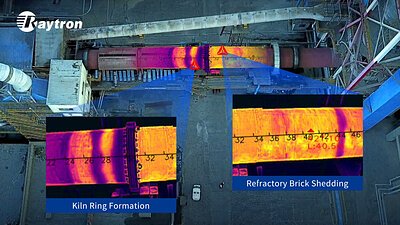
The economic benefits are compelling, but the impact on human safety is arguably more significant. The press release highlights a critical application: monitoring rotary kilns, the massive, rotating furnaces that are the heart of cement and metallurgical plants. The refractory lining inside these kilns is under constant thermal and chemical stress, and a failure can be catastrophic. If the lining wears away, a "hot spot" can form on the kiln's outer steel shell, causing it to glow cherry-red in a condition known as a "red kiln."
This compromises the structural integrity of the kiln, risking a collapse that could halt production for months and endanger workers. Raytron's TN460U high-temperature camera continuously scans the kiln's surface, using AI to track lining health, predict wear, and provide early warnings of red kiln conditions. This allows plant managers to schedule maintenance proactively, manage ring formations, and prevent disaster.
This focus on safety and reliability extends to other sectors, including monitoring for thermal runaway in electric vehicle battery arrays and inspecting equipment in hazardous petrochemical environments. By providing an early warning system, this technology helps companies not only protect their bottom line but also comply with stringent safety and asset management standards like ISO 18434 and NFPA 70B, which increasingly mandate proactive maintenance and thorough documentation. This convergence of AI, advanced sensing, and regulatory pressure is fundamentally reshaping how industries manage risk and ensure a safer, more efficient future.
Topics & Related
Artificial Intelligence
Industry 4.0
Revenue
AI & Machine Learning
Related Company Pulse