
- 775GB: Unified memory pool for seamless CPU-GPU data access
- 20 PFLOPS: AI performance, enabling rapid model training and inference
- 1.4 kW: Power draw per Blackwell Ultra GPU, requiring dedicated circuits
Experts view the ASUS ET900N G3 as a game-changer for AI development, enabling on-premise, high-performance computing that addresses cloud bottlenecks, security concerns, and cost unpredictability, particularly for industries handling sensitive data.
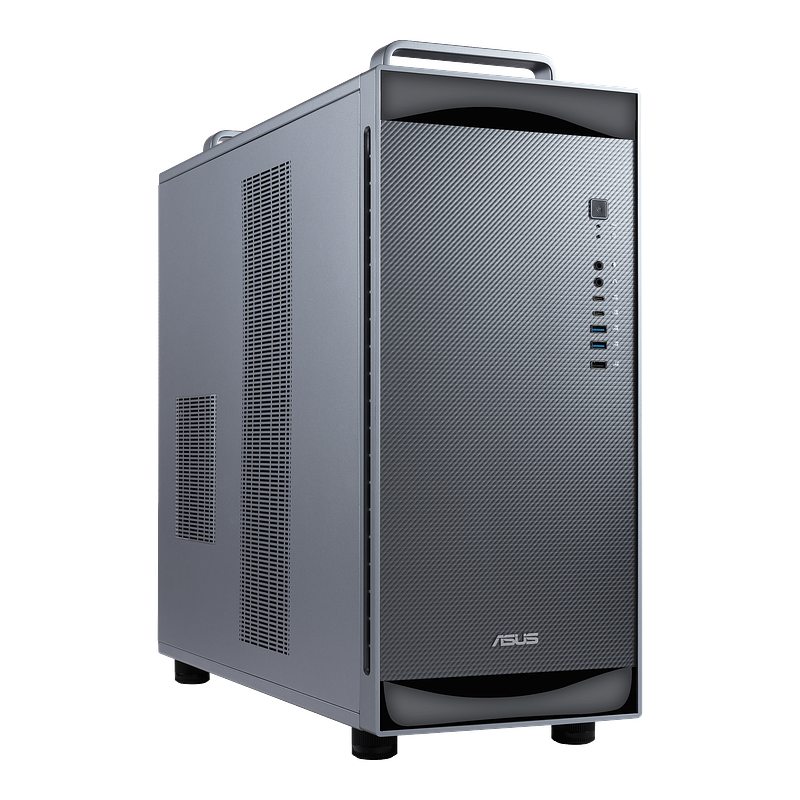
The AI Data Center on Your Desk: ASUS Launches the ET900N G3
LAS VEGAS, NV – January 06, 2026 – At CES 2026, ASUS has pulled back the curtain on a machine that could fundamentally reshape the landscape of artificial intelligence development. The new ExpertCenter Pro ET900N G3 is not just another powerful workstation; it's being hailed as a "deskside AI supercomputer," designed to bring the colossal power once reserved for sprawling data centers directly to the offices of researchers, developers, and data scientists.
Powered by the formidable NVIDIA GB300 Grace Blackwell Ultra Desktop Platform, this new system from ASUS promises to solve what many in the field call the "last-mile challenge" of AI, empowering innovators by putting petaflop-scale computing within arm's reach.
Beyond the Cloud: Solving AI's 'Last-Mile' Problem
For years, the story of advanced AI has been one of massive, centralized cloud infrastructure. While these services from tech giants offer immense scale, they have also created a bottleneck for many professionals. The process of uploading massive datasets, waiting for processing queues, and dealing with the latency of remote servers can stifle the rapid iteration that is crucial for discovery. Furthermore, concerns over data privacy, security, and the unpredictable, often staggering costs of cloud computing have become major pain points for enterprises and research institutions alike.
The ASUS ExpertCenter Pro ET900N G3 is engineered to directly address these issues. By providing a local, private, and immediately accessible powerhouse, it allows developers to train and fine-tune large language models (LLMs), run complex simulations, and experiment with multi-modal AI without sending sensitive data to a third-party server.
"For projects involving proprietary algorithms or confidential customer data, the cloud is often a non-starter," noted one industry analyst specializing in AI infrastructure. "A system that offers data-center-level performance while keeping everything on-premise is not just a convenience; it's a critical enabler for security-conscious industries like finance, healthcare, and defense." This shift towards local processing represents a broader trend of "cloud repatriation," where companies are strategically moving certain high-intensity, stable workloads back in-house to gain better control over performance, security, and long-term costs.
The Power Within: A Deep Dive into the Grace Blackwell Ultra Platform
At the core of the ET900N G3's remarkable capabilities is the NVIDIA GB300 Grace Blackwell Ultra Desktop Platform. This is not a simple pairing of a CPU and GPU; it's an integrated superchip where an NVIDIA Grace CPU and a next-generation NVIDIA Blackwell Ultra GPU are fused together with a high-speed, low-latency interconnect called NVLink-C2C.
This architecture enables one of the system's most revolutionary features: a massive 775GB pool of coherent unified memory. This means the CPU and GPU can access the same memory pool seamlessly, eliminating the time-consuming process of copying data back and forth between system and GPU memory—a traditional bottleneck in AI workloads. This unified memory is more than double what is found in a typical high-end, four-GPU workstation, allowing developers to work with significantly larger models and datasets than ever before on a deskside machine.
The raw computational muscle is equally staggering. The system delivers up to 20 PFLOPS of AI performance. A petaflop is a quadrillion floating-point operations per second, a measure of speed previously associated with room-sized supercomputers. This power, driven by NVIDIA's new fifth-generation Tensor Cores and advanced FP4 precision, dramatically accelerates tasks like LLM fine-tuning, deep learning research, and high-speed inference, turning weeks of computation into days or even hours.
A New Battlefield: The Deskside Supercomputer Market Heats Up
ASUS is not alone in recognizing this pivotal shift in the market. The launch of the ET900N G3, one of the first systems based on NVIDIA's DGX Station architecture to hit the broader market, places it at the forefront of a new and intensely competitive product category. The willingness of NVIDIA, which has historically kept its most powerful DGX-branded hardware in-house, to partner with OEMs like ASUS signals a major strategic push to democratize access to this technology.
Other major hardware players are already entering the fray. Dell has announced its "Pro Max with GB300" workstation, and HP has unveiled the ZGX Fury AI Station G1n, both leveraging the same powerful NVIDIA platform. Supermicro is also rolling out solutions based on the Blackwell architecture.
This burgeoning competition suggests a healthy and rapidly growing market for on-premise AI hardware. ASUS aims to differentiate itself with its deep expertise in thermal engineering, system integration, and its established enterprise support network. The ET900N G3 also features the ability to be interconnected with a second unit, effectively doubling its supercomputing power and providing a scalable pathway for organizations whose AI ambitions grow over time.
The Practical Realities of a Supercomputer on Your Desk
While the promise of a personal AI supercomputer is tantalizing, its adoption comes with practical considerations. The first is cost. While official pricing has not been released, the cutting-edge technology inside suggests a price tag well into the five-digit range, making it a significant capital investment for any organization.
The second major hurdle is infrastructure. A machine boasting this level of performance consumes a tremendous amount of power. For context, a single Blackwell Ultra GPU can have a power draw of up to 1.4 kilowatts. A complete system like the ET900N G3 will demand far more electricity than a standard office outlet can provide, likely requiring dedicated, high-amperage circuits.
This power consumption generates an enormous amount of heat, necessitating sophisticated cooling solutions. While ASUS is known for its thermal design, the noise from high-powered fans required to keep the system from throttling could be a significant issue in a quiet office environment. These are not plug-and-play devices; they are serious pieces of industrial hardware that demand a planned environment.
Despite these challenges, the launch of the ASUS ExpertCenter Pro ET900N G3, expected to be available in late Q1 2026, marks a watershed moment. It represents a fundamental democratization of AI power, moving it from the exclusive domain of hyperscale cloud providers to the hands of the innovators on the front lines. For businesses, research labs, and even individual creators, this accessibility could unlock a new wave of discovery and development, accelerating the arrival of the next generation of artificial intelligence.
Topics & Related
Artificial Intelligence
Generative AI
Large Language Models
Revenue
AI & Machine Learning
Cloud & Infrastructure
Semiconductors
AI & Software Platforms
Related Company Pulse