
- 60-70% cost savings: Companies can save 60-70% by engaging a fractional CFO instead of a full-time executive.
- $6.4 billion market by 2028: The fractional CFO services market is projected to reach $6.4 billion.
- 70% adoption rate: Over 70% of North American SMEs (revenues $5M–$50M) now use or consider fractional CFO services, up from 35% five years ago.
Experts agree that fractional CFOs provide a cost-effective, strategic alternative to full-time executives, enabling SMEs to access high-level financial guidance while maintaining agility in a competitive market.
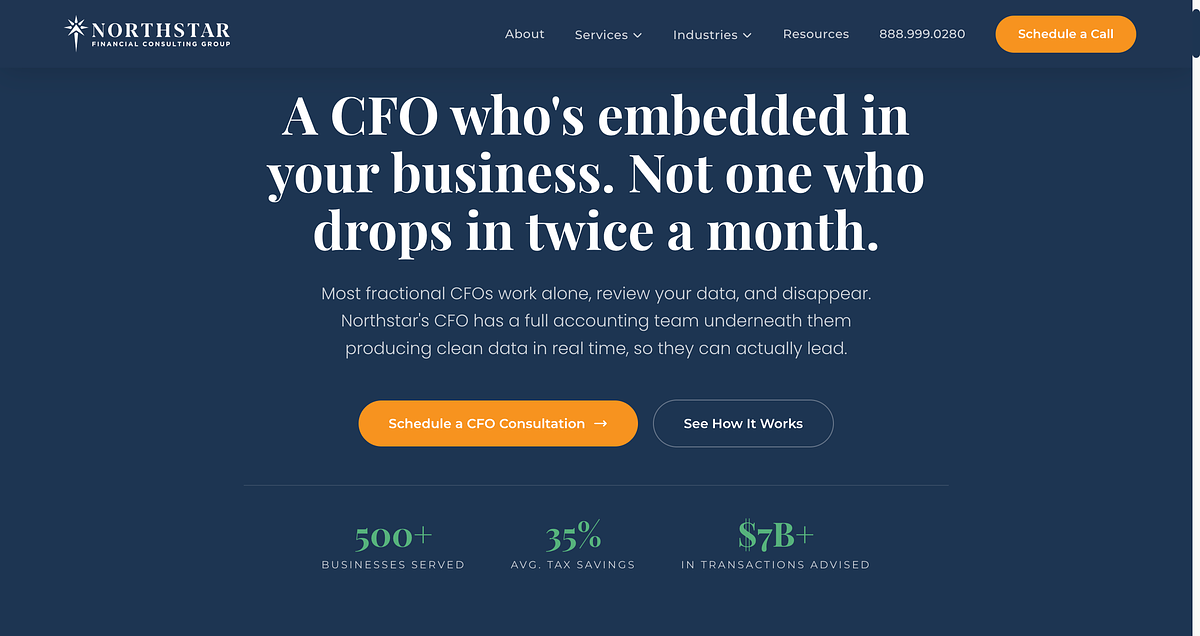
The Agile CFO: How Fractional Leadership is Reshaping Business Finance
BEVERLY HILLS, CA – April 13, 2026 – For many growth-stage companies, the path to expansion is paved with complex financial decisions. Yet, the very expertise needed to navigate this terrain—a Chief Financial Officer—often comes with a six-figure price tag that remains out of reach. This classic dilemma is now fueling a significant transformation in corporate finance: the rise of the fractional CFO.
A recent report from Beverly Hills-based Northstar Financial Advisory highlights a growing trend among companies in healthcare, e-commerce, and construction. Instead of committing to a full-time executive, these businesses are opting for flexible, on-demand financial leadership. This model provides access to seasoned strategic guidance without the hefty salary, benefits, and equity demands of a traditional C-suite hire, fundamentally changing how scaling businesses manage their money and their future.
A Market Shift Driven by Cost and Agility
The move toward fractional financial leadership is not just anecdotal; it’s a market shift backed by compelling data. With full-time CFO salaries continuing to climb, the fractional model presents an economically rational alternative. Research indicates that companies can achieve cost savings of 60-70% by engaging a part-time expert instead of hiring a full-time executive.
This cost-efficiency is a major driver behind the model's explosive growth. The market for fractional CFO services is projected to swell to $6.4 billion by 2028. Adoption rates are particularly high among small and mid-sized enterprises (SMEs), the very engine of the economy. According to recent industry surveys, more than 70% of North American companies with revenues between $5 million and $50 million are now using or considering fractional CFO services—a dramatic leap from just 35% five years ago.
"We reached a point where our bookkeeping software wasn't enough," stated the founder of a mid-sized e-commerce brand. "We needed strategic forecasting for inventory and marketing spend, but we couldn't justify a $250,000-a-year salary. A fractional CFO gave us that high-level insight for a price we could actually afford."
This trend is further accelerated by the modern realities of remote work and a tightening talent market. The scarcity of experienced financial talent has made it difficult for SMEs to compete for top-tier executives, while cloud-based accounting and communication platforms have made it easier than ever to integrate a virtual CFO into a company's daily operations.
Beyond Bookkeeping: The Strategic Role of a Modern CFO
A common misconception is to equate a fractional CFO with a high-level accountant or controller. While both roles are crucial, their focus is fundamentally different. Accounting is historical, meticulously recording and verifying financial transactions that have already occurred. A fractional CFO's role, however, is prospective.
These financial strategists interpret historical data to map out the future. Their work involves building detailed financial models to project cash flow, analyzing profitability by product or service line, and establishing key performance indicators (KPIs) that align with the company's growth objectives. They act as a strategic partner to the CEO, providing the financial grounding needed to make critical decisions about hiring, market expansion, pricing strategies, and capital investments.
Engagements often extend beyond day-to-day financial management to include high-stakes projects such as preparing for an audit, managing a capital raise, or overseeing the implementation of new financial systems. By focusing on forward-looking strategy rather than just backward-looking compliance, a fractional CFO helps a business move from simply surviving to strategically thriving.
Specialization is the New Superpower
As the fractional model matures, a new layer of value is emerging: deep industry specialization. A generalist financial background is no longer sufficient for companies operating in highly regulated or operationally complex sectors. Today, the most effective fractional CFOs are those who bring a wealth of industry-specific knowledge to the table.
This expertise is critical in navigating unique challenges and unlocking hidden opportunities.
* In healthcare, a fractional CFO must analyze complex payer reimbursement mixes, assess provider-level profitability, and navigate the intricate compliance landscape of medical billing.
* For construction firms, financial oversight centers on granular job costing, managing project-based cash flow, and mastering percentage-of-completion accounting to maintain profitability across long-term projects.
* E-commerce companies require a CFO who understands multi-channel revenue recognition, can optimize cost of goods sold (COGS) across a global supply chain, and can manage the complex web of sales tax nexus compliance.
* Even in nascent industries like cannabis, a specialized CFO is indispensable for navigating punitive tax codes like Section 280E and structuring the business to remain compliant with evolving state regulations.
This specialized expertise provides a competitive advantage, ensuring that financial strategy is not just theoretically sound but also practically grounded in the operational realities of the business.
Building the Finance Team of the Future
The rise of the fractional CFO does not signal the end of the in-house finance department. Instead, it points toward a more sophisticated, hybrid model. Many companies are finding success by pairing their internal bookkeepers and controllers with an external fractional CFO.
In this structure, the internal team manages the day-to-day financial operations—processing transactions, running payroll, and closing the books—while the fractional CFO provides the overarching strategic direction, mentorship, and a crucial external perspective. This integrated approach offers the best of both worlds: the consistency and institutional knowledge of an internal team combined with the high-level, on-demand expertise of a seasoned executive.
However, the model is not without its challenges. Success requires clear communication, well-defined roles, and a strong cultural fit. A fractional CFO, who may be juggling multiple clients, must be highly organized to provide the necessary attention, and the company's leadership must be prepared to trust and integrate an external advisor into key decision-making processes.
As businesses of all sizes continue to navigate economic uncertainty and intense competition, the need for agile, intelligent financial leadership has never been greater. The fractional CFO model has emerged as a powerful solution, democratizing access to strategic expertise and enabling a new generation of companies to scale with greater confidence, discipline, and financial control.
Topics & Related
Healthcare & Life Sciences
Financial Services
Digital Transformation
Workforce & Talent
Corporate Finance
Related Company Pulse