
- 15% faster installation compared to competitors
- 21.6 manhours saved per megawatt installed
- $1,080–$2,160 cost savings per megawatt based on labor rates
Experts agree that Terrasmart’s TerraTrak 1P Tracker offers a data-backed efficiency advantage, significantly improving installation speed and project economics for utility-scale solar developments.
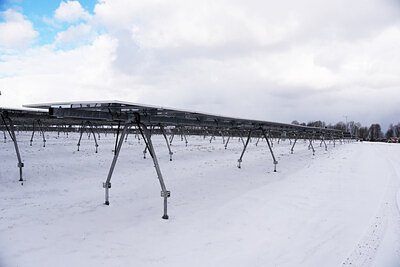
Terrasmart Tracker Cuts Solar Install Time by 15%, Study Finds
BUFFALO, NY – December 02, 2025 – In the relentless push to expand renewable energy, the solar industry's focus often gravitates toward photovoltaic cell efficiency. However, a significant, and often more impactful, battle is being waged on the ground, in the realm of installation logistics and construction speed. Terrasmart, a key player in solar racking and infrastructure, has just fired a significant volley in this battle, armed with data from an independent study that validates a major efficiency claim for its TerraTrak 1P Tracker.
A new report by Eclipse-M, a specialized third-party consulting firm for the solar industry, has concluded that Terrasmart’s single-axis tracker can be installed 15 percent faster than the average of three unnamed but market-relevant competitors. This finding moves beyond marketing claims and provides a data-backed benchmark that could have profound implications for the profitability and feasibility of utility-scale solar projects across North America.
The Bottom-Line Impact of Speed
For solar developers, engineering, procurement, and construction (EPC) firms, and investors, project timelines are intrinsically linked to financial returns. The 15 percent headline figure, while impressive, only scratches the surface of the economic impact. The Eclipse-M study dives deeper, quantifying the efficiency in terms of manhours per megawatt (MH/MW), the industry's standard unit for labor productivity.
The findings show that the TerraTrak 1P requires 160.2 MH/MW for value-added labor, a marked improvement over the 181.8 MH/MW average for the competing trackers. This translates to a direct saving of 21.6 manhours for every megawatt installed. In scenarios requiring pre-drilling for foundations, the advantage becomes even more pronounced, with the TerraTrak 1P using ground screws proving up to 41 MH/MW faster to install.
Translating these hours into dollars reveals a compelling business case. With blended labor rates for utility-scale solar projects often ranging from $50 to $100 per hour, the savings can accumulate rapidly. A 21.6 MH/MW reduction could yield savings of $1,080 to $2,160 per megawatt. For a standard 50 MW solar farm, this could represent a labor cost reduction between $54,000 and $108,000. In more complex pre-drill situations, those savings could nearly double.
Beyond direct labor costs, accelerated installation timelines shorten the entire construction schedule. This reduction minimizes a project's exposure to risks like weather delays and fluctuating material costs. More importantly, it brings the project online faster, allowing developers to begin generating revenue and delivering power to the grid sooner. This seemingly simple shift can significantly improve a project’s Internal Rate of Return (IRR), a critical metric for securing financing and ensuring long-term profitability.
Unlocking Solar's Potential on Challenging Terrain
Perhaps more strategically significant than the raw speed is how this efficiency is achieved and what it enables. The solar industry is increasingly confronting the scarcity of flat, easily developable land. The next frontier for large-scale solar lies on more complex sites: rolling hills, rocky ground, and reclaimed brownfields. These are the environments where traditional installation methods falter, often requiring extensive and costly civil work like land grading, which carries both financial and environmental burdens.
This is where the design of the TerraTrak 1P becomes a critical enabler. The study by Eclipse-M highlights key attributes contributing to its installation speed, including a high degree of pre-assembly of components like the motor and gearbox. However, its true versatility lies in its adaptability. The system features up to 36 inches of vertical adjustability in its A-frames and ground screws, allowing it to follow the natural contours of undulating terrain. This terrain-following capability dramatically reduces or even eliminates the need for site grading, a major cost center and source of project delays.
As Renee Roggow, VP of Racking Project Operations at Terrasmart, noted in the announcement, this versatility is becoming essential. "New solar site construction is taking place on more and more challenging sites, with trickier terrains and more extreme weather conditions," she stated. "Now, more than ever, keeping projects on-time and on-budget mean that owners and developers value versatile, fast, and easy-to-install trackers."
The tracker's "foundation agnostic" design further enhances this flexibility, allowing it to be paired with standard piles or, more strategically, with ground screws. This optionality allows engineers to select the optimal foundation for varying soil conditions across a single site, mitigating geotechnical risks like pile refusal in rocky soil, a common cause of costly construction standstills.
The Strategic Value of Third-Party Validation
In a competitive market flooded with performance claims, independent verification is the currency of trust. The decision to commission a study from Eclipse-M, a firm specializing in solar industry analytics, was a strategic one for Terrasmart. It elevates their efficiency claims from marketing assertions to validated, data-driven facts.
The methodology employed by Eclipse-M involved a rigorous process of reviewing installation documents, collecting on-site field data, and processing it through proprietary video analysis and time study modules. The use of statistical normalization was key to creating a true "apples-to-apples" comparison, ensuring that variables were controlled to isolate the performance of the tracker system itself.
For procurement managers at EPC firms and the financial analysts backing these multi-million-dollar projects, such credible, third-party data is invaluable. It provides a defensible basis for technology selection, helping to de-risk the construction phase—often the most unpredictable part of a project budget. By demonstrating a lower total installed cost through reduced labor and mitigated site-prep expenses, Terrasmart is shifting the conversation from the upfront price of components to the overall project value and profitability.
This move sets a higher bar for competitors in the crowded solar tracker space, which includes major players like Nextracker, Array Technologies, and Arctech Solar. It suggests a future where data-backed constructability reports become a standard part of the sales and evaluation process, driving the entire industry toward greater transparency and innovation focused on real-world field performance. Ultimately, innovations that streamline the physical assembly of our energy future are proving to be just as crucial as the silicon that captures the sun's rays.