
- 120,000-square-foot facility: Tendeg's new production plant is designed to manufacture over 100 deployable space antennas annually.
- $6.91 billion market projection: The global deployable antenna market is expected to grow from $3.18 billion in 2024 to $6.91 billion by 2033.
- $2.2 million in federal investment: NASA has backed Tendeg's compactable antenna technology with significant funding.
Experts would likely conclude that Tendeg's new facility represents a critical step in securing U.S. leadership in space hardware manufacturing, addressing both commercial demand and national security needs through scalable, high-quality production.
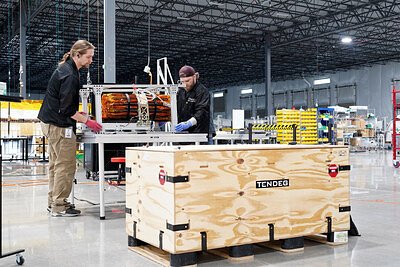
Tendeg's New Factory Aims to Secure US Lead in Space Hardware
LOUISVILLE, Colo. – April 14, 2026 – In a significant move signaling a new era of industrial-scale space manufacturing, Tendeg today announced the first flight antenna has shipped from its new 120,000-square-foot production facility. The milestone delivery from the "Innovation Drive" plant marks the company's pivotal transition from crafting bespoke, mission-specific components to high-volume production capable of supporting the booming demand for satellite constellations.
The state-of-the-art facility is engineered to produce more than 100 deployable space antennas annually, a capacity designed to meet the rigorous cadence required by both national security and commercial space programs. This shift addresses a critical bottleneck in the space industry, where the demand for proliferated satellite architectures has outpaced the traditional, slower manufacturing capabilities for complex hardware.
The Industrialization of the Final Frontier
The space economy is undergoing a profound transformation. The rise of Low-Earth Orbit (LEO) satellite constellations for everything from global broadband internet to advanced Earth observation has created an insatiable appetite for reliable, flight-proven hardware delivered at an unprecedented pace. The global market for deployable antennas alone is projected to more than double in the next decade, growing from roughly $3.18 billion in 2024 to an estimated $6.91 billion by 2033.
Tendeg's Innovation Drive facility is built to capture this explosive growth. By bringing engineering, precision manufacturing, integration, and environmental testing under one roof, the company aims to master the art of repeatability. The plant features vertically integrated capabilities, including specialized processes like mesh knitting and cord braiding, which gives Tendeg greater control over quality, production schedules, and its supply chain. This model is a departure from the one-off, highly customized approach that has defined specialized space hardware for decades.
"Over the past decade, we have proven these systems on orbit," said Gregg Freebury, CEO of Tendeg, in a statement. "Innovation Drive is the next step in that progression. It allows us to deliver proven deployable antenna technology with the manufacturing discipline, scale, and consistency that the market increasingly demands." This manufacturing discipline is key to reducing costs and lead times, making large-scale satellite deployments more economically viable.
Bolstering National Security and Supply Chain Resilience
Beyond the commercial implications, Tendeg's expansion carries significant weight for U.S. national security. As space becomes an increasingly contested domain, the ability to rapidly produce and deploy space assets is a strategic imperative. The U.S. Department of War and other government agencies have highlighted the risks associated with fragile, overseas supply chains for critical technologies. A resilient domestic industrial base is no longer a preference but a core component of national defense.
The Innovation Drive facility directly addresses these concerns. By onshoring the production of these vital components, Tendeg is strengthening the sovereign U.S. supply chain for space infrastructure. This move mitigates risks from geopolitical instability and ensures that defense programs have a reliable source for high-performance antennas. The company is already a strategic supplier to major defense contractors like Lockheed Martin, providing antennas for critical global security space missions, including tactical satellite communications that require secure and resilient links for military operations.
This domestic manufacturing capability provides the Department of War and intelligence agencies with schedule confidence and the ability to surge production if necessary, a crucial advantage in a dynamic security environment. The emphasis on a U.S.-based, vertically integrated facility ensures a trusted and traceable supply chain, safeguarding sensitive missions from counterfeit parts or foreign interference.
Enabling the Next Generation of Space Missions
Tendeg's deployable antennas are not just components; they are the enabling technology behind some of today's most advanced space missions. With over two dozen antennas already successfully deployed on orbit, the company has paired its proven flight heritage with this new production capacity. These antennas are characterized by their ability to be stowed in a compact volume for launch and then unfurl to a large aperture in space, providing the high gain necessary for powerful data transmission and reception.
This technology is critical for customers like Capella Space, which operates a constellation of Synthetic Aperture Radar (SAR) satellites. Tendeg provides the large reflectors that allow Capella's Acadia-class satellites to capture high-resolution, all-weather Earth imagery for defense, intelligence, and commercial clients. The partnership has already seen 25 successful on-orbit deployments.
For Astranis, Tendeg's antennas are a key part of its Omega-class satellite bus, designed to deliver affordable, high-throughput internet connectivity to underserved regions from geostationary orbit. The compact, efficient design is essential to the company's business model.
The technology is also advancing scientific discovery. NASA is leveraging Tendeg's antennas for its INCUS (Investigation of Convective Updrafts) mission, which will use a trio of small satellites to study the formation of tropical storms and improve climate models. The company's work with NASA, backed by over $2.2 million in federal investment for its compactable antenna technology, also includes developing hardware for future JPL projects like the RainCube follow-on mission and the ambitious Starshade exoplanet imaging concept.
Founded in 2016, Tendeg's rapid growth has been fueled by this strong demand from both government and commercial sectors. The company's expansion, apparently financed through revenue and strategic contracts rather than venture capital, underscores a sustainable business model built on proven performance and clear market need. The new facility in Louisville, Colorado, is not just an expansion of floor space; it represents a calculated investment in the future of space, positioning Tendeg to supply the critical hardware for the next generation of communications, sensing, and exploration in orbit.