
- $25 billion: Targeted new investments over the next five years
- 500,000 jobs: High-quality positions expected to be created
- $250 billion: Projected size of Telangana's life sciences ecosystem by 2030
Experts would likely conclude that Telangana's strategic pivot from manufacturing to innovation-driven biotech, backed by substantial investments and infrastructure development, positions it to become a leading global life sciences hub by 2030.
Telangana's $25B Bid to Become a Global Biotech Powerhouse
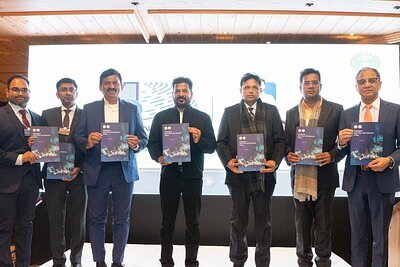
DAVOS, Switzerland – January 21, 2026 – The Government of Telangana, India, chose the global stage of the World Economic Forum to announce a radical transformation of its economic ambitions, unveiling a new policy designed to catapult the state into the world's top five life sciences clusters by 2030. The Next-Gen Life Sciences Policy 2026–30 signals a decisive pivot from a manufacturing-heavy model to one driven by high-value innovation, targeting an immense USD 25 billion in new investments and the creation of 500,000 high-quality jobs over the next five years.
Unveiled by Chief Minister A. Revanth Reddy, the policy is less an evolution and more a strategic reinvention. For decades, Telangana, and its capital Hyderabad, have been known as the reliable workhorse of the global pharmaceutical industry. The state currently accounts for 40% of India's pharmaceutical production and, critically, supplies one-third of the world's vaccines, earning it the moniker "Vaccine Capital of the World." But this new strategy aims to move the region far beyond its reputation for scale, positioning it as an originator of advanced therapies and a key player in shaping the future of global healthcare.
"We are building one of the world's most trusted and transformational biosciences ecosystems—driving global health impact from Telangana," said Chief Minister A. Revanth Reddy during the launch. "The policy's global unveiling at Davos reflects Telangana's conviction that the next phase of growth in life sciences will be driven by cross-border collaboration, global capital, and shared innovation agendas."
A Strategic Pivot from Scale to Science
The policy's core objective is to transition Telangana's already formidable USD 80 billion life sciences ecosystem into a USD 250 billion behemoth by 2030. This ambitious goal is predicated on a fundamental shift from scale-driven manufacturing to value-led, innovation-powered growth. While the state's existing infrastructure—home to over 2,000 life sciences companies and one of the highest concentrations of USFDA-approved facilities globally—provides a robust foundation, the new focus is squarely on research and development.
This shift is already underway. Global pharmaceutical giants like Amgen, Sanofi, Bristol Myers Squibb, and Lilly have recently established or expanded R&D, digital, and global capability centers in Hyderabad, a vote of confidence in the region's scientific talent and innovation-ready infrastructure. The city was recently the only one in India to be featured in the 'Global Life Sciences Atlas 2025' alongside established hubs like Boston, Cambridge, and Tokyo, signaling its rising prominence.
"The policy prioritizes frontier science and advanced manufacturing platforms, including cell and gene therapies, peptides, precision fermentation, and other next-generation modalities," explained D. Sridhar Babu, Minister for IT, Electronics & Communications, and Industries. He added that the strategy will strengthen the entire ecosystem, from clinical research and diagnostics to medical electronics and digital health, solidifying Telangana's position as a preferred destination for global life sciences investment.
Cultivating an Innovation Ecosystem
To power this transition, the government is rolling out two cornerstone initiatives designed to foster a self-sustaining cycle of innovation and talent development: a dedicated venture fund and a world-class university.
The Life Sciences Innovation Fund, launched with an initial corpus scalable up to INR 1,000 crore (approximately USD 100 million), is designed to be a powerful catalyst for the startup ecosystem. Operating on a public-private partnership model, the fund will co-invest alongside private venture capital to support early- and growth-stage deep-tech ventures. Its goal is to de-risk investment in novel technologies and ensure that promising translational research makes it out of the lab and into the market.
Complementing the financial support is a focus on human capital. The government announced the establishment of the Telangana School of Life Sciences, envisioned as a "university of global excellence." The institution's mission is to build a "ready-to-deploy bio-digital workforce" by developing industry-aligned curricula in critical domains like biologics, artificial intelligence in drug discovery, bioinformatics, and health economics. By providing structured internships and lifelong learning pathways, the school aims to create a deep talent pool capable of driving the next wave of scientific breakthroughs.
Building the Infrastructure for a Biotech Future
Telangana's ambition is backed by a massive infrastructure development plan aimed at creating globally benchmarked, sustainable industrial clusters. A key project is the establishment of a Green Pharma City, an integrated hub designed with sustainability at its core, featuring zero liquid discharge (ZLD) systems, centralized waste management, and a commitment to net-zero practices.
In a move to promote balanced and inclusive industrialization, the policy also outlines the creation of ten Pharma Villages. These specialized clusters, each spanning 1,000 to 3,000 acres, will be developed along Hyderabad's Outer Ring Road to decentralize growth and create new economic centers. These initiatives will be supported by the continued expansion of the renowned Genome Valley and the further strengthening of the state's Medical Devices Park, which offers plug-and-play facilities for manufacturing.
To ensure these ambitious projects translate into swift investment, the state is doubling down on its business-friendly regulatory framework. The TG-iPASS single-window system guarantees time-bound approvals, while a raft of new financial incentives—including 100% reimbursement of stamp duty, power subsidies, and SGST reimbursement for five years—are designed to make Telangana one of the most attractive investment destinations in Asia. By explicitly recognizing R&D units as full-fledged industrial enterprises, the policy ensures that innovators receive the same level of support as manufacturers, directly fueling the state's strategic pivot.