
- 77% overall response rate in heavily pre-treated leukemia patients using Revuforj
- 90% relapse-free survival in high-risk pediatric patients after stem cell transplant with Revuforj
- 86% overall response rate in newly diagnosed patients unfit for intensive chemotherapy when treated with Revuforj in combination therapy
Experts conclude that Revuforj represents a transformative advancement in leukemia treatment, particularly for patients with menin-dependent mutations, offering high response rates and durable remissions across diverse patient populations.
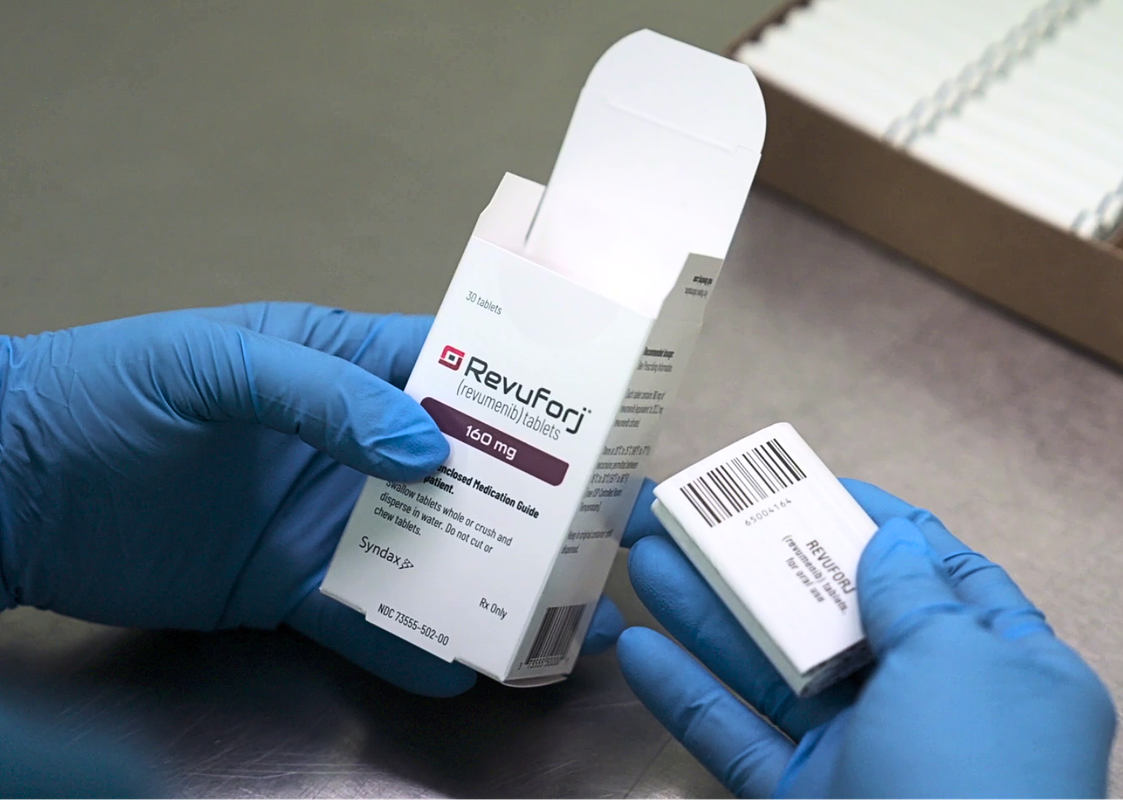
Syndax's Revuforj Rewrites the Playbook for Leukemia Treatment
NEW YORK, NY – December 08, 2025 – In the fast-paced world of oncology, true paradigm shifts are rare. Yet, data unveiled by Syndax Pharmaceuticals at the 67th American Society of Hematology (ASH) Annual Meeting suggests such a shift is underway for patients with acute leukemia. The company's oral menin inhibitor, Revuforj (revumenib), is not just meeting expectations but dramatically exceeding them, demonstrating remarkable efficacy and a manageable safety profile across a wide spectrum of treatment settings—from last-ditch efforts in relapsed patients to frontline therapy in the newly diagnosed.
The torrent of positive results, spanning a dozen presentations, solidifies Revuforj's position as a leader in a new class of targeted therapies and signals Syndax's aggressive strategy to redefine the standard of care for leukemias driven by specific genetic mutations, such as NPM1m and KMT2Ar. For patients, it offers new hope. For the business of biotech, it ignites a fierce competition for a multi-billion-dollar market.
Beyond a Last Resort: Real-World Efficacy and Expanding Hope
For any new drug, the transition from the pristine environment of a clinical trial to the messy reality of clinical practice is the ultimate test. Revuforj just passed with flying colors. The first-ever real-world evidence for a menin inhibitor, presented from a retrospective review at the Moffitt Cancer Center, showed a 77% overall response rate in a group of heavily pre-treated patients who had, on average, failed four previous lines of therapy.
Even more impressively, 75% of responding patients achieved measurable residual disease (MRD) negativity—a deep, molecular-level remission that is a strong predictor of long-term survival. This is a critical metric for oncologists and a powerful value proposition for the drug. It suggests Revuforj is not just temporarily stalling the disease but potentially eradicating it at its source.
“Among a real-world group of heavily pre-treated NPM1m, KMT2Ar, and NUP98r patients who received Revuforj as a monotherapy or in combination, it is very encouraging to observe the vast majority of patients achieve MRD negative responses and to see a meaningful number of patients proceed to a stem cell transplant with durable ongoing remissions,” said Dr. David Sallman, Associate Member in the Department of Malignant Hematology at Moffitt Cancer Center. “Our results underscore the potential for Revuforj to transform the standard of care for patients with menin-dependent acute leukemias.”
The drug's promise extends to the youngest and most vulnerable patients. In a separate study, Revuforj was used as a maintenance therapy for children who had undergone a hematopoietic stem cell transplant (HSCT). At a median follow-up of 19 months, 90% of these high-risk children were relapse-free, and all were still alive. The therapy was well-tolerated, with no patients discontinuing due to side effects—a crucial finding in pediatric oncology, where long-term quality of life is paramount.
The Frontline Offensive: A Strategy to Dominate the Market
While its initial FDA approval focused on the relapsed or refractory (R/R) setting, Syndax is making a bold strategic push into frontline treatment, aiming to make Revuforj a foundational therapy from the moment of diagnosis. The data from ASH 2025 provides a powerful tailwind for this offensive.
The Phase 2 SAVE trial evaluated an all-oral combination of Revuforj with other targeted agents (venetoclax and decitabine/cedazuridine) in newly diagnosed patients unfit for intensive chemotherapy, a group with limited options. The results were stunning: an 86% overall response rate and, among those who responded, a 100% rate of MRD negativity. A third of these elderly patients were able to proceed to a potentially curative stem cell transplant, an outcome often out of reach for this population.
For patients strong enough to tolerate intensive chemotherapy, another study showed that adding Revuforj to the standard regimen produced a 96% overall response rate and a 92% composite complete remission rate. This move into the frontline setting is the linchpin of Syndax's commercial strategy. It expands the addressable patient population from thousands in the R/R setting to tens of thousands, targeting the 40-50% of AML patients who may benefit from menin inhibition.
A Two-Horse Race: The Competitive Landscape Heats Up
Syndax isn't alone in this promising new field. The emergence of menin inhibitors has sparked a head-to-head competition, primarily with Kura Oncology and its recently approved drug, Komzifti (ziftomenib). Both companies are now racing to prove their drug is the superior option, particularly in lucrative combination therapies.
The battleground is increasingly focused on safety and "combinability." While both drugs carry a boxed warning for a serious side effect known as differentiation syndrome, Revuforj's label also includes a warning for QTc prolongation, a type of heart rhythm disturbance. While the ASH data showed these side effects were generally manageable—with low rates of treatment discontinuation—it remains a key point of differentiation.
Competitor Kura Oncology has been keen to highlight Komzifti's safety profile, suggesting it may be a more flexible partner for combination regimens. At ASH, Kura presented its own compelling frontline data for Komzifti in combination therapy, showing an 84% composite complete remission rate, setting the stage for a direct comparison. For physicians and health systems, the choice between these two powerful drugs may come down to a nuanced assessment of efficacy versus the ease of managing their respective side effect profiles. The company that can best demonstrate a superior balance will hold a significant competitive advantage.
From Clinical Win to Commercial Success: The Investor's Perspective
For investors, the flood of positive data has transformed Syndax's outlook. The company's stock has surged over 77% in the past six months, trading near its 52-week high. Analysts are taking note, with firms like Stifel reiterating a "Buy" rating and setting a price target of $44—more than double its current trading price—citing the drug's potential to become a blockbuster.
While Revuforj’s initial sales since its November 2024 launch have been described as "lighter than anticipated," the long-term thesis rests on the successful expansion into the frontline setting, which these new data sets strongly support. The initiation of pivotal frontline trials in early 2025 will be the next major catalyst, moving the company closer to a market opportunity that could redefine its financial future.
The key challenge remains execution. Syndax must effectively communicate the drug's robust efficacy and manageable safety profile to a clinical community now weighing multiple menin inhibitor options. As the company leverages its first-mover advantage and the wealth of data presented at ASH, the focus shifts from clinical validation to commercial acceleration. The data has been delivered; now, the race to capture the market and deliver this transformative therapy to patients who desperately need it begins in earnest.