
- EUR 16 million: Additional lifecycle returns projected for a 1 GWh project using PowerTitan 3.0
- 92%: System round-trip efficiency (RTE), maximizing revenue from energy storage
- 12 days: Time required to deploy a 1 GWh project, significantly reducing construction timelines
Experts view Sungrow's PowerTitan 3.0 as a transformative solution for Europe's energy transition, offering unparalleled efficiency, safety, and grid stability to support the region's renewable energy goals.
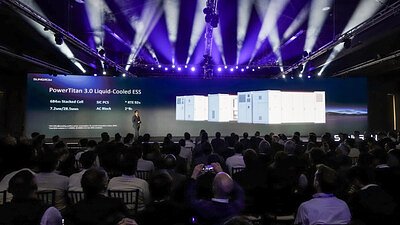
Sungrow's PowerTitan 3.0 Aims to Revolutionize Europe's Energy Grid
MADRID, Spain – January 29, 2026 – As Europe accelerates its shift towards a renewable-powered future, global energy technology leader Sungrow has launched its next-generation utility-scale energy storage system, the PowerTitan 3.0, on the continent. The system arrives at a critical juncture, designed to tackle Europe’s most pressing energy challenges—razor-thin profit margins, increasingly stringent grid codes, and an unwavering demand for safety and reliability.
Unveiled in Madrid, the PowerTitan 3.0 is a liquid-cooled battery energy storage system (BESS) engineered to unlock new levels of efficiency and profitability. Sungrow projects that the system can deliver an additional EUR 16 million in returns over the lifetime of a 1 GWh project, a figure that could fundamentally reshape the investment landscape for energy storage across the region.
The Economic Imperative: Redefining Profitability
In a market often constrained by low Power Purchase Agreement (PPA) prices, the financial viability of energy storage projects is paramount. The PowerTitan 3.0 directly addresses this with a multi-pronged approach to boosting revenue and cutting costs. The promise of EUR 16 million in additional lifecycle returns stems from a suite of technological and design enhancements.
At its core is a remarkable system round-trip efficiency (RTE) of 92%, a significant figure in an industry where typical lithium-ion RTEs can range from 77% to 95%. This high efficiency, powered by an industry-first large-scale application of a fully liquid-cooled Silicon Carbide (SiC) Power Conversion System (PCS), ensures that more of the stored energy is available for sale, maximizing revenue from every charge-discharge cycle. The PCS itself boasts a maximum efficiency of 99.3%.
Furthermore, the system's innovative architecture enables up to 8% more discharged energy over its lifetime through advanced plant-level State of Charge (SOC) balancing. By assigning one PCS per rack, it eliminates the common issue of SOC imbalance between different battery racks, ensuring the entire plant's capacity is utilized effectively.
Cost reductions begin before the system is even operational. With an energy density of 483 kWh/m², a 1 GWh plant can be constructed on a footprint of just 6,951 m², reducing land and construction costs by over 20% compared to peer solutions. Perhaps most impressively, the system’s modular, pre-installed, and pre-commissioned design enables a 1 GWh project to be fully deployed in just 12 days, drastically cutting project timelines and associated labor costs.
Engineering a Safer, More Efficient Core
Beyond the economics, Sungrow has placed an intense focus on the underlying battery technology and safety systems. The PowerTitan 3.0 moves away from traditional wound battery cells, instead adopting an innovative stacked cell design with capacities up to 684 Ah. This design eliminates the corner stress found in wound cells, a common point of failure, thereby reducing internal resistance and significantly lowering the risks of lithium plating, internal short circuits, and thermal runaway.
This inherent design safety is augmented by a sophisticated, multi-layered safety protocol. Sungrow's proprietary Battery Management 2.0 system provides over 95% accuracy in diagnosing lithium plating and more than 99% precision in thermal risk warnings, allowing for proactive prevention rather than reactive mitigation. The company has also pioneered a thermal-electric separation technology that physically isolates exhaust vents and electrode tabs, while patented heat-insulating layers are designed to reduce the risk of thermal runaway propagation by 40%. These advancements are validated by record-breaking large-scale burn tests that demonstrated zero fire propagation under extreme conditions.
The system's full liquid cooling is central to both its safety and longevity. By maintaining a consistent and optimal temperature across all cells, it prevents overheating and extends the battery's operational life. Research indicates the market for liquid-cooled stationary BESS is growing significantly, as the technology is recognized as a superior solution for managing the thermal demands of large-scale systems.
Anchoring Europe's Renewable Future
As the share of intermittent renewables like solar and wind grows, maintaining grid stability becomes exponentially more complex. The PowerTitan 3.0 is equipped with advanced “stem-cell” grid-forming technology, transforming it from a passive energy storage device into an active grid stabilizer. This capability is no longer a luxury but a growing requirement under tightening European grid codes.
The system can provide a 20-millisecond reactive power response and perform microsecond-level voltage construction, effectively mimicking the stabilizing inertia traditionally supplied by fossil fuel power plants. It also enables GW-scale black-start capability, allowing it to help restore a section of the grid after a complete blackout. The robustness of this technology has already been proven at an unprecedented scale in projects like the 7.8 GWh facility in Saudi Arabia, the world's largest grid-forming energy storage plant, giving European grid operators confidence in its performance.
With the European Union aiming for a 42.5% share of renewable energy by 2030, the need for intelligent, grid-forming storage solutions is undeniable. The PowerTitan 3.0 is positioned to be a cornerstone of this transition, enabling deeper penetration of renewables while enhancing overall grid security.
Built for Europe: Rapid Deployment and All-Weather Resilience
Recognizing Europe's diverse geography and climate, the PowerTitan 3.0 is built to withstand a wide range of environmental conditions without compromising performance. It can operate without derating in temperatures as low as –40°C, making it suitable for Nordic and Alpine regions, while its IP55 protection and C5 anti-corrosion rating ensure durability in coastal and high-humidity areas.
Sungrow is not a newcomer to the European market. The company has already deployed its PowerTitan series in several flagship projects, including the 800 MWh Vilvoorde BESS in Belgium, the 331 MWh Bramley BESS in the United Kingdom, and large-scale facilities in Finland and Germany. This established track record provides a strong foundation for the introduction of its latest, most advanced system. By combining proven resilience with breakthrough speed of deployment and advanced grid-support functions, the PowerTitan 3.0 is set to play a pivotal role in accelerating Europe’s journey toward a secure and sustainable energy future.