
- USDT Integration: SuisseGold now accepts Tether (USDT) payments for its entire catalog of physical precious metals, including gold, silver, and platinum.
- Global Access: Transactions can be settled in minutes, 24/7, with significantly lower costs compared to traditional banking infrastructure.
- Market Position: SuisseGold is among the first bullion dealers to price its entire inventory directly in USDT, offering a deeper integration for the stablecoin economy.
Experts view this integration as a strategic move to cater to the growing demand for seamless, efficient, and globally accessible investment options that bridge digital assets with traditional safe-haven assets like precious metals.
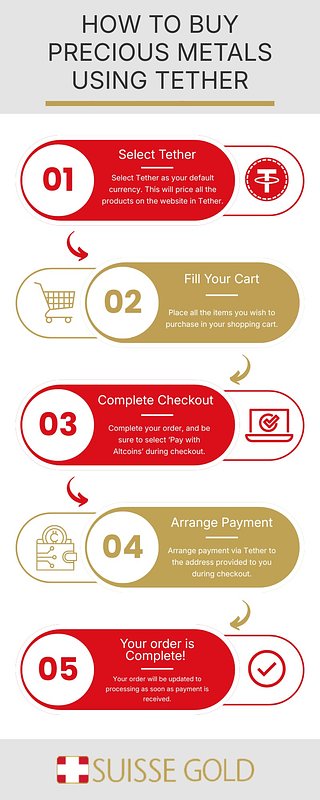
SuisseGold Integrates Tether for Gold, Bridging Crypto and Bullion
HONG KONG – March 13, 2026 – In a significant move to merge digital finance with traditional hard assets, bullion dealer SuisseGold has integrated Tether (USDT) payments for its entire catalog of physical precious metals. The initiative allows investors globally to purchase gold, silver, platinum, and other metals directly with the world’s most widely used stablecoin, creating a seamless pathway from blockchain capital to tangible wealth preservation.
The Hong Kong-based company announced that all its products are now priced in real-time in USDT, enabling digital asset holders to convert their holdings into physical bars and coins without interacting with traditional banking infrastructure. The development underscores a growing demand from investors looking to diversify portfolios and hedge against volatility in both digital and traditional markets.
“Stablecoins have become a major settlement layer in global finance,” a company spokesperson stated in the announcement. “By accepting USDT, we are creating a direct bridge between blockchain-based capital and physical precious metals for clients worldwide.”
The New Digital Gold Rush
The decision by SuisseGold taps into a burgeoning demographic of investors: cryptocurrency holders seeking to lock in gains or diversify their portfolios into time-tested safe-haven assets. For this group, which is often global, tech-savvy, and accustomed to the speed of digital transactions, using stablecoins to acquire physical gold is a natural next step.
The primary appeal lies in efficiency and accessibility. Traditional cross-border purchases of bullion can be encumbered by slow wire transfers, high banking fees, and business-hour limitations. Stablecoin transactions, however, can be settled in minutes, 24/7, from anywhere in the world, often with significantly lower costs. By pricing assets directly in USDT, SuisseGold aims to eliminate the friction of converting crypto-to-fiat before making a purchase, streamlining the entire investment process.
This trend is driven by a desire to hedge against economic uncertainty. As investors grapple with inflation and market volatility, the ability to fluidly move between the digital asset space and the physical world of precious metals offers a powerful diversification tool. It allows them to leverage the liquidity of their digital holdings to secure a tangible asset known for its historical stability.
A Competitive and Evolving Marketplace
SuisseGold is not the first bullion dealer to embrace digital currency, but its specific focus on a direct USDT integration highlights an evolution in the market. Several major retailers, including U.S.-based giants like APMEX and JM Bullion, have been accepting cryptocurrencies for years, typically through third-party processors like BitPay. These services allow payments in a variety of digital assets, from Bitcoin and Ethereum to meme coins like Dogecoin.
However, the direct pricing in USDT, a stablecoin pegged to the U.S. dollar, offers a distinct advantage by mitigating the price volatility inherent in cryptocurrencies like Bitcoin. This provides greater certainty for both the buyer and seller at the moment of transaction. While competitors like APMEX and Sharps Pixley also accept various stablecoins, SuisseGold's move to price its entire inventory in USDT suggests a deeper, more native integration designed to cater specifically to the stablecoin economy.
The convergence is also happening from the other direction. Major crypto platforms like Binance now offer perpetual futures contracts for gold and silver settled in USDT, allowing traders to speculate on metal prices without physical ownership. This growing ecosystem of financial products demonstrates an increasing comfort level with using stablecoins as a unit of account and settlement for commodity-linked assets, solidifying their role beyond simple crypto-to-crypto trading.
Benefits, Risks, and the Road Ahead
For consumers, the benefits of using stablecoins for such purchases are clear: speed, reduced costs, and global access. Yet, the technology comes with its own set of risks and responsibilities. As SuisseGold noted in its announcement, cryptocurrency transactions are irreversible. Once funds are sent from a digital wallet, there is no bank or intermediary to call to reverse the transaction if a mistake is made.
This places a significant onus on the customer to ensure accuracy. Verifying wallet addresses, understanding transaction fees on the blockchain (gas fees), and securing one's own digital assets against theft or loss are critical prerequisites. The finality of blockchain transactions is a feature, not a bug, but it represents a paradigm shift for consumers accustomed to the safety nets of traditional finance, such as chargebacks.
The choice of USDT itself is strategic. As the largest stablecoin by market capitalization, it offers deep liquidity and is integrated across countless exchanges and wallets. Its peg to the U.S. dollar provides the price stability necessary for high-value commerce, removing the risk that the value of the payment asset could dramatically change between checkout and settlement. This stability is a key reason why stablecoins are increasingly seen as the most viable digital currency for real-world transactions.
The Regulatory Horizon Looms
As the bridge between crypto and physical assets becomes more heavily trafficked, it is drawing increased attention from global regulators. Precious metals dealers are already highly regulated entities, subject to stringent Anti-Money Laundering (AML) and Know-Your-Customer (KYC) laws. Accepting cryptocurrencies does not exempt them from these obligations; in fact, it often invites greater scrutiny.
Dealers like SuisseGold must comply with frameworks established by bodies like the Financial Action Task Force (FATF), whose "Travel Rule" mandates that financial institutions and crypto service providers collect and transmit sender and receiver information for transactions above a certain threshold. This effectively dispels the myth of anonymous crypto-bullion purchases for any significant amount.
Furthermore, the stablecoin market itself is facing a wave of new legislation. The European Union’s Markets in Crypto-Assets (MiCA) regulation will impose strict requirements on stablecoin issuers regarding reserve management, transparency, and redemption rights. In the United States, lawmakers are debating federal oversight to ensure all stablecoins are fully backed by high-quality assets and operate with the same safeguards as traditional payment systems. This regulatory push aims to protect consumers and ensure financial stability, but it will also add compliance complexity and costs for businesses operating at this intersection. For investors, this means that while the technology offers new efficiencies, the transactions will be increasingly embedded within a formal, regulated financial structure.