
- Revenue growth: ₹3,260 crore in FY23 to ₹4,657 crore (US$561 million) in FY25
- Net losses reduced by 28% to ₹424 crore in FY25
- Facilitates over 200,000 car transactions annually across 22 cities
Experts would likely conclude that Spinny's vertically integrated, technology-driven model has successfully disrupted India's fragmented used car market, setting new standards for transparency and trust while demonstrating strong financial growth and investor confidence.
Spinny's Drive: How a Decade of Disruption Led to India's Top Growth Spot
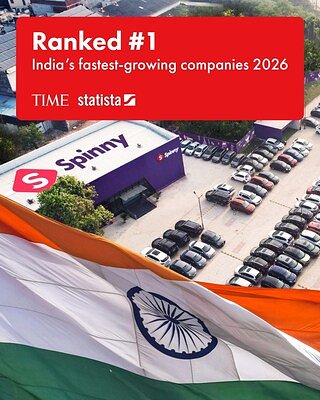
NEW DELHI, India – February 20, 2026 – On its tenth anniversary, used car platform Spinny has been crowned the fastest-growing company in India by TIME and Statista, a landmark recognition that validates a decade-long effort to bring order to one of the country's most fragmented markets. The inaugural 'India's Fastest-Growing Companies 2026' list placed Spinny at the #1 spot, a position earned through staggering revenue growth and sustained business performance between fiscal years 2022 and 2025.
The ranking, which required companies to demonstrate primarily organic growth and meet significant revenue thresholds, highlights Spinny's success in navigating and reshaping the notoriously opaque pre-owned vehicle sector. By building a vertically integrated system in a market dominated by unorganized brokers, the company has not only achieved rapid financial expansion but has also become a central figure in the ongoing formalization of India's automotive landscape.
A Decade of Driving Change in a Fragmented Market
When Spinny began its journey ten years ago, India's used car market was a landscape of uncertainty. Transactions were often fraught with mistrust, inconsistent quality, opaque pricing, and a near-total lack of post-purchase accountability. The company’s rise is a story of strategic evolution, beginning with a pivot from a peer-to-peer marketplace to a full-stack, inventory-led model in 2017.
This 'full-stack' approach is the cornerstone of its success. Unlike classifieds platforms, Spinny directly procures vehicles from sellers, puts them through a proprietary refurbishment process at its own facilities, and then retails them through a network of physical 'Spinny Car Hubs' and its online platform. This asset-heavy model gives the company end-to-end control over the value chain—from procurement and quality certification to retail and after-sales support. By internalizing these functions, it introduced a level of accountability previously rare in the sector.
This structured model has allowed the company to scale rapidly while maintaining standardized practices. Facilitating over 200,000 car transactions annually across 22 cities, Spinny has demonstrated that a systematic approach can thrive. Its investment in physical infrastructure, including 57 car hubs and large-scale refurbishment centers, combined with technology-led price discovery and inventory management, has helped establish clearer benchmarks for a more reliable and predictable used car ecosystem.
Building Trust on a Bumpy Road
A core pillar of Spinny’s brand identity is trust, a valuable and hard-won commodity in the used car business. The company has aggressively marketed a suite of customer-centric policies designed to build confidence and mitigate the risks associated with buying a pre-owned vehicle.
Central to this is its 'Spinny Assured' promise, which includes a rigorous 200+ point inspection process that the company claims only one in twenty cars passes. This is complemented by a 5-day, no-questions-asked money-back guarantee, allowing customers to return a vehicle if unsatisfied. In a significant move in June 2025, Spinny raised the industry bar by introducing a standard 3-year comprehensive warranty on its vehicles, covering critical components like the engine and transmission—a policy far more extensive than those offered by most competitors.
However, the road to building unwavering consumer trust is not without its challenges. While many customers praise the professionalism of Spinny's staff and the convenience of its home test drives and transparent pricing, online forums and review platforms reveal a more mixed reality. A significant volume of customer feedback points to post-purchase disappointments, with some buyers reporting mechanical issues and quality concerns that they feel should have been caught during the vaunted 200-point inspection. Reports also highlight frustrations with after-sales service and the warranty claim process, suggesting that scaling a consistent, high-quality post-sale experience remains a key operational hurdle.
This contrast between the company's stated promises and the varied experiences on the ground underscores the immense difficulty of standardizing quality and service at scale in such a complex product category. While Spinny has undeniably pushed the market toward greater transparency, its journey illustrates the persistent gap between a disruptive business model and its flawless execution.
The Financial Engine Behind the Growth
Spinny's #1 ranking is fundamentally a story of explosive financial growth, backed by strong investor confidence and astute financial management. The company's revenue trajectory validates its top position, with operating revenue surging from ₹3,260 crore in FY23 to ₹4,657 crore (US$561 million) in FY25. This growth has been accompanied by a clear focus on profitability.
For the second consecutive year, Spinny has narrowed its net losses, which fell by 28% to ₹424 crore in FY25. This improvement is credited to better gross margins and operational efficiencies achieved through technology and a rationalization of costs, including a notable reduction in employee benefits and advertising expenses. This disciplined approach suggests a maturing business model focused on sustainable growth rather than just cash burn.
This performance has kept investors enthusiastic. After achieving unicorn status in 2021 with a valuation of $1.8 billion, Spinny has continued to attract significant capital. Throughout 2025 and early 2026, it secured multiple funding rounds totaling over $300 million from prominent investors like Accel, Tiger Global, Fidelity, and WestBridge Capital, maintaining a steady valuation around $1.5 billion. This capital is being deployed to deepen its market penetration and expand its ecosystem, most notably through the acquisition of vehicle servicing startup GoMechanic in November 2025. The move signals Spinny's ambition to control an even larger portion of the automotive ownership lifecycle, from purchase to long-term maintenance.
A Bellwether for India's Digital Economy
Ultimately, Spinny's success transcends the automotive sector; it serves as a powerful case study for the broader digital transformation of India's economy. Its journey reflects a wider trend of homegrown startups leveraging technology and integrated business models to bring structure, transparency, and trust to traditionally unorganized industries.
The Indian used car market is projected to become an over $82 billion industry by 2031, and the organized segment's share is rapidly expanding, expected to grow from 20% to 35% by 2027. Spinny, along with competitors like CARS24 and CarDekho, is at the forefront of capturing this shift. By proving that a technology-enabled, full-stack model can win consumer trust and achieve massive scale, it provides a blueprint for disruption in other fragmented, high-value markets across India.
As the company celebrates its tenth year with this prestigious ranking, its story is not just about selling cars. It is about building a scalable, trust-based ecosystem in a market that desperately needed one, serving as a bellwether for a new generation of Indian enterprise poised for global recognition.