
- 5 MW electrolyzer system connected to a 10 MWp solar array for initial hydrogen production
- Project aims to scale to 50 MW of electrolysis capacity powered by up to 80 MWp of solar generation
- Spain's 2030 electrolyzer capacity target increased to 12 GW under the updated National Integrated Energy and Climate Plan (PNIEC)
Experts view this project as a critical test for economically viable green hydrogen production, leveraging off-grid solar power to reduce costs and demonstrate a scalable model for decarbonizing heavy industry and enhancing European energy independence.
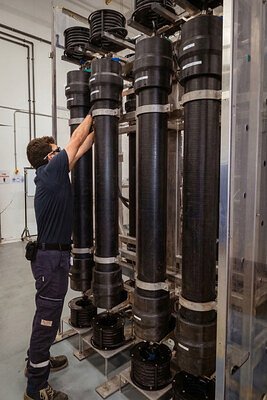
Spain to Host First Off-Grid Solar-to-Hydrogen Gas Blending Project
SEVILLE, Spain – March 11, 2026 – A landmark agreement signed today at the European Hydrogen Energy Conference (EHEC) is set to launch the world's first project to produce green hydrogen from entirely off-grid solar power for direct blending into a national gas network. Israeli clean-tech innovator H2Pro and global renewable developer Doral Hydrogen have partnered to co-develop the facility in Extremadura, Spain, a region blessed with some of Europe's highest levels of solar irradiation.
The project represents a critical test for a new generation of hydrogen production technology designed to solve the industry's most persistent economic challenge: the high cost of green hydrogen. By operating completely independent of the electrical grid, the venture aims to demonstrate a new, more economically viable model for scaling up the clean fuel, which is seen as essential for decarbonizing heavy industry and ensuring European energy independence.
Initially, the facility will feature a 5 MW electrolyzer system from H2Pro connected directly to a 10 MWp solar array. The produced hydrogen will be injected into the existing natural gas pipeline operated by Enagás. Ambitious plans are already in place to scale the project tenfold to 50 MW of electrolysis capacity, powered by up to 80 MWp of solar generation. In its later stages, the facility is slated to connect directly to the planned H2Med hydrogen backbone, a major artery designed to transport green hydrogen from the Iberian Peninsula to the rest of Europe.
A Technological Leap to Cut Costs
At the heart of the project is H2Pro's Decoupled Water Electrolysis (DWE) technology, a system engineered specifically to overcome the limitations of conventional electrolyzers. For years, the green hydrogen sector has faced a paradox: while the cost of renewable electricity has plummeted, the Levelized Cost of Hydrogen (LCOH) has remained stubbornly high. The core issue lies with traditional electrolyzers, such as PEM and Alkaline systems, which were designed for the steady, constant power supplied by a grid, not the fluctuating output of a solar panel or wind turbine.
When subjected to intermittent power, conventional electrolyzers suffer from accelerated degradation, reduced efficiency, and the risk of dangerous gas crossover. To compensate, developers are forced to add expensive battery storage systems or maintain costly grid connections, erasing the economic advantage of cheap renewable power. H2Pro's DWE technology, also known as E-TAC (Electro-chemical, Thermally Activated Chemical), sidesteps this problem entirely.
Developed from research at the Technion-Israel Institute of Technology, the DWE system separates the production of hydrogen and oxygen into two distinct steps. This temporal separation eliminates the need for the expensive and fragile membrane found in conventional electrolyzers. The result is a hyper-flexible system that can be turned on and off an unlimited number of times without damage, rapidly ramp its output up or down to match the sun's intensity, and maintain high efficiency across a wide operational range. By using common materials like nickel and standard plastics, the system also promises significantly lower capital costs.
"This project will demonstrate how hydrogen production can be designed from the outset to operate directly on renewable energy," said Tzahi Rodrig, CEO of H2Pro. "The ability to operate on intermittent renewable power, with endless on and off cycles and high efficiency at partial loads, is critical to unlocking lower-cost green hydrogen. By combining Doral Hydrogen's renewable development expertise with our DWE technology, we aim to demonstrate a new model for economically and technically viable fully off-grid hydrogen production."
Forging a New Economic Model
The ability to produce green hydrogen without grid reliance is being hailed as a potential game-changer for project developers. The simplified design reduces capital expenditure not only by eliminating the need for batteries but also by streamlining the entire engineering and construction process. This direct-to-renewables approach could fundamentally improve the business case for green hydrogen worldwide.
"From a developer's perspective, the ability to produce Green hydrogen without relying on grid electricity is a significant breakthrough," stated Yam Efrati, CEO of Doral Hydrogen. "Systems that can operate directly on renewable power simplify project design and reduce the need for costly batteries or grid backup. This can materially improve project economics."
This economic advantage is crucial for Doral Hydrogen, which is advancing a global portfolio of over 1 GW of green hydrogen projects. The company, which is the dedicated green gases platform of Doral Group, views the Extremadura site as a blueprint for future developments. "We are excited to work with H2Pro to demonstrate how renewable energy can integrate into existing energy infrastructure until future H2Med pipelines are built, and to ultimately replicate this model throughout our global portfolio," Efrati added.
Powering Spain's Green Hydrogen Highway
The project's location in Extremadura is no accident. Spain has firmly positioned itself as a future leader in Europe's hydrogen economy, backed by ambitious national policies and immense renewable resources. The Spanish government's updated National Integrated Energy and Climate Plan (PNIEC) dramatically increased its 2030 target for electrolyzer capacity to 12 GW.
To fuel this growth, Spain has unlocked billions in subsidies, much of it sourced from the European Union's pandemic recovery funds, to support everything from large-scale "hydrogen valleys" to the development of a national hydrogen backbone by gas operator Enagás. The H2Pro-Doral project provides an immediate pathway for this new hydrogen production by leveraging the existing gas grid for blending, a crucial transitional step before dedicated hydrogen pipelines are widespread.
Looking further ahead, the project is strategically located along the path of the future H2Med corridor. This transnational initiative, designated a Project of Common Interest by the EU, aims to build a pipeline capable of transporting two million tonnes of green hydrogen per year from Spain and Portugal to France and Germany by the early 2030s. Projects like the one in Extremadura are foundational, serving as the initial supply nodes for what will become a pan-European market for clean energy, enhancing the continent's energy security and accelerating its path to net-zero emissions.