
- 706.6 g/t silver in a 9.30-meter intercept, over 10x the average Canadian VMS deposit grade
- Visible gold discovered for the first time in the Detour-Selbaie Zone
- 90-meter-thick massive sulphide horizon identified at 1,137 meters depth
Experts would likely conclude that SOQUEM's discovery at the Wagosic Project represents a high-potential, high-grade polymetallic system with significant economic implications for Quebec's mining sector.
SOQUEM Hits Bonanza Silver, Visible Gold at Quebec's Wagosic Project
VAL-D'OR, QC – February 27, 2026 – Quebec’s state-backed exploration firm, SOQUEM, has unveiled a significant high-grade polymetallic discovery at its Wagosic Project, sending ripples of excitement through the province’s mining sector. Preliminary results from a single drill hole have returned exceptional silver grades, along with the first-ever visible gold found in the project's key zone, signaling the potential for a major new mineral deposit in the Abitibi greenstone belt.
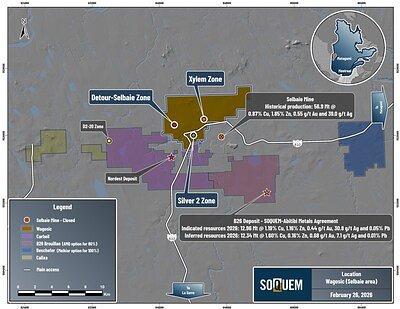
The discovery, located approximately 90 kilometers west of Matagami, is part of an aggressive drilling campaign aimed at expanding a mineral system near the historically significant Selbaie mine, a former giant that produced nearly 57 million tonnes of ore. The new results from SOQUEM suggest the Wagosic property could host a similarly large, and potentially richer, system.
A Bonanza-Grade Intercept
The standout result comes from drill hole 1338-26-093A in the Detour-Selbaie Zone. The hole intersected a 9.30-meter interval grading an impressive 706.6 grams per tonne (g/t) of silver (Ag), 1.27% zinc (Zn), 0.21 g/t gold (Au), and 0.28% lead (Pb). This high-grade section was part of a wider 20-meter mineralized zone that averaged 357.8 g/t silver.
To put the silver grade into perspective, the 706.6 g/t result is more than ten times the average grade for Canadian volcanogenic massive sulfide (VMS) deposits, which typically sit around 63 g/t. Even specialized high-silver VMS systems average closer to 150 g/t, making the Wagosic intercept exceptionally rich and a strong indicator of economic potential. While the zinc and gold grades are more modest compared to some of the world's richest VMS deposits, the sheer concentration of silver over a considerable width is what makes this discovery particularly noteworthy.
This high-grade zone, found at a depth of over 850 meters, contains visible quartz-sulphide-native silver veinlets and a 1.70-meter section of semi-massive sulphides, confirming the presence of a robust mineralizing system. The company noted this intercept represents a 230-meter extension from a large stockwork zone identified in previous drilling campaigns in 2024 and 2025, demonstrating significant growth in the system's known footprint.
Geological Breakthroughs Unlock Deeper Potential
Beyond the high-grade silver, the same drill hole yielded two other major geological breakthroughs for the Wagosic Project. For the first time in the Detour-Selbaie Zone, drillers observed visible gold. A small, 3-millimeter cluster of gold was identified at a depth of 1,020 meters within a separate 28-meter-thick mineralized interval containing copper and zinc sulphides. While the overall gold grade in this section is still pending, the presence of visible gold is a highly encouraging sign that can point to localized, very high-grade pockets of the precious metal.
Furthermore, the drill hole continued to deliver surprises at greater depths. At 1,137 meters, it intersected a substantial 90-meter-thick horizon of massive to semi-massive pyrite. This marks the first time such a massive sulphide lens has been encountered at this depth in the zone. In VMS systems, these massive sulphide bodies are often the primary ore-bearing lenses. Discovering such a thick horizon dramatically increases the project's potential for hosting a large-tonnage deposit.
According to the technical information released by the company and reviewed by its Qualified Person, Catherine Jalbert, these findings are consistent with a complex, multi-stage hydrothermal system that combines features of both VMS and epithermal-style deposits. This geological model involves mineral-rich fluids depositing metals at different levels, creating distinct zones enriched in zinc-silver, copper-gold, and massive sulphides. The mineralized system is now understood to be over 800 meters wide and extends to a depth of more than 900 meters.
Wagosic in the Shadow of a Giant
The Wagosic Project is strategically located near the former Selbaie mine, which operated from 1981 to 2004 and was a major producer of copper, zinc, gold, and silver. The historical production from Selbaie—56.9 million tonnes grading 0.87% copper, 1.85% zinc, 0.55 g/t gold, and 39 g/t silver—establishes the region's geological pedigree for hosting world-class deposits.
While Wagosic's zinc and gold grades in the latest intercept are lower than Selbaie's lifetime average, its silver grade of 706.6 g/t dwarfs Selbaie's 39 g/t average. This suggests Wagosic may represent a different, silver-rich part of the broader mineral district, or a completely distinct system with its own unique high-grade characteristics. The successful extension of mineralization and the discovery of new sulphide horizons fuel optimism that Wagosic could eventually define a resource rivaling its historic neighbor in scale, but with a potentially more valuable precious metals component.
A Strategic Play for Quebec's Mineral Future
As a subsidiary of Investissement Québec, the provincial government's economic development arm, SOQUEM's success is more than just a corporate achievement. It represents a validation of the government's strategy to proactively explore and develop Quebec's vast mineral wealth. SOQUEM’s mandate is not only to make discoveries but also to stimulate local economies and solidify Quebec’s status as a top-tier global mining jurisdiction.
Because SOQUEM is not a publicly traded company, these results won't trigger a stock market frenzy. However, the discovery is expected to generate significant buzz within the industry, likely attracting further exploration investment into the Matagami region from other junior and major mining companies. A major discovery by a well-funded, state-backed entity often de-risks a region for other explorers, creating a positive feedback loop of investment and activity.
The ongoing exploration program is substantial, with over 16,000 meters of drilling planned for the 2025-2026 season. With three active drill rigs, SOQUEM is simultaneously testing the Detour-Selbaie, Silver 2, and Xylem zones. The objective is to rapidly advance the Detour-Selbaie and Silver 2 zones towards an initial assessment of their mineral potential, which the company has scheduled for 2027.
Crucial metallurgical testwork is already underway on samples from previous drill holes to determine the efficiency of metal recovery. The results of these tests will be a key factor in determining the project's future economic viability. In the meantime, additional drilling is planned to further define the extent of the high-grade mineralization around the successful 2025 and 2026 drill holes, with an electromagnetic survey also planned to help define deeper targets for the next phase of exploration in 2027.