
- $32M in new funding secured for expansion
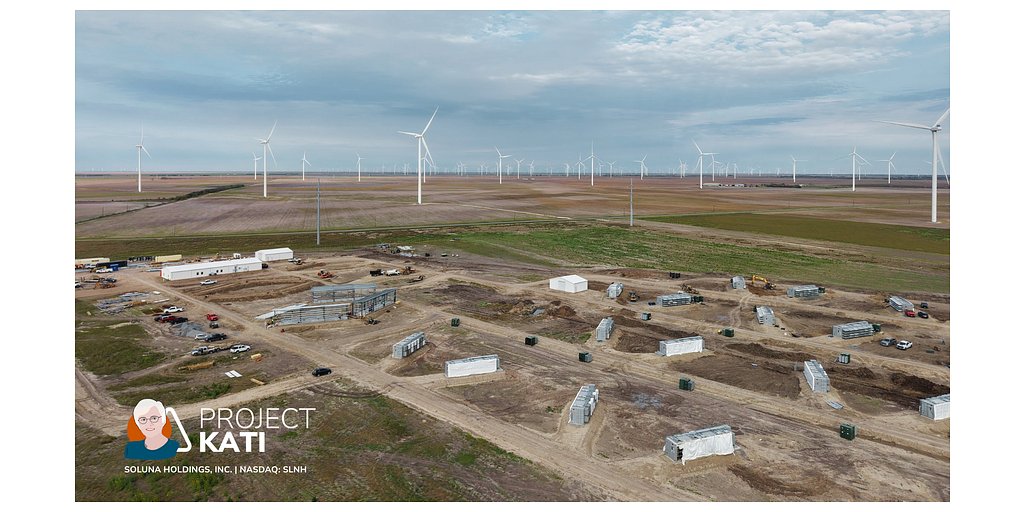
- 83 MW facility (Project Kati) under construction in Texas
- 50 MW expansion planned for AI-focused Project Kati 2
Experts would likely conclude that Soluna's strategic integration of renewable energy with high-intensity computing positions it as a leader in sustainable AI and crypto infrastructure, addressing critical energy challenges in the tech industry.
Soluna's Green Data Centers to Power AI, Crypto with $32M Boost
ALBANY, N.Y. – January 13, 2026 – Soluna Holdings, Inc. is aggressively scaling its operations at the intersection of renewable energy and high-intensity computing, backed by a fresh $32 million in funding. The company's latest monthly update reveals significant progress in constructing new green data centers for both Bitcoin mining and the burgeoning Artificial Intelligence (AI) market, signaling a strategic push to transform surplus green energy into a critical digital resource.
Securing Capital for a Compute-Intensive Future
A key development underpinning Soluna's ambitious roadmap is the recent closure of a $32 million registered direct offering. The capital injection, priced at-the-market, is earmarked for working capital and project-level equity, directly strengthening the company’s balance sheet to fuel its expansion. This financing arrives at a pivotal moment, providing the necessary resources to advance a multi-project pipeline designed to meet the voracious energy demands of modern computing.
The funds will support the build-out of several large-scale sites, including the rapid construction of facilities in Texas. This financial maneuver positions Soluna to execute on its plans without delay, a critical advantage in the fast-paced data center industry where power availability has become the primary bottleneck for growth.
From Bitcoin Mining to AI Supercomputing
Soluna's project updates illustrate a dual-pronged strategy that leverages its expertise in Bitcoin mining infrastructure while pivoting toward the high-growth AI and High-Performance Computing (HPC) sector.
Its established Bitcoin hosting and mining sites—Projects Dorothy and Sophie—are operating near full capacity, though they have begun participating in winter demand response programs. This involves periodically curtailing power usage to help stabilize the local energy grid during peak demand, showcasing the symbiotic relationship Soluna aims to build with energy providers.
The most significant construction is at Project Kati in Texas. The first phase, an 83 MW facility for Bitcoin hosting, is advancing rapidly, with the initial 48 MW section on track for substantial completion by the end of January 2026. This site alone represents a major increase in the company's operational footprint.
More strategically important, however, is the development of Project Kati 2, an adjacent facility being designed specifically for AI and HPC workloads. Soluna has secured a non-binding letter of intent from a potential "Neocloud tenant" for this site. Neoclouds are a new class of specialized cloud providers focused on delivering the high-density GPU power required for AI model training and inference, a market segment that traditional hyperscalers are struggling to fully accommodate. The plan for Kati 2 includes an expansion of over 50 MW, underscoring the scale of demand for AI-ready data centers. A smaller, 2 MW AI-focused site, Project Grace, is also in the detailed engineering phase, serving as a proving ground for integrating AI workloads into its microgrid designs.
The Green Grid: Taming Renewable Power for Digital Demand
Soluna's core thesis is that the future of computing lies not in crowded urban hubs, but at the source of abundant, often underutilized, renewable energy. The company’s strategy directly confronts the challenge of intermittency associated with wind and solar power by building data centers that can act as a flexible, dispatchable load.
Project Kati exemplifies this model. The facility is co-located with the 273 MW Las Majadas Wind Farm in South Texas, owned by industry giants EDF Renewables and Masdar. Through an innovative Power Purchase Agreement (PPA), Soluna will draw up to 166 MW of "behind-the-meter" power directly from the wind project. This arrangement allows it to capture clean electricity that might otherwise be curtailed due to grid congestion, effectively turning a potential energy surplus into valuable computing output.
The company's participation in demand response programs further reinforces this integration. By powering down during times of high grid stress, Soluna not only contributes to grid stability but also capitalizes on favorable energy market dynamics. This flexible approach is becoming increasingly critical as grids strain to support the electrification of transport and the explosive growth of data centers, where power procurement can now involve multi-year waiting lists.
A New Engineering Philosophy for the AI Era
Underpinning Soluna's physical expansion is a distinct technological philosophy articulated by its leadership. Recent essays from CTO Dip Patel champion a move away from traditional cloud architecture towards a more holistic "systems engineering" approach, particularly for the power-dense requirements of AI. The argument is that building the next generation of data centers is less like software architecture and more like designing high-power radar systems—requiring an obsessive focus on power efficiency, thermal management, and hardware integration from the ground up.
This philosophy manifests in the company's "bring compute to power" strategy. Instead of transmitting electricity over long distances to data centers, Soluna builds the data centers where the green power is generated. This reduces transmission losses and taps into energy sources that are otherwise "stranded" due to a lack of grid capacity. By designing its computing operations to be flexible and match the variable output of renewable sources, the company aims to create a cost-effective and sustainable solution for the world's most compute-intensive applications.
With definitive agreements to acquire land for several new pipeline projects—codenamed Rosa, Ellen, and Hedy—and ongoing negotiations for others, Soluna is laying the groundwork for a future where gigawatts of renewable computing capacity are unlocked. The company's progress in December 2025 demonstrates a clear execution of this vision, positioning it as a key enabler of a greener digital economy.