
- 73% of total solar project financial losses are due to hail, despite hail representing only 6% of all loss events.
- 19% of hail-related losses occurred in North Carolina, a region not traditionally considered high-risk.
- Wind speeds during hailstorms were found to be more than double previous estimates in some locations.
Experts agree that the newly quantified interaction between wind and hail significantly increases the risk of damage to solar infrastructure, necessitating more accurate risk models and proactive protective measures to ensure grid stability and financial resilience.
Solar's Hail Risk Redefined by New High-Wind Threat Data
SAN JOSE, CA – March 10, 2026 – The solar industry is confronting a newly quantified and significant threat as emerging data reveals that wind speeds during hailstorms are far stronger than previously understood, dramatically increasing the risk of catastrophic damage to solar power facilities. In response, VDE Americas, a global leader in renewable energy risk assessment, has announced a major enhancement to its proprietary Hail Risk Model, incorporating the new meteorological findings to provide what it calls a more realistic and accurate prediction of potential losses.
This development comes at a critical time for the energy sector. As solar power expands into new territories to become the world's largest source of new electricity, its infrastructure is increasingly exposed to extreme weather. The new analysis indicates that stronger winds cause hailstones to strike solar panels more directly and with greater force, a dangerous combination that significantly raises the likelihood of costly panel breakage and long-term performance degradation.
The Billion-Dollar Blind Spot
Hail has long been recognized as the solar industry's most financially damaging peril. According to data from kWh Analytics, a specialty climate insurance provider, hail accounts for a staggering 73% of total solar project financial losses, despite representing only 6% of all loss events. This disproportionate impact highlights the catastrophic nature of severe hailstorms, which can cripple a multi-million-dollar facility in minutes.
“Our loss database of physical damage events to renewables assets reveals that hail accounts for 73% of total solar losses despite representing only 6% of loss events,” said Nicole Thompson, Senior Data Science Manager for Property Insurance at kWh Analytics. “Moreover, we found that, by count, 19% of these hail-related losses occurred in North Carolina, which is not traditionally considered a high-risk area for hail.”
Historically, the interaction between wind and hail was a known variable, but its true force was a blind spot in many risk calculations. VDE's recent analysis, which involved carefully filtering weather records to isolate events where hailstorms passed directly over weather stations, found that wind speeds in some locations were more than double the previous estimates. This finding fundamentally alters the risk equation.
“Wind speed and direction modify both the fall angle and impact energy of hail,” explained Dr. John Allen of Central Michigan University, a leading hail meteorology expert and consultant to VDE. “To effectively predict damage in the field, hail loss models need to account for the influence of wind. VDE's improved loss model better informs this extremely important piece of the puzzle by more accurately characterizing representative wind speed and direction during hail events.”
A New Generation of Weather Intelligence
The enhanced risk model from VDE Americas is designed to move beyond broad statistical probabilities and provide project-specific, actionable intelligence. By integrating the more accurate wind data, the model aims to deliver more effective storm warnings with fewer false alarms and offer more precise guidance on protective measures, such as the optimal “hail stow” angle for solar trackers.
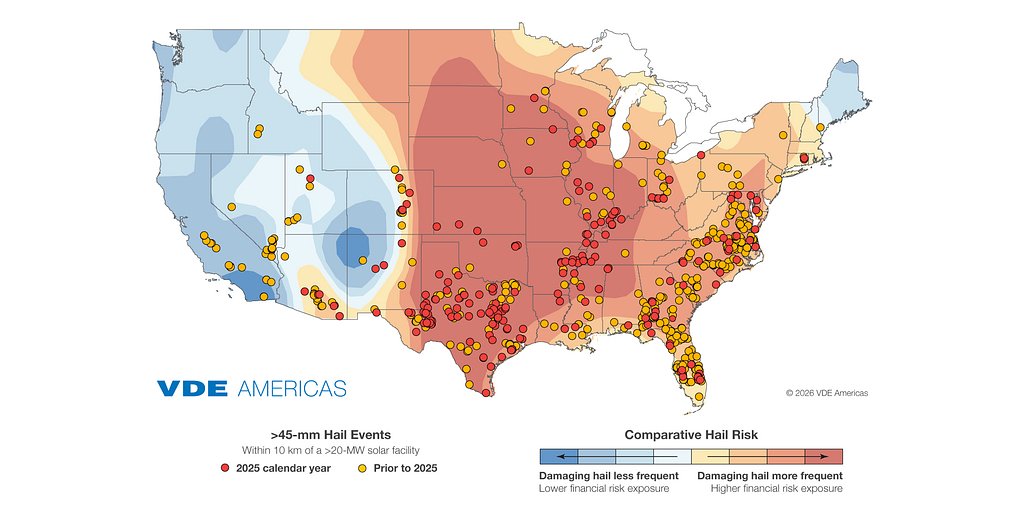
This is particularly relevant given the findings from VDE’s analysis of 2025 weather radar data, which indicated that severe convective storms—producing hail larger than 45 millimeters, a typical damage threshold for panels—occurred near dozens of utility-scale solar plants. While reported catastrophic losses were lower in 2025 than in previous years, this is largely attributed to the increased adoption of proactive measures like severe weather alerts and hail stow protocols by project operators. This trend underscores a growing industry awareness and a demand for more sophisticated tools.
To meet this demand, VDE is launching a suite of “Hail Risk Intelligence” products and services through a new sales portal. A key offering is an annual subscription service that delivers updated hail loss reports to support clients during insurance renewal negotiations. Other services include high-resolution hail risk maps, engineered financial loss reports, and customized hail stow protocols designed to maximize asset protection.
“Solar is the largest source of new electricity capacity globally, but without adequate planning, the combination of wind and hail represents a significant threat to the operation of these facilities,” said Brian Grenko, CEO and President of VDE Americas. “Our Hail Risk Intelligence products and services provide project stakeholders with the most accurate data available to optimize asset resiliency and mitigate potential financial losses.”
Building a More Resilient Energy Future
The implications of this refined risk modeling extend far beyond individual projects, touching on the broader goals of grid stability and climate resilience. As the U.S. and other nations invest trillions in the energy transition, ensuring the durability of renewable infrastructure against increasingly frequent and intense weather events is paramount for energy security.
The expansion of solar energy from its traditional strongholds in the arid Southwest into hail-prone regions like Texas and the Midwest has put more assets directly in harm's way. A single 2019 hailstorm in Texas, for instance, resulted in an estimated $70-80 million in insurance claims for one facility. With the renewable energy insurance market absorbing hundreds of millions in hail-related losses in recent years, accurate risk assessment is no longer a luxury but a necessity for securing affordable insurance and project financing.
This push for greater resilience is an industry-wide effort. Solar panel manufacturers are working to engineer more durable modules, while tracker companies are designing systems that can quickly and reliably move into defensive stow positions. Research from institutions like the National Renewable Energy Laboratory (NREL) continues to quantify the long-term productivity losses caused by severe weather, providing a scientific basis for investment in stronger materials and smarter operational strategies. VDE's enhanced model represents a critical piece of this collaborative puzzle, providing the high-fidelity data needed to connect advanced hardware with intelligent, real-time decision-making, ultimately helping to build a more robust and reliable renewable energy grid.