
- $100 billion: Projected global solar highway market size by 2032
- 35 lbs: Weight of the new SR5 Solar Road Panel, half of its predecessor
- $5 million: Funding goal for Solar Roadways' equity crowdfunding campaign
Experts acknowledge Solar Roadways' innovative approach but caution about significant challenges in efficiency, cost, and durability that must be overcome for widespread adoption.
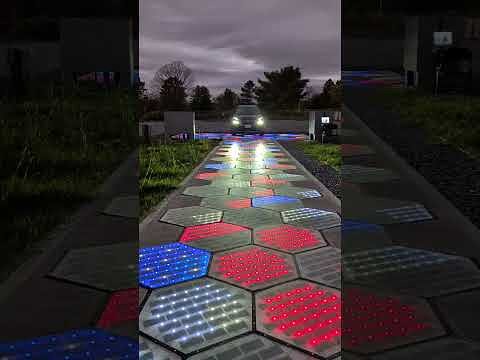
Solar Roadways Unveils New Panel, Military Deal in Push for Mass Market
SANDPOINT, ID – April 08, 2026 – After two decades of development, Idaho-based Solar Roadways is making a significant push toward commercialization, unveiling its fifth-generation solar panel, announcing its first deployment on a U.S. military base, and launching a new public investment round to scale manufacturing. The company, which aims to replace asphalt and concrete with power-generating, intelligent pavement, hopes these milestones will pave the way for a technology once relegated to viral videos to become a tangible part of American infrastructure.
The recent announcements cap a long journey for the company founded in 2006 by Scott and Julie Brusaw. They first captured global attention with their "Solar Freakin' Roadways" video, which amassed millions of views and sparked widespread enthusiasm. "I watched the worldwide enthusiasm for Solar Roadways explode when we released our viral Solar Freakin' Roadways video," said Co-Founder Julie Brusaw in a statement, noting that people love the idea of a panel that doubles for sports and games while enhancing safety.
This public interest was matched by government support, with the company successfully completing seven grants from federal agencies, including the U.S. Department of Transportation (USDOT) and the Department of Defense (DoD), which funded extensive research, independent testing, and the creation of the world's first solar parking lot.
A Fifth-Generation Panel Hits the Pavement
At the heart of the announcement is the new SR5 Solar Road Panel. This latest iteration incorporates years of engineering lessons learned from previous prototypes. To improve performance and serviceability, the panel's intelligence is now housed in an external "Brain Box," allowing for easier upgrades. The design also features a new aluminum base, which has reportedly cut the panel's weight by more than half—from 75 to 35 pounds—and aids in heat dissipation, a critical factor for solar efficiency.
This SR5 model is the version that has been deployed at an undisclosed U.S. military base, a significant validation for the technology's robustness. The DoD's interest is not new, with the Air Force Research Laboratory (AFRL) having previously awarded the company research contracts.
"I love supporting our military bases and our country," said Co-Founder Scott Brusaw, a Marine veteran. "Our manufacturing partner manufactured the panels for our first military installation and shares our commitment for America's SRPs to be made in the USA. We want to support American manufacturing and job growth while protecting the environment."
This commitment to domestic production is a core part of the company's strategy. Solar Roadways has identified its first manufacturing partner in Ohio and is pursuing a decentralized model, aiming to establish partners in various states and countries to reduce shipping costs and environmental impact.
Navigating a Crowded and Skeptical Market
Solar Roadways is entering a market that, while nascent, is projected to be enormous. A 2023 report from Polaris Market Research predicts the global solar highway market will grow from over $31 billion in 2022 to more than $100 billion by 2032. The company positions itself at the intersection of clean energy, smart cities, and decentralized power grids.
However, the road is far from clear. Several international competitors have already deployed similar technologies with mixed results. France's Wattway, built by the Colas Group, saw its flagship solar road project in Normandy suffer from rapid surface deterioration and lower-than-expected energy output. A test highway in Jinan, China, also faced performance and durability issues, leading the country to shift its focus toward installing panels alongside highways rather than embedding them in the surface. Other players like SolaRoad in the Netherlands and PLATIO in the residential sector are also vying for a piece of the market.
Beyond competition, the core concept faces significant skepticism from engineering and energy experts. A primary concern is efficiency. "Flat-lying panels are inherently less efficient than tilted ones," noted one renewable energy analyst. "When you add shading from vehicles, dirt, and the simple fact that they can't track the sun, you're looking at a significant power loss, perhaps generating only a third of what a conventional solar farm could with the same cells."
The High Cost of Intelligent Infrastructure
Cost remains the most significant hurdle. While traditional asphalt is relatively cheap, the price of intelligent, power-generating glass panels is orders of magnitude higher. An early demonstration project in the company's hometown of Sandpoint, Idaho, reportedly cost over $60,000 to install just 1.5 kilowatts of capacity—a price per kilowatt far exceeding that of standard rooftop or utility-scale solar installations. Critics argue that replacing all U.S. roads would be astronomically expensive, with some estimates running into the tens of trillions of dollars.
Furthermore, the panels' signature features, such as embedded LEDs for dynamic lane markings and heating elements to melt snow, consume a substantial portion of the power they generate. One analysis suggested the heating elements alone could negate any net energy gain if used for even a few days a year. Durability and safety also remain open questions. Experts question whether a glass surface, even a heavily textured and reinforced one, can withstand the constant punishment of heavy truck traffic over decades as well as flexible asphalt does, or provide adequate traction in all weather conditions.
To overcome these challenges and move toward mass production, Solar Roadways is again turning to the public for funding. The company has launched an equity crowdfunding campaign on Wefunder, seeking up to $5 million at a pre-money valuation of $33 million. The funds are earmarked to complete the crucial UL certification process—a key step for commercial viability—and to accelerate the scaling of its manufacturing capabilities. This financial push represents a critical moment for the company, as it seeks to prove that its ambitious vision for the roads of the future can overcome the practical and economic obstacles that lie in its path.