
- J.D. Power Score: SoFi achieved a satisfaction score of 724/1000, outperforming competitors like Citi (710) and Fidelity (707).
- Member Growth: SoFi added 1 million new members in Q4 2025, with revenue climbing 37% year-over-year to over $1 billion.
- Ecosystem Engagement: 40% of new products were opened by existing members, highlighting successful cross-selling.
Experts agree that SoFi's digital-first strategy and integrated financial ecosystem have set a new standard for DIY investor satisfaction, outpacing traditional firms through seamless technology and transparent value.
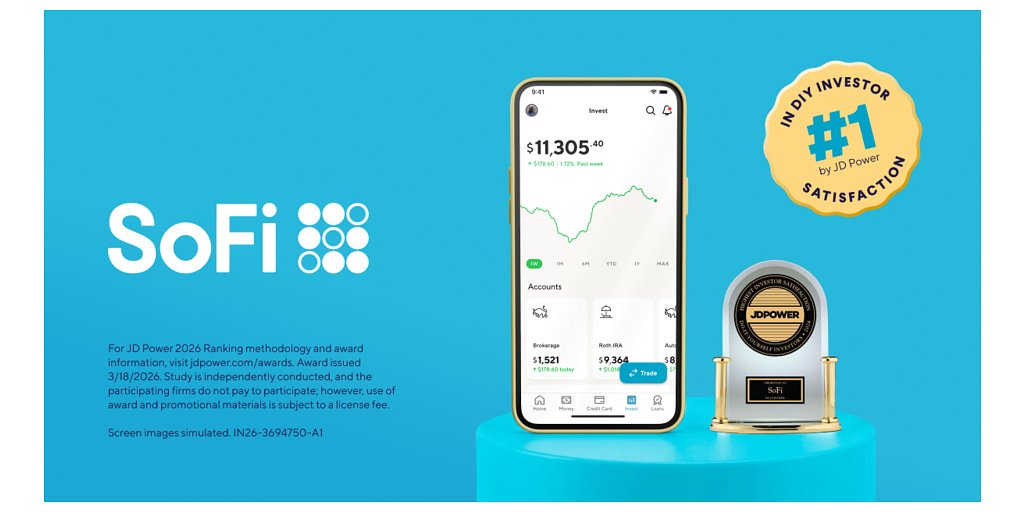
SoFi's Digital Edge: How It Became #1 for DIY Investors
SAN FRANCISCO, CA – March 18, 2026 – In a decisive validation of its digital-first strategy, SoFi Technologies has secured the top spot for do-it-yourself (DIY) investing in the prestigious J.D. Power 2026 U.S. Investor Satisfaction Study. The recognition signals a potential changing of the guard in the competitive wealth management landscape, where fintech agility is increasingly outmaneuvering the legacy of traditional finance.
SoFi Invest, the investment arm of the digital finance behemoth, earned the highest overall satisfaction score among self-directed brokerage platforms. The award underscores the company's success in building an integrated financial ecosystem that resonates with a new generation of investors who demand seamless technology, transparent value, and comprehensive control over their financial lives.
A New Leader in Investor Satisfaction
The J.D. Power study, a benchmark for consumer satisfaction, evaluated platforms based on responses from 4,335 DIY investors surveyed between January 2025 and January 2026. SoFi achieved an overall satisfaction score of 724 on a 1,000-point scale, placing it firmly ahead of a crowded field of both established and emerging players.
The fintech firm outperformed notable competitors, including Citi, which ranked second with a score of 710, and a tie for third place between Ally and industry giant Fidelity, both scoring 707. The results are particularly striking as they show two fintech-centric brands occupying the top three positions, highlighting a significant industry trend.
SoFi's leadership was not confined to the overall score. The company ranked #1 across several critical dimensions that define the modern user experience: digital channels, ease of doing business, value for fees paid, and product and service offerings. This sweep of top rankings points to a platform that is not just functional but holistically superior in meeting the needs of today's self-directed investor. The win reflects a deep understanding of user expectations, from a mobile-first interface that simplifies complex transactions to a fee structure that users perceive as fair and transparent.
The 'Get Your Money Right' Ecosystem
SoFi's success is rooted in a philosophy that extends far beyond a single investment app. The company's mission, as articulated by CEO Anthony Noto, is to help its members “get their money right.” This ethos is built on a simple formula: “spend less than you make, and invest the rest.” The J.D. Power award suggests this mission-driven approach is not just a marketing slogan but a tangible product strategy that is paying dividends in customer loyalty and satisfaction.
“Being ranked #1 in DIY investor satisfaction by JD Power reflects our commitment to building world class products that help our members get their money right,” Noto stated in the company's press release. He emphasized that SoFi's combination of seamless technology and an integrated suite of products empowers members on their journey to financial independence.
This integrated model is the cornerstone of SoFi's appeal. The company serves its 13.7 million members as a “one-stop shop” for borrowing, saving, spending, and investing—all within a single application. The strategy is proving effective, with company data from late 2025 showing that 40% of new products were opened by existing members, a powerful indicator of successful cross-selling and a sticky, high-value ecosystem. For an investor using SoFi Invest, their portfolio sits alongside their checking, savings, and loan accounts, providing a truly comprehensive financial dashboard that few competitors can match.
Riding a Generational Wave
The J.D. Power study arrives at what industry analysts are calling a “generational inflection point” for wealth management. Younger investors, particularly those under 40, are increasingly turning to digital-first platforms, and they perceive fintech brands like SoFi as being just as trustworthy as long-established financial institutions, while also being significantly more innovative.
SoFi's financial performance provides concrete evidence of this momentum. In the fourth quarter of 2025, the company reported record-breaking growth, adding a million new members and seeing revenue climb 37% year-over-year to over $1 billion. This growth is fueled by a product that attracts and retains a key demographic that legacy firms are struggling to capture. By offering a wide range of investment options—from stocks, ETFs, and options to alternative assets and IPO access—SoFi meets the diverse demands of both novice and experienced investors.
Beyond DIY: The Future of Digital Wealth
While SoFi's victory is a clear win for the DIY model, the J.D. Power study also unearthed a more nuanced trend: a growing interest in professional guidance among affluent younger investors. The report found that 19% of DIY investors under 50 with at least $250,000 in assets are “definitely likely” to seek out a financial advisor within the next year, up from just 10% in 2025. This suggests that the future of wealth management may not be purely self-directed but rather a hybrid model that blends powerful digital tools with accessible human advice.
This is where SoFi’s ecosystem strategy may provide its next competitive advantage. By first winning customers with a best-in-class DIY platform, SoFi builds a foundation of trust and gathers invaluable data on user behavior. This positions the company perfectly to offer additional services, including robo-advisory and financial planning, as its members' financial lives become more complex. The platform's continuous innovation, including the recent launch of options trading and access to private company investments, demonstrates a commitment to evolving alongside its user base.
The clear message from SoFi's top ranking is that the standards for investor satisfaction have been raised. An intuitive digital experience, fair value, and an integrated product suite are no longer just nice-to-have features; they are the essential table stakes in the modern battle for the retail investor. As traditional firms scramble to enhance their own technology, SoFi is already defining the next phase of digital finance.
Topics & Related
Fintech
Wealth Management
Software & SaaS
Related Company Pulse