
- 76% of business owners expect revenue growth over the next 12 months
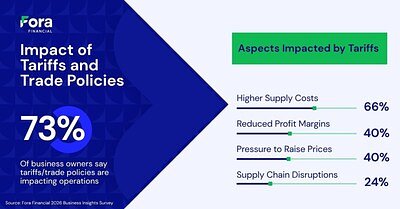
- 73% report that tariffs are impacting their operations
- 39% of SMBs are actively using AI tools, with adopters more than three times as likely to expect strong growth
Experts would likely conclude that while SMBs demonstrate resilience in growth expectations despite tariff challenges and cash flow pressures, AI adoption is creating a significant competitive divide, with early adopters positioned for stronger performance.
SMBs See Growth Despite Tariffs; AI Adoption Creates a New Divide
NEW YORK, NY – April 29, 2026 – American small businesses are projecting remarkable confidence in their growth prospects, even as they navigate a complex maze of international tariffs, persistent cash flow pressures, and rising costs. A new report reveals a striking paradox: while nearly three-quarters of businesses feel the sting of trade policies, an even larger majority remain optimistic about their revenue.
The 2026 Business Insights Trends Report, released by financing provider Fora Financial, found that 76% of business owners expect revenue growth over the next 12 months. This steadfast optimism persists despite 73% reporting that tariffs are impacting their operations and 55% citing cash flow as their biggest challenge for the second consecutive year. The findings underscore not only the resilience of the nation's entrepreneurs but also an emerging competitive fault line, with businesses adopting artificial intelligence being significantly more likely to anticipate strong growth.
The Tariff Tightrope
The impact of tariffs has become a pervasive challenge for small and medium-sized businesses (SMBs). The Fora Financial report notes that of the businesses affected, 66% are grappling with higher supply costs, 41% face reduced profit margins, and 40% have been forced to raise prices on their customers.
This data aligns with broader economic indicators and the complex tariff landscape of 2026. Businesses are contending with a multi-front trade environment, including long-standing Section 232 tariffs on steel and aluminum—now at rates as high as 50%—and Section 301 tariffs targeting a wide array of Chinese goods. Compounding the issue was a temporary 10% global tariff introduced in February, adding another layer of cost and complexity. Industries like manufacturing, construction, and retail, which rely heavily on imported materials and goods, are feeling the impact most acutely.
The financial strain is significant. Recent analysis from the Center for American Progress showed that the average small-business importer saw their monthly tariff payments triple over the past year. This pressure forces entrepreneurs into a difficult position: absorb the costs and sacrifice profitability, or pass the increases on to consumers and risk losing sales in a price-sensitive market.
The Enduring Cash Flow Crunch
For the second year running, cash flow remains the top concern for a majority of business owners. This chronic issue is exacerbated by the current economic climate. Rising operational expenses, fueled by inflation and the tariff-driven cost increases, put constant pressure on working capital.
Other recent surveys reinforce this reality. The U.S. Chamber of Commerce identified inflation as the single biggest challenge for 53% of small businesses in the first quarter of 2026. This environment makes managing day-to-day finances precarious. A separate report highlighted that nearly half of all SMBs struggle with late customer payments, creating unpredictable revenue streams and making it difficult to secure traditional financing for growth. This constant battle for liquidity has become a defining feature of running a small business in the current economy.
The AI Advantage: A Widening Divide
Amid these challenges, the report highlights a powerful differentiator shaping the future of business success: artificial intelligence. While overall AI adoption among SMBs in the survey stands at 39%, the correlation with growth expectations is stark. Businesses anticipating strong growth are more than three times as likely to be actively using AI tools compared to those expecting a decline.
"The companies already using AI are far more likely to expect strong growth, that's a clear signal of where the competitive gap is opening," said Jared Feldman, CEO of Fora Financial, in the report's press release.
Independent research confirms this trend is accelerating. Some recent studies show that well over half of SMBs are now using AI, primarily for marketing content creation, data analysis, and customer service. The benefits are tangible and immediate. One Salesforce study found that 91% of SMBs using AI reported increased revenue, while other data suggests AI tools can save the average employee over five hours of work per week by automating routine tasks.
From generating social media campaigns and providing 24/7 customer support via chatbots to analyzing sales data for smarter inventory management, AI is acting as an "equalizer." It allows smaller firms to access capabilities previously reserved for large corporations with dedicated analytics and marketing departments, enabling them to operate with greater efficiency and make more informed, data-driven decisions.
The Evolving Quest for Capital
The convergence of rising costs, tariff pressures, and cash flow constraints is fueling a growing demand for financing. The Fora Financial survey found that 38% of businesses sought additional funding specifically to manage these rising costs.
As traditional banks maintain tight lending standards, many SMBs are turning to the alternative financing sector for the capital they need to stabilize and grow. Lenders in this space offer products like short-term loans and revenue advances that prioritize speed and accessibility, often providing funds within 24 to 72 hours. This agility is crucial for businesses needing to quickly purchase inventory to get ahead of a potential price hike or cover an unexpected cash flow gap.
These financing options cater to businesses that might not qualify for a traditional bank loan due to a limited credit history, a lack of physical collateral, or the simple need for immediate capital. While the cost of this convenience can be higher than conventional loans, for many entrepreneurs, quick access to working capital is the critical factor that enables them to navigate economic uncertainty, invest in new technologies like AI, and ultimately position their business for the growth they so optimistically expect.