
- 300kW smart solar system: Triples the school's previous solar capacity, meeting high daytime energy demands.
- 4-year payback period: Projected time to offset upfront capital costs, ensuring long-term savings.
- 525-615 tonnes of CO2 reduction annually: Significant environmental impact from the new solar installation.
Experts agree that Saint Columba Anglican School's solar upgrade is a strategic financial and educational investment, demonstrating how renewable energy can reduce operational costs, enhance STEM learning, and promote environmental sustainability in educational institutions.
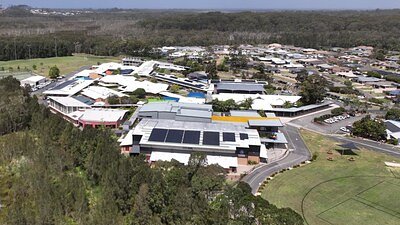
Smart Solar Powers School's Budget and STEM Learning
PORT MACQUARIE, Australia – January 15, 2026 – Saint Columba Anglican School (SCAS) has completed a significant energy transformation, replacing an aging solar installation with a powerful 300kW smart solar system. The project, a collaboration between global energy technology leader Sungrow and local specialist MNC Solar Power, is set to drastically reduce the school's operational costs, provide a unique educational resource for students, and solidify its commitment to environmental sustainability.
The ambitious upgrade triples the school's previous solar capacity and is engineered to meet the high daytime energy demands of a sprawling educational campus. By leveraging cutting-edge inverter technology and intelligent monitoring, SCAS is not only shielding its budget from volatile electricity prices but is also creating a living laboratory for the next generation of students.
A Strategic Investment in a Sustainable Future
For large institutions like SCAS, rising energy costs represent a significant and unpredictable strain on operational budgets. With commercial electricity rates in New South Wales sometimes exceeding 33 cents per kilowatt-hour during peak periods, the decision to invest in a high-capacity solar solution was as much a strategic financial move as it was an environmental one. The new system is projected to pay for itself in a remarkably short timeframe.
"We'll be able to offset the upfront capital costs within around four years," said Steve Mitchell, Business Manager at Saint Columba Anglican School. "That means ongoing savings for the school, which helps take pressure off our operating expenses and allows us to continue delivering a great education for our students without rising electricity costs."
This rapid return on investment transforms a recurring expense into a long-term asset. Once the initial investment is recouped, the substantial savings on electricity bills can be redirected toward core educational programs, faculty development, and student resources. This forward-thinking financial strategy essentially creates an endowment for learning, powered by the sun, future-proofing the school against energy market fluctuations for decades to come.
The Smart Campus: Technology Revolutionizing Energy and Education
At the heart of the school's energy overhaul is advanced technology that solves common logistical challenges for large-scale solar installations. The system integrates 708 high-efficiency Canadian Solar panels with three of Sungrow's 110 kW commercial inverters. What makes the installation particularly innovative is its communication architecture.
Instead of requiring extensive and disruptive trenching to lay new data cables across the multi-building campus, the system employs what Sungrow's technical team describes as a "logger-based wireless cascading technology." This allows the inverters to connect and communicate seamlessly over the school's existing wireless network, enabling intelligent and dynamic load sharing across different distribution boards. This sophisticated setup ensures that the more than 300 kW of solar generation is used optimally where it's needed most, maximizing on-site energy consumption and minimizing reliance on the grid.
Beyond the operational efficiency, the upgrade extends its benefits directly into the classroom. The system is connected to the iSolarCloud platform, a real-time energy monitoring dashboard. "We've now got data at our fingertips," Mitchell highlighted. "We can log into the dashboard and see how much electricity the panels are generating, what we're consuming, and what's being exported to the grid."
This accessibility transforms abstract concepts of energy production and consumption into tangible, observable data. It provides a powerful, real-world tool for STEM education, allowing teachers to integrate live analytics into lessons on physics, environmental science, and data analysis. In an institution that champions a "Deep Learning" model to foster future-ready learners, this hands-on connection to sustainable technology offers an invaluable educational experience.
Global Power, Local Expertise: A Partnership Model for Success
The project's seamless execution underscores the critical importance of combining global technological leadership with deep local expertise. While Sungrow provided the state-of-the-art inverter technology, the design and installation were managed by MNC Solar Power, a trusted installer with over 30 years of experience serving Australia's Mid North Coast.
MNC Solar Power's intimate knowledge of local conditions and building requirements was instrumental in designing a system for maximum performance and longevity. The installation itself was a feat of careful planning, with the entire project—from the removal of the old 100kW system to the commissioning of the new 300kW one—completed during a two-week school holiday period. This meticulous scheduling ensured zero disruption to school operations and student learning, highlighting the professionalism and efficiency of the partnership.
This collaborative model demonstrates a successful blueprint for deploying complex renewable energy projects in community-focused environments. The combination of Sungrow's bankable technology and robust technical support with MNC Solar Power's regional experience and customer focus ensured the delivery of a reliable, scalable, and safe energy solution tailored to the school's unique needs.
Powering a National Trend in Australian Education
Saint Columba's initiative is a prominent example of a wider national trend that sees Australian schools increasingly turning to solar power. This movement is fueled by a combination of clear financial incentives, growing environmental awareness, and powerful educational opportunities. Across the country, educational institutions are recognizing that their large rooftops and high daytime energy usage make them ideal candidates for solar generation.
Government support has been a key catalyst. While federal programs have laid the groundwork, state-level initiatives like the NSW Smart Energy Schools Pilot Project and Victoria's Greener Government School Buildings program are accelerating adoption. These programs provide funding, technical support, and even frameworks for schools to participate in Virtual Power Plants (VPPs). Nationally, financial mechanisms like Small-Scale Technology Certificates (STCs) can reduce the upfront cost of systems significantly.
The environmental impact of this trend is substantial. The new 300kW system at SCAS alone is estimated to prevent between 525 and 615 tonnes of CO2 from entering the atmosphere annually. With approximately 1,500 public schools in NSW having already installed solar, the cumulative effect on Australia's carbon footprint is growing daily. By integrating advanced energy management with educational outcomes, schools like Saint Columba are not just cutting costs; they are investing in a more resilient and sustainable future for their students and their communities.
Topics & Related
ESG
AI & Emerging Technology
Cryptocurrency & Digital Assets
Education & Research
Expansion
Revenue
Related Company Pulse