
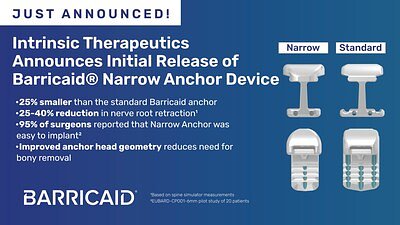
- 25% smaller: The Barricaid Narrow Anchor is 25% smaller than its predecessor, reducing nerve root retraction by 25-40%.
- 95% surgeon approval: In a European pilot study, 95% of surgeons found the Narrow Anchor easy to implant.
- 41% reduction in reherniation: Clinical trials showed a 41% reduction in reherniation for high-risk patients using the Barricaid device.
Experts agree that the Barricaid Narrow Anchor represents a significant advancement in spinal surgery, offering a safer, more effective solution to prevent recurrent disc herniation and improve long-term patient outcomes.
Smaller Implant, Bigger Impact: New Device Reshapes Back Surgery
BOSTON, MA – March 04, 2026 – For the millions who undergo back surgery for a herniated disc, the fear of a second, painful ordeal is all too real. Now, a significant advancement in medical technology aims to close the door on repeat surgeries. Intrinsic Therapeutics announced today the launch of its Barricaid® Narrow Anchor, a next-generation device designed to make spinal procedures safer, simpler, and more effective at preventing reherniation.
This new device, a refined version of the company’s FDA-approved Barricaid implant, is 25 percent smaller than its predecessor. While seemingly a modest change, this reduction in size represents a major leap forward in surgical practice, promising to expand access to a proven solution for a wider group of high-risk patients.
A Refined Approach to Spinal Repair
The core innovation of the Barricaid Narrow Anchor lies in its streamlined design. The bone anchor component has been reduced from 8mm to a mere 6mm in width. This change was driven directly by feedback from surgeons seeking to optimize the implantation process during a lumbar discectomy—a common procedure to remove herniated disc material that is pressing on a nerve root.
In practice, the smaller footprint has several critical benefits. According to data from spine simulator measurements, the Narrow Anchor can reduce the amount of nerve root retraction required during placement by 25 to 40 percent. Less manipulation of sensitive neural structures is a key goal in any spinal surgery, potentially leading to smoother recoveries. The optimized geometry also enhances a surgeon's visibility during the procedure, allowing for more precise placement.
“In practice, even small design changes can make a meaningful difference,” said Robert Eastlack, MD, Professor and Division Head of Spine Surgery at Scripps Clinic, in a statement. “The Narrow Anchor allows for easier implantation while accomplishing the same surgical goals, which can help streamline the procedure and expand the number of patients who may benefit from annular closure.”
Despite its smaller size, the company confirms the device passed the same rigorous mechanical testing as the original, ensuring its strength and resistance to migration or fracture. In an early European pilot study of 20 patients, 95 percent of surgeons reported that the Narrow Anchor was easy to implant, validating its design goals.
Tackling the Revolving Door of Back Surgery
The development of devices like Barricaid targets one of the most persistent challenges in spinal care: recurrent disc herniation. Following a standard discectomy, patients with large defects in their spinal disc wall—the annulus—face a risk of reherniation as high as 25%. This can lead to a frustrating cycle of recurring pain, disability, and the need for more complex and often less successful revision surgeries.
The Barricaid implant is designed to break this cycle. After the surgeon removes the problematic disc material, the device is anchored to the vertebral bone, and a flexible polymer mesh blocks the hole in the disc wall. This acts as a barrier, preventing the remaining disc nucleus from pushing out again.
This approach is backed by robust clinical evidence. A landmark Level I randomized controlled trial, with five-year follow-up results published in the prestigious journal JAMA Network Open, found that high-risk patients treated with the Barricaid device had a 41% reduction in reherniation and a 29% reduction in reoperations compared to patients who received a discectomy alone. These patients also reported better long-term outcomes for leg and back pain.
With nearly 13,000 patients implanted worldwide, the technology has established a track record for improving patient outcomes. By preventing the need for repeat surgeries, the device not only spares patients from additional pain and recovery time but also offers significant long-term value by improving their overall quality of life.
Paving the Way for Broader Adoption
Technological innovation alone is not always enough to ensure a new treatment becomes a standard of care. The path to widespread adoption is often paved by supportive reimbursement and healthcare policies. The launch of the Barricaid Narrow Anchor comes at a pivotal moment, supported by major positive developments in this area.
Crucially, the American Medical Association (AMA) has established a new Category I CPT code, 63032, which will become effective on January 1, 2026. This code specifically describes the procedure of implanting a bone-anchored annular closure device, providing a standardized way for surgeons and hospitals to bill for the procedure. The creation of a dedicated CPT code is a major milestone that signals recognition of the procedure's clinical value and is expected to dramatically increase patient access.
This follows a significant decision by the Centers for Medicare & Medicaid Services (CMS). In its 2025 Final Rule, CMS increased the Medicare payment rate for the procedure in Ambulatory Surgical Centers (ASCs) by 46%, making it more economically feasible for outpatient facilities to offer the treatment.
Major commercial insurers are also taking note. Cigna, one of the largest private payers in the U.S., issued a positive coverage policy for Barricaid in 2023. While some other insurers still classify the procedure as investigational, the growing body of high-quality clinical evidence and new billing codes are building powerful momentum toward universal coverage.
“Barricaid Narrow Anchor shortens the learning curve and ease of access for surgeons adopting annular closure, making the benefits of Barricaid available to more patients at high risk of recurrent disc and disability following a discectomy,” said Greg Lambrecht, the founder of Barricaid.
The Evolving Landscape of Spinal Care
The introduction of the Barricaid Narrow Anchor fits squarely within the broader evolution of spinal surgery, which is increasingly focused on minimally invasive techniques, motion preservation, and more durable outcomes. As the only FDA PMA-approved device in the United States specifically indicated to reduce reherniation after a lumbar discectomy, Barricaid holds a unique position in the market.
While competitors have explored other annular repair concepts, none have achieved the same level of regulatory approval and clinical validation in the U.S. market. This new, more surgeon-friendly iteration of the device strengthens Intrinsic Therapeutics' leadership position and sets a higher bar for innovation in the field.
By addressing a clear clinical need with a solution that is now easier to use and better supported by the healthcare system, the Barricaid Narrow Anchor is poised to make a substantial impact. For surgeons seeking to provide the best possible outcomes and patients desperate for a lasting solution to their back pain, this refined technology represents a significant step forward.