
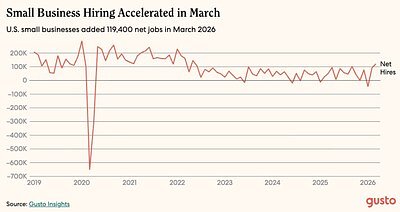
- 119,400 jobs added by small businesses in March 2026, the highest since 2022
- 15.2% year-over-year increase in hiring activity
- Micro-businesses (1-4 employees) added only 700 jobs/month on average, while firms with 20-49 employees added 22,600 jobs/month
Experts view the hiring surge as a significant thaw in the labor market, but caution persists due to uneven recovery, labor quality concerns, and cautious economic policies.
Small Business Hiring Surges to 4-Year High, But Will the Thaw Last?
SAN FRANCISCO, CA – March 31, 2026 – America's small businesses went on a hiring spree in March, adding jobs at the fastest pace seen since 2022 and providing the strongest signal yet that the labor market's prolonged chill may finally be breaking. According to a new report from payroll and HR provider Gusto, small firms added a net 119,400 jobs last month, a figure that dwarfs the 12-month average of 56,800 and suggests a significant revival of business confidence.
The surge marks a dramatic acceleration in the small business economy, which for nearly two years had been mired in what Gusto has termed the "Great Freeze"—a period of stagnation where both hiring and employee separations fell to historic lows as workers and employers alike hesitated to make moves in an uncertain climate. That dynamic appears to be reversing. The report shows that hiring activity rose 15.2% year-over-year, while employee separations also climbed 12.7%, indicating a return to a more fluid and dynamic labor market.
"After nearly two years of the Great Freeze — when both workers and employers were reluctant to make moves — we're finally seeing the thaw," said Aaron Terrazas, an economist at Gusto, in the report's release. "Two back-to-back months of broad-based gains, across every region and every size tier, suggests small businesses have found firmer footing — not just a one-month bounce."
A Broad-Based Rebound
The most encouraging aspect of the March data is its breadth. Job creation was positive in 18 of the 19 sectors tracked by Gusto, a sign of widespread economic health. The gains were also geographically diverse, with all four major U.S. regions posting positive net hires for the second consecutive month. The South led the pack with 41,400 new jobs, followed by a strong showing in the Northeast, which added 30,600 jobs, suggesting a recovery from any weather-related softness earlier in the year.
This widespread momentum stands in stark contrast to the choppy, uneven patterns that characterized much of late 2025. The positive trend extended across all company sizes, from micro-businesses to firms with up to 49 employees, further bolstering the narrative of a comprehensive recovery taking hold on Main Street.
Engines of Growth: Healthcare, Hospitality, and a White-Collar Revival
Leading the charge were sectors driven by powerful long-term and cyclical trends. Healthcare and Social Assistance was the top performer, adding 24,200 jobs. This growth is underpinned by structural tailwinds, including an aging U.S. population that increases demand for chronic and home-based care, coupled with persistent workforce shortages that necessitate continuous hiring.
The Accommodation and Food Services sector also posted strong gains, adding 17,400 jobs as it ramped up for the spring season. This hiring reflects a rebound in consumer dining and travel activity following the winter lull, a trend that continues to define the industry's post-pandemic recovery.
Perhaps most telling, however, was the accelerating growth in Professional, Scientific, and Technical Services, which added 9,700 net hires. After a prolonged slump for white-collar jobs throughout 2024 and early 2025, this continued acceleration suggests that small businesses in fields like consulting, legal, and accounting are regaining the confidence to expand their teams. This growth is partly fueled by a technological shift, as firms invest in talent that can leverage AI and automation to augment human capabilities and deliver higher-value services.
A Tale of Two Recoveries?
While Gusto's report paints a vibrant picture of a 'Great Thaw,' other industry data suggests a more temperate climate. Some economists describe the current environment as "low-fire, low-hire," where overall labor market churn remains subdued. The National Federation of Independent Business (NFIB) Small Business Optimism Index for February, for instance, showed that the net percentage of owners planning to increase employment fell to its lowest level since May 2025. Labor quality remains a top concern for many owners, with a high percentage reporting few or no qualified applicants for their open positions.
This juxtaposition suggests that while many firms are indeed hiring, as Gusto's real-time payroll data shows, a significant undercurrent of caution persists. The broader economic landscape is one of moderate GDP growth, around 2%, and persistent, albeit moderating, inflation. With the Federal Reserve holding interest rates steady in a target range of 3.5%-3.75% for its second consecutive meeting, the cost of capital remains a significant consideration for businesses contemplating expansion.
This cautious stance from the Fed, aimed at ensuring inflation returns to its target, means businesses are not getting the relief from lower borrowing costs that might otherwise fuel a more explosive hiring boom. The result is a complex market where opportunity and uncertainty coexist.
The Micro-Business Fault Line
Digging deeper into the data reveals a persistent fault line in the small business recovery. While all company size tiers posted positive gains in March, the smallest firms—those with just one to four employees—continue to lag their larger counterparts significantly. Over the past twelve months, these micro-businesses have added an average of only 700 jobs per month.
In stark contrast, small businesses with 20 to 49 employees have averaged 22,600 monthly net hires over the same period. This vast disparity highlights the unique vulnerabilities of the smallest enterprises. Lacking the financial cushion, administrative resources, and competitive leverage of slightly larger firms, micro-businesses often struggle to compete for talent, absorb the costs of hiring, and navigate economic uncertainty. This gap suggests that the recovery's benefits are not filtering down evenly, and the foundation of the American entrepreneurial ecosystem remains on less stable ground.
As the economy moves further into 2026, the key question is whether the robust momentum seen in March can be sustained and, crucially, whether it will begin to lift the fortunes of the smallest firms. The breadth of the recent gains provides a solid foundation, but the path forward will likely be shaped by the competing forces of renewed business confidence and the persistent headwinds of a cautious central bank and an uncertain global economic outlook.