
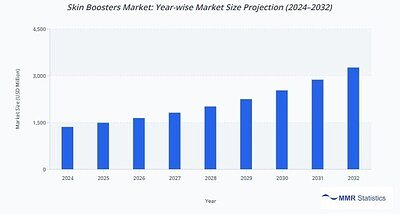
- Market Size: The global Skin Boosters Market is projected to reach USD 3.26 billion by 2032, up from USD 1.49 billion in 2025.
- Growth Rate: The market is expected to grow at a compound annual growth rate (CAGR) of 11.58%.
- Regional Dominance: North America leads with over 32% of global revenues, while the Asia-Pacific region is expanding rapidly with nearly 25% of the market.
Experts agree that the skin boosters market is experiencing explosive growth driven by scientific innovation, consumer demand for natural-looking anti-aging solutions, and aggressive market strategies from major pharmaceutical companies.
Skin Boosters: The $3.2B Industry Redefining Anti-Aging
PUNE, India – January 28, 2026 – The global pursuit of youthful, luminous skin is fueling a seismic shift in the aesthetics industry. A new analysis projects the global Skin Boosters Market will surge past USD 3.26 billion by 2032, climbing from a 2025 valuation of USD 1.49 billion at a robust compound annual growth rate (CAGR) of 11.58%. This explosive growth signals more than a fleeting trend; it marks the rise of a new pillar in anti-aging care, driven by scientific innovation, savvy marketing, and a profound cultural shift in how we approach beauty and aging.
At the heart of this boom is a category of minimally invasive injectable treatments designed not to alter facial structure, but to fundamentally improve skin quality from within. Unlike traditional dermal fillers that add volume, skin boosters deliver micro-injections of substances like Hyaluronic Acid (HA) directly into the skin to enhance hydration, improve elasticity, and restore a natural, healthy glow.
A New Era of Injectable Skincare
The market's current vanguard is Hyaluronic Acid, a substance naturally found in the body known for its remarkable ability to retain moisture. When used in skin boosters, non-cross-linked or lightly cross-linked HA formulations act as an internal moisturizer, smoothing fine lines and revitalizing dull, dehydrated skin. Leading products like AbbVie's SKINVIVE™ by JUVÉDERM®, Galderma's Restylane® Skinboosters, and IBSA's Profhilo® have become household names in dermatology clinics, prized for their proven safety and ability to deliver subtle, yet significant, improvements.
However, the innovation pipeline is rapidly evolving beyond simple hydration. The industry is embracing a new class of “biostimulators” that encourage the body's own regenerative processes. These next-generation boosters include ingredients like:
- Polynucleotides (PN/PDRN): Derived from salmon DNA, these molecules are celebrated for their ability to repair cellular damage, reduce inflammation, and stimulate collagen production for long-term skin health.
- Poly-L-Lactic Acid (PLLA) and Polycaprolactone (PCL): These are biocompatible substances that act as scaffolds, triggering a gradual and sustained production of collagen, leading to firmer, thicker skin over time.
- Peptides and Exosomes: Advanced formulations are incorporating growth factor peptides and exosome-based therapies—tiny vesicles that facilitate cell-to-cell communication—to orchestrate a more sophisticated and targeted skin rejuvenation.
This shift from passive hydration to active regeneration is redefining the possibilities of non-invasive aesthetics, offering a powerful alternative to more aggressive procedures and aligning with a consumer desire for results that are both effective and natural-looking.
The Business of Beauty: A Global Gold Rush
The financial landscape of the skin booster market is as dynamic as its technology. While a consensus of market reports confirms double-digit growth, the strategic plays of major pharmaceutical companies reveal the high stakes involved. Industry giants like AbbVie, Galderma, Merz Aesthetics, and Teoxane are locked in a global race, pouring resources into research and development, securing regulatory approvals, and executing aggressive market expansion strategies.
In 2025, AbbVie expanded its SKINVIVE™ offering to 57 global markets, while Galderma presented new clinical data reinforcing the efficacy of its Restylane portfolio. Merz, meanwhile, focused on enhancing the practitioner experience with redesigned syringes while pursuing FDA approvals for new booster formulations. This intense competition is a clear indicator of the sector's perceived value and long-term potential.
Geographically, the market is a story of established dominance and explosive new growth. North America currently leads, commanding over 32% of global revenues, driven by high consumer awareness, advanced clinical infrastructure, and early adoption of luxury aesthetic treatments. Europe remains a robust and mature market, bolstered by a strong regulatory framework and a long-standing appreciation for dermatological care. Yet, all eyes are on the Asia-Pacific region, which holds nearly 25% of the market and is expanding at a breathtaking pace. Fueled by rising disposable incomes, the cultural influence of 'K-beauty,' and a booming med-spa industry, countries across Asia are making anti-aging treatments more accessible and aspirational than ever before.
The Democratization and Dilemmas of Aesthetic Medicine
The rapid growth of skin boosters is not just a clinical or business story; it is a societal one. The proliferation of professional dermatology clinics, medical spas, and aesthetic centers has democratized access to treatments that were once the preserve of the wealthy. This accessibility is amplified by the power of digital marketing and social media, where beauty influencers and targeted campaigns have transformed injectable treatments from a whispered secret into a celebrated act of self-care.
The demand is particularly strong among younger demographics. Millennials and even Gen Z are increasingly embracing “preventative” treatments, seeking to maintain skin quality and delay the visible signs of aging before they become pronounced. The pursuit of trends like “glass skin”—a term describing a flawless, luminous complexion—has made skin boosters an integral part of many wellness routines.
This widespread adoption, however, is not without its complexities. The constant exposure to digitally perfected images on social media can create unrealistic beauty standards and heighten anxieties about aging. As the line between wellness and cosmetic enhancement blurs, it raises important ethical questions about societal pressure and the commercialization of self-worth. The key, experts argue, lies in consumer education and a focus on realistic outcomes.
Regulation in a Rapidly Evolving Market
As the market surges, regulatory bodies worldwide are working to ensure patient safety. It is a critical distinction that skin boosters are classified as medical devices, not cosmetics. This subjects them to a much higher level of scrutiny. In the United States, the Food and Drug Administration (FDA) requires rigorous clinical trials to demonstrate both safety and effectiveness before a product can be approved for the market. Similarly, in Europe, the stringent Medical Device Regulation (MDR) mandates comprehensive clinical evidence and post-market surveillance.
These regulatory frameworks are essential for protecting consumers in an industry where the risk of complications—though rare—is real. Adverse events, ranging from infection to the more serious risk of vascular occlusion, underscore the absolute necessity of seeking treatment from a qualified and licensed medical professional. As analysts note, growing consumer confidence is directly tied to the expansion of professional clinics and the assurance that these procedures are performed safely and effectively.
The convergence of these forces—powerful consumer demand for natural-looking results, groundbreaking scientific innovation, and expanding global accessibility—has positioned skin boosters at the forefront of the modern aesthetics industry. As these treatments become further integrated into holistic skincare and wellness regimens, they are cementing their place not as a fleeting fad, but as a fundamental and enduring component of contemporary self-care.