
- $14B Valuation: Skild AI achieves a $14B valuation after raising $1.4B in funding.
- $30M Revenue: The company grew from $0 to $30M in revenue in months during 2025.
- Omni-Bodied Brain: Skild's AI model adapts to any robot hardware in real-time without prior training.
Experts view Skild AI's universal robot brain as a transformative leap in AI-driven automation, with potential to revolutionize industries from manufacturing to consumer robotics, though its success hinges on proving adaptability across diverse hardware.
Skild AI Hits $14B Valuation on Bet to Build One Brain for All Robots
PITTSBURGH, PA – January 14, 2026 – Skild AI, a robotics company with the audacious goal of building a single, universal AI brain for any machine, today confirmed it has raised nearly $1.4 billion in a landmark funding round. The investment, led by SoftBank Group, catapults the company's valuation to over $14 billion, signaling a massive vote of confidence from some of the world's most influential technology investors.
The Pittsburgh-based startup is now one of the most valuable private companies in the AI robotics sector, attracting capital from a who's-who of venture and strategic players. The round saw participation from NVentures (NVIDIA’s venture arm), Macquarie Capital, and Jeff Bezos's Bezos Expeditions. Existing investors, including Lightspeed and Sequoia Capital, doubled down on their commitments, while strategic partners like Samsung, LG, and Salesforce Ventures also joined, hinting at future integrations and applications.
Founded in 2023 by former Carnegie Mellon University professors Deepak Pathak and Abhinav Gupta, Skild AI is tackling one of the holy grails of artificial intelligence: creating a general-purpose physical intelligence. Instead of building specialized robots for specific tasks, the company is developing a foundational software model, the 'Skild Brain', designed to operate any robot, regardless of its physical form.
The Omni-Bodied Brain
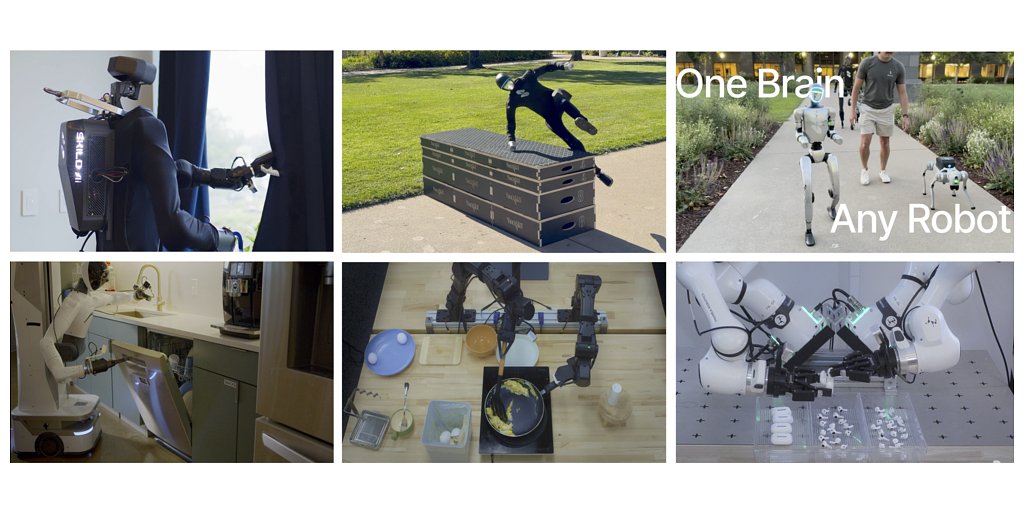
At the heart of Skild AI's technology is the 'Skild Brain', what the company calls the industry’s first "omni-bodied" foundation model. Unlike traditional AI that is painstakingly trained for a specific robot's mechanics—a bipedal humanoid, a four-legged "dog," or a stationary factory arm—the Skild Brain is designed to be hardware-agnostic. It can, in theory, control any machine with moving parts without prior knowledge of its exact body type.
This versatility is made possible by a key research breakthrough the company calls "In-Context Learning." When the model is deployed on a new robot or encounters an unexpected situation, it doesn't need to be sent back for weeks of retraining. Instead, it adapts its behavior in real-time based on its live physical experience. The company has demonstrated its model adjusting on the fly to challenges like a jammed wheel, a lost limb, or a sudden increase in payload—problems that would typically sideline a conventional robot.
“The Skild Brain can control robots it has never trained on, adapting in real time to extreme changes in form or environments. The model is forced to adapt rather than memorize – much like intelligence in nature,” said Deepak Pathak, CEO and Co-Founder of Skild AI. “We believe that a unified, omni-bodied brain is the fastest way to establish a continuous data flywheel where the model gets better with every single deployment, no matter what the hardware or task.”
To build such a generalized intelligence, Skild AI had to overcome the fundamental data problem in robotics. Unlike language models that can be trained on the vast expanse of the internet's text, there is no "internet of physical interaction." The company addressed this by pre-training its model on two alternate, scalable data sources: watching millions of hours of human videos to learn physical intuition, and practicing in massive, physics-based simulations powered by NVIDIA's accelerated computing platforms.
A Billion-Dollar Bet on a Universal Mind
The staggering $1.4 billion capital injection and the resulting $14 billion valuation underscore a major shift in the investment landscape for AI. This round, which brings Skild AI's total funding to over $1.83 billion, represents a tripling of its valuation in just seven months. The company also reports staggering commercial traction, claiming it grew from zero to approximately $30 million in revenue in just a few months during 2025.
This financial firepower is backed by investors with deep pockets and strategic interests in the future of automation. The involvement of SoftBank, a long-time backer of transformative technology, alongside NVIDIA, the chipmaker powering the AI revolution, and Jeff Bezos, whose Amazon empire was built on logistics and automation, provides Skild AI with more than just capital. It provides a network of potential partners and customers.
“Skild AI is building foundational technology for Physical AI across robots, tasks, and environments,” said Dennis Chang, Managing Partner at SoftBank Investment Advisers, in a statement. “We’re proud to partner with Deepak, Abhinav, and the Skild AI team to bring that shared vision into real-world applications worldwide.”
The investment also highlights a belief in the strategic importance of general-purpose robotics. “Solving intelligence for the physical world unlocks enormous commercial value and long-term strategic national importance,” noted Rita Waite, a Partner at IQT, another investor.
Navigating a Crowded Field
Skild AI's ambition to create a universal robot brain places it in a highly competitive and rapidly evolving arena. It is vying with some of the largest technology companies and other well-funded startups, each with a different strategy for cracking the code of physical AGI.
Google DeepMind, for instance, is developing its Gemini Robotics foundation models, recently announcing a high-profile partnership to integrate its AI with Boston Dynamics' new generation of Atlas humanoid robots. This approach pairs a powerful AI model with cutting-edge, purpose-built hardware. Similarly, OpenAI has intensified its focus on robotics, backing humanoid-maker Figure AI and pursuing partnerships to give its AI models physical embodiment.
Skild AI's strategy stands in contrast. By focusing exclusively on the "brain" and remaining hardware-agnostic, it aims to become the "Android" or "Windows" for the entire robotics industry, licensing its AI to a wide array of hardware manufacturers. This software-as-a-service model could allow for faster, broader market penetration if it can prove its adaptability across different machines from different vendors.
"We believe this omni-bodied learning is essential for building AGI that works reliably in the physical world, paving the way for robots that can safely help humans in everyday environments,” said Abhinav Gupta, Co-Founder and President of Skild AI. This approach, he explained, enables robots to operate in complex, dynamic environments without needing pre-programmed instructions for every possible scenario.
From Factory Floors to Living Rooms
With its new war chest, Skild AI plans to aggressively scale its model training and accelerate the deployment of its technology. The company's initial go-to-market strategy focuses on enterprise applications where the need for automation is most acute.
The Skild Brain is already being deployed in security and facility inspection, last-mile delivery, warehouse logistics, and manufacturing. The goal is to address labor shortages and make automation more flexible and accessible, potentially helping to reinvent American manufacturing.
The long-term vision, however, extends far beyond the factory floor. The ultimate goal is to bring intelligent, helpful robots into consumer homes for chores and assistance. The strategic investments from consumer electronics giants like Samsung and LG, both of whom are heavily investing in home automation and service robotics, suggest a clear path toward this future. LG, for instance, recently acquired a majority stake in service robot company Bear Robotics with an explicit goal of expanding into home robotics.
For now, Skild AI is focused on proving its value in the industrial world. The new capital will be critical in scaling its operations and demonstrating that a single, adaptable AI can indeed serve as the central nervous system for the coming age of robotics.