
- 200 TOPS: The AI PC delivers 200 trillion operations per second (TOPS) for AI performance.
- 70B-parameter models: Capable of running massive 70-billion-parameter language models entirely on-device.
- 128 GB LPDDR5: Features up to 128 GB of unified memory for handling large AI workloads locally.
Experts would likely conclude that Singtech's AI PC represents a significant advancement in on-device AI processing, offering a viable alternative to cloud-based solutions with strong potential for enterprise applications requiring data privacy and low-latency performance.
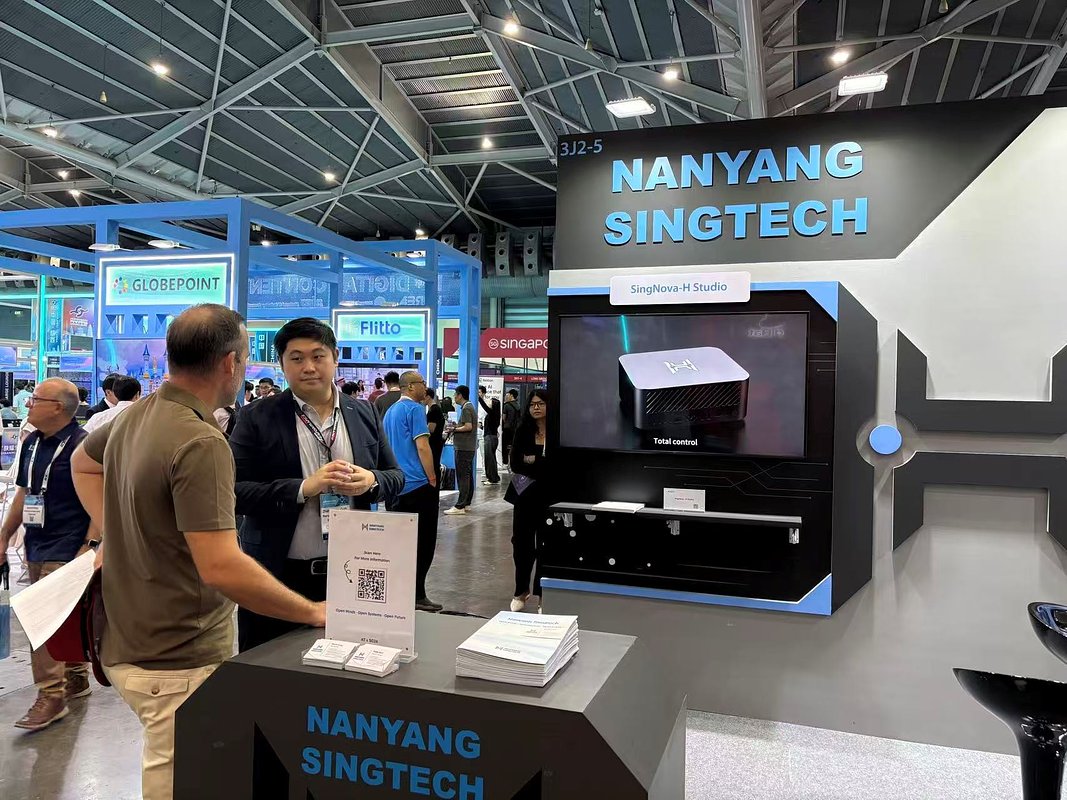
Singtech's 200 TOPS AI PC Aims to Move Large AI Models Off the Cloud
SINGAPORE – May 21, 2026 – A Singaporean deep-tech firm has unveiled a next-generation AI PC that promises to bring the immense power of large language models out of the cloud and onto the desktop. At the ATxSG technology exhibition, Nanyang Singtech, a company incubated by the prestigious Nanyang Technological University (NTU), debuted its SingNova-H Studio, a workstation it bills as the first to be powered by a RISC-V dataflow architecture system-on-chip (SoC).
The machine's specifications are ambitious, claiming 200 TOPS of computing power—a measure of AI performance—and the ability to run massive 70-billion-parameter language models entirely on-device. The launch marks a direct challenge to the AI industry's increasing reliance on centralized cloud infrastructure, targeting growing enterprise concerns over data privacy, spiraling inference costs, and network latency.
A New Architecture to Break the 'Memory Wall'
At the heart of the SingNova-H Studio is a fundamental redesign of how computers handle complex AI workloads. For decades, traditional computer architectures, including the dominant x86 and ARM designs, have been based on a 'control-flow' model. This model often struggles with a bottleneck known as the "memory wall," where the processor's speed outpaces its ability to fetch data from memory, leading to inefficiencies as data is constantly shuttled back and forth between processing units and memory.
Nanyang Singtech claims to overcome this limitation with a 'dataflow' architecture built on the open-source RISC-V instruction set. In this model, the availability of data, rather than a rigid set of program instructions, dictates the execution of operations. The company's implementation uses what it calls "control-data collaborative optimization" to enable high-concurrency and low-latency processing, which is critical for AI inference and complex video analytics.
The core of the system is a 12-core RISC-V CPU running at 2.0 GHz, but the real powerhouse is its integrated AI accelerator, delivering 200 TOPS (trillion operations per second) for INT8 calculations and 32 TFLOPS (trillion floating-point operations per second) for FP16. This is paired with up to 128 GB of LPDDR5 unified memory, a crucial feature that provides enough capacity to hold the massive weights of models like a 70B-parameter LLM locally. By keeping all computation on the device, the system inherently ensures data privacy and eliminates the performance lag associated with sending queries to a remote server.
While other RISC-V-based AI PCs have been announced, such as DeepComputing's 50 TOPS DC-ROMA, Nanyang Singtech's offering stands apart with its significantly higher claimed performance and its specific focus on a dataflow architecture, a design more commonly seen in high-end data center accelerators than in desktop workstations.
Responding to the Demand for Private, Efficient AI
The debut of the SingNova-H Studio arrives at a pivotal moment. As businesses from finance to healthcare rush to integrate generative AI, many are confronting the strategic risks of cloud dependency. Sending sensitive customer data, proprietary code, or internal documents to third-party cloud services for processing creates significant security and compliance challenges. Furthermore, the operational costs of running AI inference at scale in the cloud can be unpredictable and substantial.
Nanyang Singtech is positioning its workstation as a direct solution to these pain points. For enterprise customers, it can function as a private AI inference engine for secure document analysis, code generation, and internal knowledge management. In the security and smart-city sectors, the company states the system can process 128 channels of 1080p video in real-time for tasks like facial recognition and behavioral analysis.
Industrial applications in robotics and smart factories could leverage its low-latency processing for real-time decision-making and control loops. Even creative professionals stand to benefit, with the hardware accelerating workflows like text-to-image generation with Stable Diffusion, 3D creation, and video editing. Despite its power, the unit is housed in a compact desktop form factor with a reported typical power draw between 10 W and 75 W, balancing performance with efficiency.
RISC-V's Growing Ambitions in a Competitive Market
The decision to build on RISC-V is a strategic one. As an open-standard instruction set architecture (ISA), RISC-V allows companies like Nanyang Singtech to design highly customized chips tailored for specific workloads like AI without the licensing fees associated with ARM or the closed ecosystem of x86. This flexibility is seen by many industry analysts as a key advantage for the future of edge computing.
However, the success of any new hardware platform hinges on its software ecosystem. Nanyang Singtech has pledged to provide a mature, full-stack software environment based on Linux, including a professional toolchain and compatibility with mainstream AI frameworks like PyTorch and TensorFlow. This will be critical for lowering the barrier to entry for developers and researchers.
The SingNova-H Studio enters a fiercely competitive market dominated by established players. NVIDIA's GPUs and Jetson edge platforms are the current standard for AI acceleration, while Intel, AMD, and Apple have all integrated powerful neural processing units (NPUs) into their latest processors. Nanyang Singtech is betting that its unique combination of an open architecture, a novel dataflow approach, and a strong focus on privacy-first local computing will be enough to carve out a significant niche.
A Milestone for Singapore's Deep-Tech Ecosystem
The launch is more than just a new product; it represents a significant milestone for Singapore's technology sector. Backed by NTU, one of Asia's leading research universities, Nanyang Singtech exemplifies the nation's strategy to move beyond software and services and become a global player in deep-tech and advanced hardware design.
University incubation programs like the one at NTU are vital for translating cutting-edge academic research into commercially viable products, creating a pipeline of innovation that can fuel economic growth and technological sovereignty. By developing complex hardware like the SingNova-H Studio, Singapore is cultivating a high-value ecosystem that attracts talent and investment.
"SingNova-H Studio embodies our belief that the future of intelligent computing must be open, local, and scalable," the company stated during its launch event. "We are not merely building a faster PC; we are redefining what an edge intelligent workstation can deliver for developers and enterprises worldwide." This debut at a major regional tech conference signals both the company's ambition and its potential to be a key infrastructure provider in the global shift toward localized, efficient, and private artificial intelligence.